Introduction
The financial challenges in running an FPO are one of the biggest reasons why many Farmer Producer Organizations struggle to sustain and grow. While the concept of FPOs is strong and beneficial for farmers, managing finances effectively remains a major hurdle.
Most FPOs are formed by farmers who have deep knowledge of agriculture but limited experience in financial planning and business management. As a result, issues like poor cash flow, lack of working capital, and dependency on external funding often arise. Understanding these financial challenges is essential to build a stable and profitable FPO.
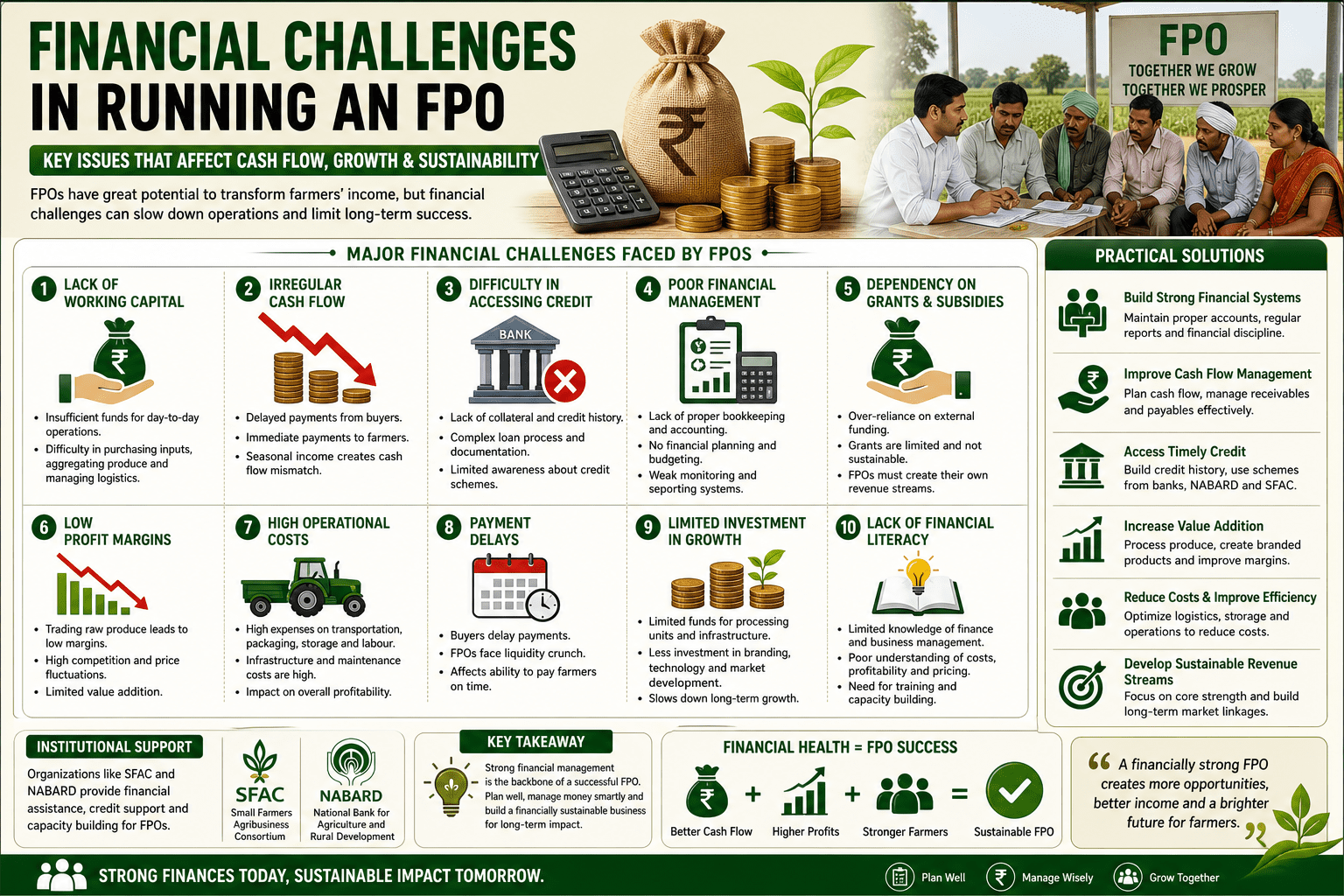
Lack of Working Capital
One of the most common financial challenges in running an FPO is the shortage of working capital.
FPOs need funds for:
- Purchasing inputs
- Aggregating produce
- Managing transportation
- Daily operations
Without sufficient working capital, even basic activities become difficult, affecting the entire business cycle.
Irregular Cash Flow
Cash flow management is critical for any business, and FPOs are no exception.
Common problems include:
- Delayed payments from buyers
- Immediate payments to farmers
- Seasonal income patterns
This mismatch creates financial stress and limits growth opportunities.
Difficulty in Accessing Credit
Many FPOs struggle to get loans from banks.
Reasons include:
- Lack of collateral
- Limited credit history
- Complex loan procedures
Even though institutions like National Bank for Agriculture and Rural Development support rural financing, access to timely credit remains a challenge.
(FARMER PRODUCER COMPANY COMPLITE GUIDE: https://belhamaifpo.com/uncategorized/farmer-producer-organizations-fpos/
Poor Financial Management
Financial mismanagement is another major issue.
Problems include:
- Lack of proper bookkeeping
- No financial planning
- Weak monitoring systems
This leads to confusion, losses, and lack of transparency.
Dependency on Grants and Subsidies
Many FPOs depend heavily on government support.
Supported by organizations like Small Farmers Agribusiness Consortium, FPOs receive initial funding. However:
❌ Over-dependence = weak sustainability
FPOs must develop their own revenue streams. Case study:
(Successful FPO business model in India: https://belhamaifpo.com/uncategorized/successful-fpo-business-model-in-india/)
Low Profit Margins
FPOs that focus only on trading raw produce often face low profit margins.
Reasons:
- High competition
- Price fluctuations
- Limited value addition
(How FPOs earn money → https://belhamaifpo.com/agriculture/how-fpos-earn-money/)
High Operational Costs
Running an FPO involves various expenses:
- Transportation
- Storage
- Labor
- Infrastructure
Without proper cost management, profits can quickly decline.
Payment Delays
Payment delays from buyers create serious financial issues.
- Farmers need immediate payment
- Buyers may delay payments
This creates a liquidity crisis.
Limited Investment in Growth
Due to financial constraints, many FPOs are unable to invest in:
- Processing units
- Branding
- Technology
This limits long-term growth.
(fitable business ideas for FPOs in India: https://belhamaifpo.com/agriculture/profitable-business-ideas-for-fpos/)
Pro Tip
Strong financial management is the backbone of a successful FPO. Maintaining proper accounts, planning cash flow, and building independent revenue streams are essential for sustainability.
Connection with Overall Business
Financial stability directly affects:
- Aggregation
- Market linkage
- Processing
- Branding
(FPO business model → https://belhamaifpo.com/uncategorized/fpo-business-model-explained/)
Institutional Support
Organizations like Small Farmers Agribusiness Consortium and National Bank for Agriculture and Rural Development provide financial and technical support, but effective utilization depends on FPO management.
❓ FAQ
What is the biggest financial challenge for FPOs?
The biggest challenge is managing cash flow and working capital while ensuring timely payments to farmers.
Conclusion
The financial challenges in running an FPO may appear complex at the initial stages, especially when resources are limited and operational demands are high. However, these challenges are not impossible to overcome if the organization adopts a structured and disciplined approach toward financial management. Proper planning plays a crucial role here. An FPO must clearly understand its cost structure, expected revenue streams, and working capital requirements. This helps in avoiding unnecessary expenses and ensures that funds are utilized efficiently.
Financial discipline is equally important. Maintaining accurate records, regular bookkeeping, and transparent financial practices not only improve internal management but also build trust among members and external stakeholders such as banks and funding agencies. When an FPO demonstrates financial stability and accountability, it becomes easier to access credit and investment opportunities.
Another key factor is developing sustainable revenue streams. Instead of relying heavily on grants and subsidies, FPOs should focus on income-generating activities such as aggregation, input supply, agro-processing, and direct market linkages. These activities create a continuous flow of income, reducing financial uncertainty over time.
FPOs that move beyond dependency on external support and build their own financial strength are better positioned for long-term growth. They can invest in infrastructure, expand operations, and create value-added products. Ultimately, strong financial management enables FPOs to not only survive but thrive, creating a lasting positive impact on farmers’ income and rural development.
some usefull links:
👉 https://www.nabard.org/EngDefault.aspx