भारतीय फलों और अनाज का आयात करने वाले प्रमुख देश
Introduction
Indian Fruits and Grains have strong demand in global markets because India is one of the world’s major agricultural producers. India grows a wide range of fruits such as mango, banana, grapes, pomegranate and citrus, along with grains such as rice, wheat, millets and maize. These products are exported to many countries based on demand, quality, price, availability and food culture.
Indian Fruits and Grains की global markets में strong demand है क्योंकि भारत दुनिया के प्रमुख agricultural producers में से एक है। भारत mango, banana, grapes, pomegranate और citrus जैसे fruits के साथ rice, wheat, millets और maize जैसे grains का बड़ा उत्पादन करता है। ये products demand, quality, price, availability और food culture के आधार पर कई देशों को export किए जाते हैं।
For farmers and Farmer Producer Organisations, understanding importing countries is very important. Export success depends not only on production but also on choosing the right market, right product, right packaging, right documentation and right buyer.
Farmers और Farmer Producer Organisations के लिए importing countries को समझना बहुत important है। Export success केवल production पर depend नहीं करती, बल्कि सही market, सही product, सही packaging, सही documentation और सही buyer चुनने पर भी depend करती है।
Why Countries Import Indian Fruits and Grains
Many countries import Indian Fruits and Grains because India offers diversity, regular supply, competitive pricing and product variety. Indian rice, especially basmati rice, is known for aroma, grain length and premium quality. Non-basmati rice is also demanded in many food-security and mass-consumption markets.
कई countries Indian Fruits and Grains import करते हैं क्योंकि भारत diversity, regular supply, competitive pricing और product variety प्रदान करता है। Indian rice, खासकर basmati rice, अपनी aroma, grain length और premium quality के लिए जाना जाता है। Non-basmati rice की भी food-security और mass-consumption markets में demand है।
Indian fruits are preferred in many markets because of taste, seasonality and strong ethnic demand. Mangoes, grapes, pomegranates, bananas and oranges are important parts of India’s fruit export basket. With better grading, cold chain, packaging and quality control, Indian fruits can reach more premium markets.
Indian fruits कई markets में taste, seasonality और strong ethnic demand के कारण पसंद किए जाते हैं। Mangoes, grapes, pomegranates, bananas और oranges India के fruit export basket का important हिस्सा हैं। Better grading, cold chain, packaging और quality control के साथ Indian fruits अधिक premium markets तक पहुंच सकते हैं।
India’s Fresh Fruits Export Position
India exported fresh fruits and vegetables worth USD 1,818.56 million during 2024–25. APEDA reports that grapes, pomegranates, mangoes, bananas and oranges account for the larger portion of fruits exported from India. This shows strong global demand for Indian fruits when quality and logistics are managed properly.
भारत ने 2024–25 के दौरान USD 1,818.56 million मूल्य के fresh fruits and vegetables export किए। Grapes, pomegranates, mangoes, bananas और oranges भारत से export होने वाले fruits के बड़े हिस्से में शामिल हैं। यह दिखाता है कि यदि quality और logistics सही हो, तो Indian fruits की global demand strong है।
Top Countries Importing Indian Fresh Fruits and Vegetables
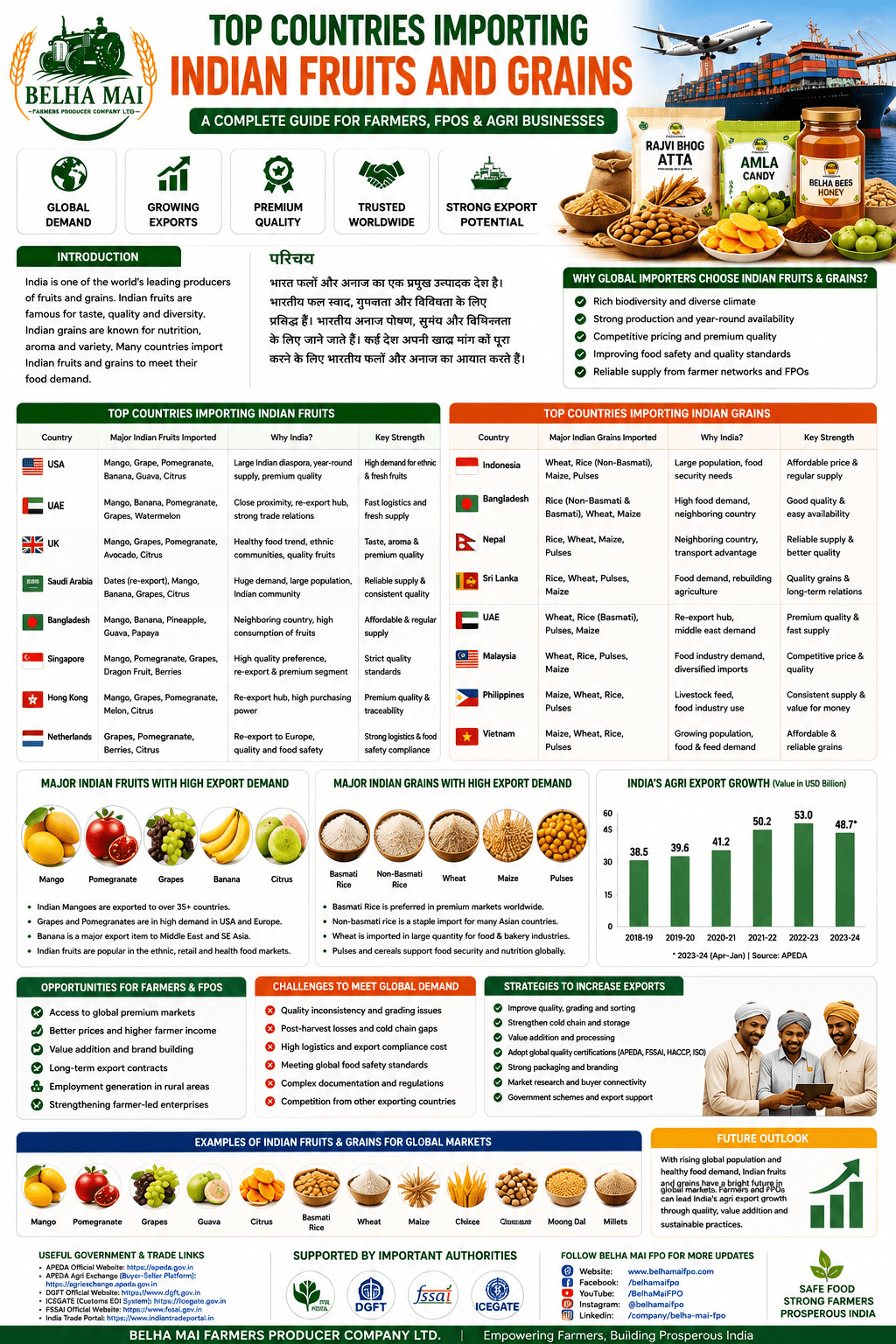
APEDA lists Bangladesh, United Arab Emirates, Iraq, Netherlands, Nepal, Malaysia, United Kingdom, Sri Lanka, Oman and Uzbekistan among major destinations for India’s fresh fruits and vegetables in 2024–25. These markets differ in demand, pricing, logistics, food safety requirements and consumer preferences.
APEDA ने 2024–25 में India’s fresh fruits and vegetables के major destinations में Bangladesh, United Arab Emirates, Iraq, Netherlands, Nepal, Malaysia, United Kingdom, Sri Lanka, Oman और Uzbekistan को include किया है। इन markets की demand, pricing, logistics, food safety requirements और consumer preferences अलग-अलग होती हैं।
For FPOs, this means market selection must be product-specific. A country suitable for mango may not be suitable for amla products. A market suitable for bulk fruits may not be suitable for premium packed processed products. Therefore, FPOs should study each market separately.
FPOs के लिए इसका अर्थ है कि market selection product-specific होना चाहिए। जो country mango के लिए suitable है, वह amla products के लिए suitable नहीं भी हो सकती। जो market bulk fruits के लिए suitable है, वह premium packed processed products के लिए suitable नहीं भी हो सकती। इसलिए FPOs को हर market अलग से study करना चाहिए।
United Arab Emirates
The United Arab Emirates is an important market for Indian fruits, grains and processed food products. Its large Indian population, strong retail network, re-export trade and proximity to India make UAE a major destination. Indian mangoes, bananas, grapes, vegetables, rice, spices, flour products and processed foods have opportunities in this market.
United Arab Emirates Indian fruits, grains और processed food products के लिए important market है। इसकी large Indian population, strong retail network, re-export trade और India से proximity इसे major destination बनाते हैं। Indian mangoes, bananas, grapes, vegetables, rice, spices, flour products और processed foods के लिए इस market में opportunities हैं।
For FPOs like Belha Mai FPO, UAE can be a practical early export market because it has demand for Indian food products and good logistics connectivity. However, quality, labelling, packaging and buyer verification remain important.
Belha Mai FPO जैसे FPOs के लिए UAE एक practical early export market हो सकता है क्योंकि वहां Indian food products की demand और logistics connectivity अच्छी है। लेकिन quality, labelling, packaging और buyer verification important रहते हैं।
Bangladesh
Bangladesh is a major neighbouring market for Indian agri products. It imports several Indian agricultural products based on availability, price and proximity. Fresh produce, rice, wheat, onions, fruits and other food products often move between India and Bangladesh depending on demand and trade rules.
Bangladesh Indian agri products के लिए major neighbouring market है। यह availability, price और proximity के आधार पर कई Indian agricultural products import करता है। Demand और trade rules के अनुसार fresh produce, rice, wheat, onions, fruits और other food products India और Bangladesh के बीच trade होते हैं।
For FPOs, Bangladesh can be relevant for bulk products and food staples, but exporters must carefully follow trade policy, documentation, product restrictions and payment safety.
FPOs के लिए Bangladesh bulk products और food staples के लिए relevant हो सकता है, लेकिन exporters को trade policy, documentation, product restrictions और payment safety carefully follow करनी चाहिए।
Netherlands
The Netherlands is an important destination for Indian fresh fruits and vegetables and also acts as a European trade and logistics hub. Products entering the Netherlands may move further into European markets. However, Europe is highly quality-sensitive and compliance-focused.
Netherlands Indian fresh fruits और vegetables के लिए important destination है और European trade तथा logistics hub के रूप में भी काम करता है। Netherlands में entry करने वाले products आगे European markets में भी move कर सकते हैं। लेकिन Europe quality-sensitive और compliance-focused market है।
For Indian exporters, European markets usually require strong food safety systems, residue compliance, traceability, cold chain, proper packaging and professional documentation. FPOs should prepare carefully before targeting this market.
Indian exporters के लिए European markets सामान्यतः strong food safety systems, residue compliance, traceability, cold chain, proper packaging और professional documentation मांगते हैं। FPOs को इस market को target करने से पहले carefully prepare करना चाहिए।
United Kingdom
The United Kingdom has a strong Indian diaspora and demand for Indian food products. Indian fruits, grains, spices, flour products, ready-to-cook foods, ethnic groceries and processed foods have market potential. However, UK buyers require compliance, labelling, food safety and consistent supply.
United Kingdom में strong Indian diaspora है और Indian food products की demand है। Indian fruits, grains, spices, flour products, ready-to-cook foods, ethnic groceries और processed foods में market potential है। लेकिन UK buyers compliance, labelling, food safety और consistent supply मांगते हैं।
For farmer-led brands, the UK market can be attractive but competitive. Products must be professionally packed and positioned. FPOs should not enter without understanding importer requirements and shelf-life expectations.
Farmer-led brands के लिए UK market attractive हो सकता है लेकिन competitive है। Products professionally packed और positioned होने चाहिए। FPOs को importer requirements और shelf-life expectations समझे बिना enter नहीं करना चाहिए।
Oman, Saudi Arabia and Gulf Markets
Oman, Saudi Arabia and other Gulf markets are important for Indian fruits, grains and food products. The Gulf region imports a large quantity of food due to limited local production and high consumer demand. Indian rice, fruits, vegetables, flour products, spices and processed foods have strong relevance.
Oman, Saudi Arabia और अन्य Gulf markets Indian fruits, grains और food products के लिए important हैं। Gulf region limited local production और high consumer demand के कारण बड़ी मात्रा में food import करता है। Indian rice, fruits, vegetables, flour products, spices और processed foods यहां strong relevance रखते हैं।
For Belha Mai FPO’s future export strategy, Gulf countries can be important for Rajvi Bhog products, honey, mango products and amla products, provided packaging, certification, labelling and buyer linkage are properly developed.
Belha Mai FPO की future export strategy के लिए Gulf countries Rajvi Bhog products, honey, mango products और amla products के लिए important हो सकते हैं, यदि packaging, certification, labelling और buyer linkage properly develop किए जाएं।
India’s Rice and Grain Export Strength
Indian grains, especially rice, have strong global demand. APEDA reports that India’s total rice export value increased from USD 8.82 billion in 2020–21 to USD 12.47 billion in 2024–25, and export quantity increased from 17.73 million metric tons to 20.19 million metric tons during the same period. India has remained the world’s largest rice exporter since 2012.
Indian grains, खासकर rice, की global demand strong है। India’s rice export value और quantity दोनों में strong growth दिखी है। India 2012 से world’s largest rice exporter रहा है। यह Indian grains की global importance को clearly दिखाता है।
For FPOs, rice and grain exports show that global demand exists, but the market is highly competitive. Exporters must maintain moisture control, grading, packaging, storage, documentation and buyer-specific quality parameters.
FPOs के लिए rice और grain exports बताते हैं कि global demand मौजूद है, लेकिन market highly competitive है। Exporters को moisture control, grading, packaging, storage, documentation और buyer-specific quality parameters maintain करने होंगे।
Top Countries Importing Indian Rice
APEDA reports that major destinations for Indian rice in 2024–25 included Saudi Arabia, Benin, Iraq, Iran, Guinea, Côte d’Ivoire, United Arab Emirates and Togo. These include both premium rice markets and food-security-focused markets.
APEDA के अनुसार 2024–25 में Indian rice के major destinations में Saudi Arabia, Benin, Iraq, Iran, Guinea, Côte d’Ivoire, United Arab Emirates और Togo शामिल थे। इनमें premium rice markets और food-security-focused markets दोनों शामिल हैं।
This shows that Indian grains serve different market segments. Some countries import premium basmati rice, while others import non-basmati rice for mass consumption. FPOs should understand whether their product is suitable for premium, institutional or bulk food markets.
यह दिखाता है कि Indian grains अलग-अलग market segments को serve करते हैं। कुछ countries premium basmati rice import करते हैं, जबकि अन्य mass consumption के लिए non-basmati rice import करते हैं। FPOs को समझना चाहिए कि उनका product premium, institutional या bulk food markets में से किसके लिए suitable है।
Top Countries Importing Indian Basmati Rice
For basmati rice, APEDA lists Saudi Arabia, Iraq, Iran, United Arab Emirates and Yemen among major export destinations for 2024–25. Basmati rice is generally a premium product and buyers focus on aroma, grain length, cooking quality, purity and packaging.
Basmati rice के लिए APEDA ने 2024–25 में Saudi Arabia, Iraq, Iran, United Arab Emirates और Yemen को major export destinations में list किया है। Basmati rice सामान्यतः premium product है और buyers aroma, grain length, cooking quality, purity और packaging पर focus करते हैं।
Although Belha Mai FPO may not be directly focused on basmati rice, this market shows how product identity and quality positioning can create premium global demand. Farmer-led brands can learn from this model.
हालांकि Belha Mai FPO directly basmati rice पर focused न हो, यह market दिखाता है कि product identity और quality positioning premium global demand बना सकती है। Farmer-led brands इस model से सीख सकते हैं।
Top Countries Importing Indian Non-Basmati Rice
APEDA reports that India exported 14.12 million metric tons of non-basmati rice worth USD 6.53 billion during 2024–25. Major destinations included Benin, Guinea, Côte d’Ivoire, Togo and Bangladesh. These markets are important for food security and bulk grain supply.
APEDA के अनुसार India ने 2024–25 में 14.12 million metric tons non-basmati rice export किया, जिसकी value USD 6.53 billion थी। Major destinations में Benin, Guinea, Côte d’Ivoire, Togo और Bangladesh शामिल थे। ये markets food security और bulk grain supply के लिए important हैं।
For FPOs dealing with grains, non-basmati rice exports show the importance of scale and consistency. Bulk markets require volume, price competitiveness, timely shipment and reliable quality.
Grains से जुड़े FPOs के लिए non-basmati rice exports scale और consistency की importance दिखाते हैं। Bulk markets volume, price competitiveness, timely shipment और reliable quality मांगते हैं।
Cereal Preparations and Processed Grain Products
Beyond raw grains, cereal preparations also have export demand. APEDA lists the United States and United Arab Emirates among major export destinations for cereal preparations in 2024–25. This category is important for processed and value-added grain products.
Raw grains के अलावा cereal preparations की भी export demand है। APEDA ने 2024–25 में cereal preparations के major export destinations में United States और United Arab Emirates को list किया है। यह category processed और value-added grain products के लिए important है।
For brands like Rajvi Bhog, this is an important signal. Instead of depending only on raw grains, FPOs can explore flour, dalia, suji, millet flour, ready-to-cook mixes and other grain-based value-added products.
Rajvi Bhog जैसे brands के लिए यह important signal है। Raw grains पर depend करने के बजाय FPOs flour, dalia, suji, millet flour, ready-to-cook mixes और other grain-based value-added products explore कर सकते हैं।
Opportunities for Fruits Export
Indian fruits such as mango, grapes, pomegranate, banana and citrus have strong export opportunities. Fresh fruit exports require careful harvesting, grading, sorting, pre-cooling, packaging, residue testing, cold chain and fast logistics.
Indian fruits जैसे mango, grapes, pomegranate, banana और citrus में strong export opportunities हैं। Fresh fruit exports के लिए careful harvesting, grading, sorting, pre-cooling, packaging, residue testing, cold chain और fast logistics की आवश्यकता होती है।
For FPOs, fresh fruit export can be challenging but rewarding. If fresh export is difficult, processed fruit products such as mango pulp, dehydrated mango slices, amla powder, amla candy and fruit ingredients can be easier to handle because they have longer shelf life.
FPOs के लिए fresh fruit export challenging लेकिन rewarding हो सकता है। यदि fresh export difficult है, तो mango pulp, dehydrated mango slices, amla powder, amla candy और fruit ingredients जैसे processed fruit products handle करने में आसान हो सकते हैं क्योंकि उनकी shelf life longer होती है।
Opportunities for Grain Export
Grain export opportunities include rice, wheat products, maize, millets, pulses and cereal preparations. However, grain exports are highly price-sensitive and quality-sensitive. Moisture, broken percentage, foreign matter, storage condition and packaging are important.
Grain export opportunities में rice, wheat products, maize, millets, pulses और cereal preparations शामिल हैं। लेकिन grain exports price-sensitive और quality-sensitive होते हैं। Moisture, broken percentage, foreign matter, storage condition और packaging important हैं।
For FPOs, value-added grain products may offer better margins than bulk grain exports. Products such as atta, suji, dalia, millet flour and ready-to-cook grain mixes can be branded and supplied to ethnic, retail and institutional markets.
FPOs के लिए value-added grain products bulk grain exports की तुलना में better margins दे सकते हैं। Atta, suji, dalia, millet flour और ready-to-cook grain mixes जैसे products को ethnic, retail और institutional markets में brand करके supply किया जा सकता है।
Why Importers Choose Indian Fruits and Grains
Importers choose Indian Fruits and Grains because India offers variety, competitive prices, large production base and cultural demand. Indian food products also have strong acceptance among Indian diaspora and South Asian communities abroad.
Importers Indian Fruits and Grains इसलिए चुनते हैं क्योंकि India variety, competitive prices, large production base और cultural demand offer करता है। Indian food products की Indian diaspora और South Asian communities abroad में strong acceptance भी है।
However, importers also compare Indian suppliers with suppliers from other countries. Therefore, Indian FPOs must improve quality, packaging, documentation, communication and reliability.
लेकिन importers Indian suppliers की तुलना अन्य countries के suppliers से भी करते हैं। इसलिए Indian FPOs को quality, packaging, documentation, communication और reliability improve करनी होगी।
Challenges in Exporting Fruits and Grains
One major challenge in fruit export is perishability. Fresh fruits can spoil quickly if cold chain, packaging and timing are not managed properly. Rejection risk is high if quality, residue level or phytosanitary requirement is not met.
Fruit export में एक major challenge perishability है। Fresh fruits जल्दी spoil हो सकते हैं यदि cold chain, packaging और timing properly manage न हो। Quality, residue level या phytosanitary requirement meet न होने पर rejection risk high होता है।
For grains, challenges include moisture control, storage pests, quality variation, price competition and export policy changes. FPOs must track policy updates and buyer requirements carefully.
Grains के लिए challenges में moisture control, storage pests, quality variation, price competition और export policy changes शामिल हैं। FPOs को policy updates और buyer requirements carefully track करनी चाहिए।
Strategies for FPOs to Enter Importing Countries
FPOs should begin by selecting a few target countries instead of trying to sell everywhere. They should study product demand, buyer type, packaging requirement, documentation, food safety standards and competitor pricing.
FPOs को हर जगह sell करने की कोशिश करने के बजाय कुछ target countries select करके शुरुआत करनी चाहिए। उन्हें product demand, buyer type, packaging requirement, documentation, food safety standards और competitor pricing study करनी चाहिए।
The second strategy is to build product samples and catalogues. Buyers need clear information about product specification, pack size, shelf life, certifications, quantity and price. Professional presentation improves trust.
दूसरी strategy product samples और catalogues build करना है। Buyers को product specification, pack size, shelf life, certifications, quantity और price की clear information चाहिए। Professional presentation trust improve करता है।
The third strategy is to work through reliable export channels. APEDA events, buyer-seller meets, verified importers, trade fairs, Indian embassies, FIEO and professional networks can help FPOs find genuine buyers.
तीसरी strategy reliable export channels के माध्यम से काम करना है। APEDA events, buyer-seller meets, verified importers, trade fairs, Indian embassies, FIEO और professional networks FPOs को genuine buyers खोजने में मदद कर सकते हैं।
Belha Mai FPO Vision for Export Markets
Belha Mai Farmers Producer Company Ltd. understands that Indian Fruits and Grains can create strong opportunities when combined with quality, processing and branding. Products under Rajvi Bhog, Belha Bees, mango value addition and amla value addition can gradually target markets where Indian food demand is strong.
Belha Mai Farmers Producer Company Ltd. समझता है कि Indian Fruits and Grains quality, processing और branding के साथ strong opportunities बना सकते हैं। Rajvi Bhog, Belha Bees, mango value addition और amla value addition के products gradually उन markets को target कर सकते हैं जहां Indian food demand strong है।
For Belha Mai FPO, export strategy should focus first on quality control, clean packaging, shelf life, product testing, buyer verification and documentation. Once this foundation is strong, global markets can become a realistic opportunity.
Belha Mai FPO के लिए export strategy को पहले quality control, clean packaging, shelf life, product testing, buyer verification और documentation पर focus करना चाहिए। जब यह foundation strong होगा, तब global markets realistic opportunity बन सकते हैं।
Conclusion
Indian Fruits and Grains are imported by many countries because of India’s production strength, diversity, competitive pricing and traditional food value. Fresh fruits have demand in countries such as UAE, Bangladesh, Netherlands, UK, Oman and others, while Indian rice reaches major markets such as Saudi Arabia, Benin, Iraq, Iran, UAE and several African countries.
Indian Fruits and Grains कई countries द्वारा import किए जाते हैं क्योंकि India की production strength, diversity, competitive pricing और traditional food value मजबूत है। Fresh fruits की demand UAE, Bangladesh, Netherlands, UK, Oman और अन्य countries में है, जबकि Indian rice Saudi Arabia, Benin, Iraq, Iran, UAE और कई African countries तक पहुंचता है।
For farmers and FPOs, these importing countries show a clear opportunity. But export success needs preparation. Quality, grading, packaging, documentation, food safety, logistics and buyer trust will decide how successfully farmer-led brands enter global markets.
Farmers और FPOs के लिए ये importing countries clear opportunity दिखाती हैं। लेकिन export success के लिए preparation जरूरी है। Quality, grading, packaging, documentation, food safety, logistics और buyer trust तय करेंगे कि farmer-led brands global markets में कितनी successfully enter करते हैं।
FAQ
Which countries import Indian fruits?
Major destinations for Indian fresh fruits and vegetables include Bangladesh, United Arab Emirates, Iraq, Netherlands, Nepal, Malaysia, United Kingdom, Sri Lanka, Oman and Uzbekistan.
Indian fresh fruits और vegetables के major destinations में Bangladesh, United Arab Emirates, Iraq, Netherlands, Nepal, Malaysia, United Kingdom, Sri Lanka, Oman और Uzbekistan शामिल हैं।
Which countries import Indian rice?
Major destinations for Indian rice include Saudi Arabia, Benin, Iraq, Iran, Guinea, Côte d’Ivoire, United Arab Emirates and Togo.
Indian rice के major destinations में Saudi Arabia, Benin, Iraq, Iran, Guinea, Côte d’Ivoire, United Arab Emirates और Togo शामिल हैं।
Which countries import Indian basmati rice?
Major basmati rice destinations include Saudi Arabia, Iraq, Iran, United Arab Emirates and Yemen.
Basmati rice के major destinations में Saudi Arabia, Iraq, Iran, United Arab Emirates और Yemen शामिल हैं।
Which countries import Indian non-basmati rice?
Major non-basmati rice destinations include Benin, Guinea, Côte d’Ivoire, Togo and Bangladesh.
Non-basmati rice के major destinations में Benin, Guinea, Côte d’Ivoire, Togo और Bangladesh शामिल हैं।
Which Indian fruits have high export demand?
Grapes, pomegranates, mangoes, bananas and oranges are among the major fruits exported from India.
Grapes, pomegranates, mangoes, bananas और oranges India से export होने वाले major fruits में शामिल हैं।
How can FPOs benefit from fruit and grain exports?
FPOs can benefit by aggregating produce, improving grading, processing products, creating brands, maintaining traceability, following export documentation and connecting with genuine buyers.
FPOs produce aggregate करके, grading improve करके, products process करके, brands बनाकर, traceability maintain करके, export documentation follow करके और genuine buyers से connect होकर benefit ले सकते हैं।
Internal Links Section
👉 Food Processing Industry in India: Complete Guide
👉 Global Demand for Indian Agricultural Products
👉 Export Documentation for Food Products
👉 How to Find International Buyers for Agri Products
👉 APEDA Registration for Agri Exporters
👉 Step-by-Step Process to Export Agricultural Products from India
External Authority Links
👉 APEDA Fresh Fruits and Vegetables
👉 APEDA Rice Export Requirements
Reference basis: APEDA reports India’s 2024–25 fresh fruits and vegetables export value and major destinations, and lists grapes, pomegranates, mangoes, bananas and oranges as major exported fruits. APEDA also reports 2024–25 destinations for Indian rice, basmati rice and non-basmati rice, including rice export value and quantity figures used in this blog.
Follow Belha Mai FPO for More Updates
Stay connected with Belha Mai Farmers Producer Company Ltd. for more updates on agriculture, food processing, farmer development, FPO awareness, market linkage, value addition, rural entrepreneurship and sustainable farming.
👉 Website
👉 YouTube
Belha Mai FPO is committed to supporting farmers through better information, technology, market linkage, value addition, FPO awareness and rural development.