Introduction
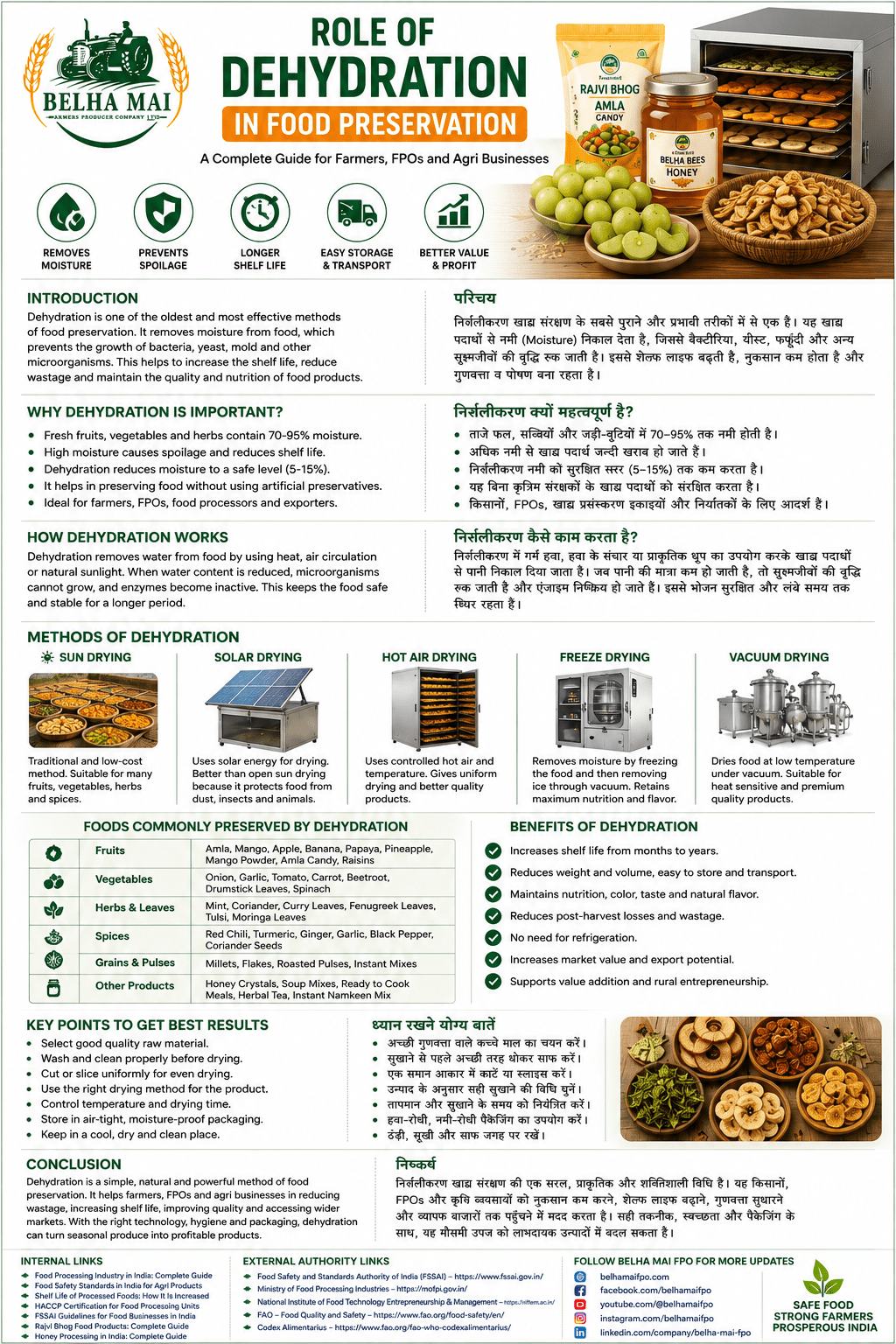
Dehydration in Food Preservation is one of the oldest and most practical methods used to protect food from spoilage. It works by removing moisture from food products so that bacteria, yeast, mould and fungus cannot grow easily. For farmers, FPOs and food processing businesses, dehydration is a powerful tool to increase shelf life, reduce wastage and create value-added products.
Dehydration in Food Preservation खाद्य पदार्थों को खराब होने से बचाने की सबसे पुरानी और व्यावहारिक विधियों में से एक है। इसमें खाद्य उत्पादों से नमी हटाई जाती है, जिससे bacteria, yeast, mould और fungus आसानी से grow नहीं कर पाते। किसानों, FPOs और food processing businesses के लिए dehydration shelf life बढ़ाने, wastage कम करने और value-added products बनाने का एक powerful tool है।
In the Food Processing Industry in India, dehydration has strong importance because India produces large quantities of fruits, vegetables, spices, herbs, amla, mango and other agricultural products. Many of these products are seasonal and perishable. Dehydration helps convert them into stable, lightweight, easy-to-store and market-ready products.
Food Processing Industry in India में dehydration का बहुत महत्व है क्योंकि भारत में fruits, vegetables, spices, herbs, amla, mango और अन्य कृषि उत्पादों का बड़ा उत्पादन होता है। इनमें से कई products seasonal और perishable होते हैं। Dehydration इन्हें stable, lightweight, easy-to-store और market-ready products में बदलने में मदद करता है।
What is Dehydration in Food Preservation?
Dehydration in Food Preservation means removing water or moisture from food to slow down spoilage. Most microorganisms need moisture to grow. When moisture is reduced to a safe level, food remains stable for a longer time. This is why dehydration is widely used for fruits, vegetables, spices, herbs, grains and powders.
Dehydration in Food Preservation का अर्थ है food से water या moisture हटाना ताकि spoilage slow हो सके। अधिकतर microorganisms को grow करने के लिए moisture की आवश्यकता होती है। जब moisture को safe level तक कम कर दिया जाता है, तो food लंबे समय तक stable रहता है। इसलिए dehydration का उपयोग fruits, vegetables, spices, herbs, grains और powders में व्यापक रूप से किया जाता है।
In simple words, dehydration removes the main condition that supports spoilage. It does not mean that food safety can be ignored. Raw material selection, cleaning, slicing, drying temperature, hygiene, packaging and storage are all important for safe dehydrated food.
सरल शब्दों में, dehydration उस मुख्य condition को हटाता है जो spoilage को support करती है। इसका अर्थ यह नहीं है कि food safety को ignore किया जा सकता है। Safe dehydrated food के लिए raw material selection, cleaning, slicing, drying temperature, hygiene, packaging और storage सभी महत्वपूर्ण हैं।
Why Dehydration Matters for Farmers and FPOs
Farmers often lose value when fruits and vegetables are sold only in fresh form. During peak season, market prices fall because supply is high and shelf life is short. Dehydration gives farmers and FPOs the option to process surplus produce instead of selling everything immediately at low prices.
किसानों को अक्सर नुकसान होता है जब फल और सब्जियां केवल fresh form में बेची जाती हैं। Peak season में supply अधिक और shelf life कम होने के कारण market prices गिर जाते हैं। Dehydration किसानों और FPOs को surplus produce process करने का विकल्प देता है, ताकि उन्हें सब कुछ तुरंत कम दाम पर न बेचना पड़े।
For FPOs, Dehydration in Food Preservation can create many business opportunities. Amla can be converted into dry amla, amla powder and amla flakes. Mango can be converted into dehydrated mango slices and aamchur. Vegetables can be converted into dried vegetables. Spices and herbs can be dried and packed for retail and institutional markets.
FPOs के लिए Dehydration in Food Preservation कई business opportunities बना सकता है। Amla को dry amla, amla powder और amla flakes में बदला जा सकता है। Mango को dehydrated mango slices और aamchur में बदला जा सकता है। Vegetables को dried vegetables में बदला जा सकता है। Spices और herbs को dry करके retail और institutional markets के लिए pack किया जा सकता है।
How Dehydration Increases Shelf Life
Dehydration increases shelf life mainly by reducing water activity in food. Water activity means the amount of water available for microorganisms to grow. Even if a product contains some moisture, it may remain stable if water activity is low enough.
Dehydration food में water activity कम करके shelf life बढ़ाता है। Water activity का अर्थ है वह water जो microorganisms के grow करने के लिए available होता है। यदि किसी product में कुछ moisture हो, फिर भी water activity low होने पर product stable रह सकता है।
When food is properly dehydrated, microbial growth slows down, enzymatic activity reduces and spoilage becomes slower. This helps products remain safe and acceptable for a longer time. However, dehydration must be combined with proper packaging and storage, otherwise dried products can again absorb moisture from the air.
जब food को properly dehydrate किया जाता है, तो microbial growth slow होती है, enzymatic activity कम होती है और spoilage धीमा हो जाता है। इससे products लंबे समय तक safe और acceptable बने रहते हैं। लेकिन dehydration को proper packaging और storage के साथ जोड़ना जरूरी है, नहीं तो dried products हवा से moisture फिर से absorb कर सकते हैं।
Common Methods of Dehydration
Sun drying is one of the oldest methods of dehydration. It is low-cost and simple, but it depends on weather and may create hygiene risks if products are exposed to dust, insects, animals or contamination. For commercial food business, controlled drying methods are usually better.
Sun drying dehydration की सबसे पुरानी methods में से एक है। यह low-cost और simple है, लेकिन यह weather पर निर्भर करती है और यदि products dust, insects, animals या contamination के संपर्क में आते हैं, तो hygiene risk पैदा हो सकता है। Commercial food business के लिए controlled drying methods सामान्यतः बेहतर होती हैं।
Solar drying is an improved method where solar energy is used in a more protected and controlled drying chamber. It reduces direct exposure to dust and insects compared to open sun drying. Solar dryers can be useful for FPOs because they reduce energy cost and support rural food processing.
Solar drying एक improved method है, जिसमें solar energy का उपयोग अधिक protected और controlled drying chamber में किया जाता है। यह open sun drying की तुलना में dust और insects के direct exposure को कम करता है। Solar dryers FPOs के लिए उपयोगी हो सकते हैं क्योंकि ये energy cost कम करते हैं और rural food processing को support करते हैं।
Mechanical dehydration uses machines such as tray dryers, cabinet dryers, tunnel dryers, fluidized bed dryers or freeze dryers. These methods provide better control over temperature, air flow, drying time and product quality. For FPO-led brands, mechanical dehydration can help produce consistent and market-ready products.
Mechanical dehydration में tray dryers, cabinet dryers, tunnel dryers, fluidized bed dryers या freeze dryers जैसी machines का उपयोग होता है। ये methods temperature, air flow, drying time और product quality पर बेहतर control देती हैं। FPO-led brands के लिए mechanical dehydration consistent और market-ready products बनाने में मदद कर सकता है।
Steps in Dehydration Process
The dehydration process starts with raw material selection. Only clean, mature and good-quality produce should be selected. Damaged, rotten, infected or contaminated material should be rejected because poor raw material can spoil the final product.
Dehydration process raw material selection से शुरू होता है। केवल clean, mature और good-quality produce का selection करना चाहिए। Damaged, rotten, infected या contaminated material को reject करना चाहिए क्योंकि खराब raw material final product को खराब कर सकता है।
After selection, the produce is washed, cleaned, peeled or sliced depending on the product. Uniform slicing helps in even drying. If pieces are too thick, drying may be incomplete. If pieces are too thin, texture and quality may suffer.
Selection के बाद produce को product के अनुसार wash, clean, peel या slice किया जाता है। Uniform slicing even drying में मदद करती है। यदि pieces बहुत thick हैं, तो drying incomplete हो सकती है। यदि pieces बहुत thin हैं, तो texture और quality प्रभावित हो सकती है।
Some products may need pre-treatment before dehydration. Pre-treatment may include blanching, dipping in salt solution, sugar solution, citric acid solution or other permitted treatments. Pre-treatment helps preserve colour, taste, texture and safety depending on the product.
कुछ products को dehydration से पहले pre-treatment की आवश्यकता हो सकती है। Pre-treatment में blanching, salt solution, sugar solution, citric acid solution या अन्य permitted treatments शामिल हो सकते हैं। Product के अनुसार pre-treatment colour, taste, texture और safety को preserve करने में मदद करता है।
After drying, products should be cooled properly before packaging. If hot products are packed immediately, condensation may form inside the package and increase moisture. This can reduce shelf life and create spoilage risk.
Drying के बाद products को packaging से पहले properly cool करना चाहिए। यदि hot products को तुरंत pack कर दिया जाता है, तो package के अंदर condensation बन सकती है और moisture बढ़ सकती है। इससे shelf life कम हो सकती है और spoilage risk पैदा हो सकता है।
Dehydration for Amla Products
Amla is an important fruit for value addition because it is rich in traditional nutritional value and has strong demand in processed form. Dehydration can convert fresh amla into dry amla, amla powder, amla flakes and other value-added ingredients.
Amla value addition के लिए एक महत्वपूर्ण fruit है क्योंकि इसकी traditional nutritional value अधिक है और processed form में इसकी strong demand है। Dehydration fresh amla को dry amla, amla powder, amla flakes और अन्य value-added ingredients में बदल सकता है।
For FPOs in amla-producing regions, dehydration can reduce post-harvest losses and create new market opportunities. Amla powder can be supplied to retail consumers, food businesses, herbal product manufacturers, nutraceutical companies and institutional buyers.
Amla-producing regions में FPOs के लिए dehydration post-harvest losses कम कर सकता है और new market opportunities बना सकता है। Amla powder को retail consumers, food businesses, herbal product manufacturers, nutraceutical companies और institutional buyers को supply किया जा सकता है।
Dehydration for Mango Products
Mango is highly seasonal and perishable. During peak season, farmers often face price pressure. Dehydration can help convert mango into dehydrated mango slices, mango powder, aamchur and ingredients for snacks, beverages and food processing industries.
Mango बहुत seasonal और perishable होता है। Peak season में farmers अक्सर price pressure का सामना करते हैं। Dehydration mango को dehydrated mango slices, mango powder, aamchur और snacks, beverages तथा food processing industries के ingredients में बदलने में मदद कर सकता है।
For mango-growing FPOs, dehydration can support better utilisation of surplus or lower-grade mangoes that are not suitable for premium fresh markets but are still safe and usable for processing. This improves farmer returns and reduces wastage.
Mango-growing FPOs के लिए dehydration surplus या lower-grade mangoes का better utilisation करने में मदद कर सकता है, जो premium fresh markets के लिए suitable नहीं हैं लेकिन processing के लिए safe और usable हैं। इससे farmer returns improve होते हैं और wastage कम होता है।
Dehydration for Vegetables and Spices
Vegetables can also be preserved through dehydration. Dried onion, garlic, tomato, green chilli, carrot, leafy vegetables and mixed vegetables have demand in homes, hotels, restaurants, food factories and ready-to-cook products.
Vegetables को भी dehydration के माध्यम से preserve किया जा सकता है। Dried onion, garlic, tomato, green chilli, carrot, leafy vegetables और mixed vegetables की demand homes, hotels, restaurants, food factories और ready-to-cook products में होती है।
Spices and herbs also depend heavily on drying. Proper dehydration helps maintain colour, aroma and quality while reducing microbial risk. FPOs working with spices must pay attention to drying temperature, moisture level, cleanliness and packaging.
Spices और herbs भी drying पर बहुत निर्भर करते हैं। Proper dehydration colour, aroma और quality को maintain करने में मदद करता है और microbial risk को कम करता है। Spices के साथ काम करने वाले FPOs को drying temperature, moisture level, cleanliness और packaging पर ध्यान देना चाहिए।
Quality Control in Dehydrated Foods
Quality control is very important in Dehydration in Food Preservation. The final product should have proper moisture level, good colour, acceptable taste, clean appearance and safe packaging. If dehydration is incomplete, the product may spoil quickly. If drying is excessive, the product may lose colour, flavour and nutritional quality.
Dehydration in Food Preservation में quality control बहुत महत्वपूर्ण है। Final product में proper moisture level, good colour, acceptable taste, clean appearance और safe packaging होनी चाहिए। यदि dehydration incomplete है, तो product जल्दी खराब हो सकता है। यदि drying excessive है, तो product colour, flavour और nutritional quality खो सकता है।
FPOs should maintain simple quality records such as raw material source, drying date, drying time, dryer temperature, batch number, packaging date and storage condition. These records help maintain consistency and buyer confidence.
FPOs को raw material source, drying date, drying time, dryer temperature, batch number, packaging date और storage condition जैसे simple quality records maintain करने चाहिए। ये records consistency और buyer confidence बनाए रखने में मदद करते हैं।
Packaging of Dehydrated Foods
Dehydrated foods can absorb moisture from the air if packaging is poor. Therefore, packaging must protect the product from moisture, air, dust, insects and contamination. Moisture-proof and food-grade packaging is very important for dried products.
Dehydrated foods poor packaging होने पर हवा से moisture absorb कर सकते हैं। इसलिए packaging को product को moisture, air, dust, insects और contamination से protect करना चाहिए। Dried products के लिए moisture-proof और food-grade packaging बहुत important है।
Depending on the product, FPOs may use laminated pouches, vacuum packaging, jars, sealed containers or bulk food-grade bags. Labelling should include product name, net weight, batch number, manufacturing date, best-before date, FSSAI details and storage instructions.
Product के अनुसार FPOs laminated pouches, vacuum packaging, jars, sealed containers या bulk food-grade bags का उपयोग कर सकते हैं। Labelling में product name, net weight, batch number, manufacturing date, best-before date, FSSAI details और storage instructions शामिल होने चाहिए।
Storage of Dehydrated Foods
Even after dehydration and packaging, storage conditions matter. Dehydrated products should be stored in a cool, dry, clean and pest-free place. They should be kept away from direct sunlight, moisture, chemicals and strong odours.
Dehydration और packaging के बाद भी storage conditions important होती हैं। Dehydrated products को cool, dry, clean और pest-free place में store करना चाहिए। उन्हें direct sunlight, moisture, chemicals और strong odours से दूर रखना चाहिए।
FPOs should follow FIFO, meaning First In, First Out. Older stock should be sold first. Batch-wise storage makes it easier to track product quality, expiry and dispatch.
FPOs को FIFO follow करना चाहिए, जिसका अर्थ है First In, First Out। पुराने stock को पहले sell करना चाहिए। Batch-wise storage product quality, expiry और dispatch को track करना आसान बनाता है।
Benefits of Dehydration for Food Businesses
Dehydration reduces wastage by preserving seasonal and surplus produce. It reduces transport cost because dried products are lighter than fresh products. It also reduces storage pressure because dehydrated products usually occupy less space.
Dehydration seasonal और surplus produce को preserve करके wastage कम करता है। यह transport cost कम करता है क्योंकि dried products fresh products की तुलना में हल्के होते हैं। यह storage pressure भी कम करता है क्योंकि dehydrated products सामान्यतः कम space लेते हैं।
For food businesses, dehydration creates value-added products with longer shelf life and better market reach. It also supports online selling, institutional supply and export preparation. This makes dehydration highly useful for farmer-led brands and rural enterprises.
Food businesses के लिए dehydration longer shelf life और better market reach वाले value-added products बनाता है। यह online selling, institutional supply और export preparation को भी support करता है। इससे dehydration farmer-led brands और rural enterprises के लिए बहुत उपयोगी बनता है।
Challenges in Dehydration
Dehydration also has challenges. If drying temperature is not controlled, product colour and taste may be affected. If hygiene is poor, contamination can happen before or after drying. If packaging is weak, moisture can enter and spoil the product.
Dehydration में challenges भी हैं। यदि drying temperature control नहीं होता, तो product colour और taste प्रभावित हो सकते हैं। यदि hygiene poor है, तो drying से पहले या बाद में contamination हो सकता है। यदि packaging weak है, तो moisture अंदर आकर product खराब कर सकता है।
Another challenge is market acceptance. Consumers must trust the quality and use of dehydrated products. FPOs should educate buyers about how to use products such as amla powder, dehydrated mango, dried vegetables, spices and herbal powders.
एक और challenge market acceptance है। Consumers को dehydrated products की quality और उपयोग पर trust होना चाहिए। FPOs को buyers को amla powder, dehydrated mango, dried vegetables, spices और herbal powders जैसे products के उपयोग के बारे में educate करना चाहिए।
Dehydration and Export Opportunities
Dehydrated foods have export potential because they are lightweight, stable and easier to transport than fresh produce. Products such as dehydrated vegetables, dried fruits, mango powder, amla powder, spices and herbs can find buyers in domestic and international markets if quality standards are met.
Dehydrated foods में export potential होता है क्योंकि वे fresh produce की तुलना में lightweight, stable और transport में आसान होते हैं। Dehydrated vegetables, dried fruits, mango powder, amla powder, spices और herbs जैसे products domestic और international markets में buyers पा सकते हैं यदि quality standards पूरे किए जाएं।
For export markets, FPOs must focus on food safety, lab testing, packaging, traceability, documentation and buyer specifications. Dehydration can support export readiness, but only when the complete quality system is strong.
Export markets के लिए FPOs को food safety, lab testing, packaging, traceability, documentation और buyer specifications पर focus करना चाहिए। Dehydration export readiness को support कर सकता है, लेकिन तभी जब complete quality system strong हो।
Belha Mai FPO Vision for Dehydration-Based Value Addition
Belha Mai Farmers Producer Company Ltd. understands that dehydration can play a major role in reducing post-harvest losses and increasing farmer income. Products such as amla powder, dry amla, dehydrated mango slices, aamchur and other agri-based processed foods can create better opportunities for farmers.
Belha Mai Farmers Producer Company Ltd. समझता है कि dehydration post-harvest losses कम करने और farmer income बढ़ाने में major role निभा सकता है। Amla powder, dry amla, dehydrated mango slices, aamchur और अन्य agri-based processed foods किसानों के लिए better opportunities बना सकते हैं।
For Belha Mai FPO, Dehydration in Food Preservation is not only a processing method. It is a rural value addition strategy. By connecting farmers with processing, packaging, branding and market linkage, dehydration can help farmer-led businesses reach better markets.
Belha Mai FPO के लिए Dehydration in Food Preservation केवल processing method नहीं है। यह rural value addition strategy है। Farmers को processing, packaging, branding और market linkage से जोड़कर dehydration farmer-led businesses को better markets तक पहुंचाने में मदद कर सकता है।
Conclusion
Dehydration in Food Preservation is one of the most useful techniques for farmers, FPOs and food businesses. It increases shelf life, reduces wastage, lowers transport cost, improves market reach and creates value-added products from seasonal agricultural produce.
Dehydration in Food Preservation किसानों, FPOs और food businesses के लिए सबसे उपयोगी techniques में से एक है। यह shelf life बढ़ाता है, wastage कम करता है, transport cost घटाता है, market reach improve करता है और seasonal agricultural produce से value-added products बनाता है।
In the future of the Food Processing Industry in India, dehydration will play a strong role in creating farmer-led brands and rural enterprises. FPOs that adopt proper dehydration, hygiene, packaging, storage and quality control can convert local crops into safe, trusted and market-ready products.
Food Processing Industry in India के future में dehydration farmer-led brands और rural enterprises बनाने में strong role निभाएगा। जो FPOs proper dehydration, hygiene, packaging, storage और quality control अपनाएंगे, वे local crops को safe, trusted और market-ready products में बदल सकते हैं।
FAQ
What is Dehydration in Food Preservation?
Dehydration in Food Preservation is the process of removing moisture from food to slow spoilage and increase shelf life.
Dehydration in Food Preservation food से moisture हटाने की प्रक्रिया है, जिससे spoilage slow होता है और shelf life बढ़ती है।
Why does dehydration increase shelf life?
Dehydration increases shelf life by reducing moisture and water activity, which makes it difficult for microorganisms to grow.
Dehydration moisture और water activity को कम करके shelf life बढ़ाता है, जिससे microorganisms के लिए grow करना कठिन हो जाता है।
Which foods can be preserved by dehydration?
Fruits, vegetables, amla, mango, spices, herbs, grains, pulses and powders can be preserved through dehydration.
Fruits, vegetables, amla, mango, spices, herbs, grains, pulses और powders को dehydration के माध्यम से preserve किया जा सकता है।
Is dehydration useful for FPOs?
Yes, dehydration is very useful for FPOs because it reduces wastage, increases shelf life and creates value-added products from local crops.
हाँ, dehydration FPOs के लिए बहुत उपयोगी है क्योंकि यह wastage कम करता है, shelf life बढ़ाता है और local crops से value-added products बनाता है।
What packaging is best for dehydrated foods?
Dehydrated foods need moisture-proof, food-grade and properly sealed packaging to prevent moisture absorption and contamination.
Dehydrated foods को moisture absorption और contamination से बचाने के लिए moisture-proof, food-grade और properly sealed packaging की आवश्यकता होती है।
Can dehydrated foods be exported?
Yes, dehydrated foods can be exported if they meet food safety, quality, packaging, testing, documentation and buyer requirements.
हाँ, dehydrated foods export किए जा सकते हैं यदि वे food safety, quality, packaging, testing, documentation और buyer requirements को पूरा करते हैं।
Internal Links Section
👉 Food Processing Industry in India: Complete Guide
👉 Shelf Life of Processed Foods: How It Is Increased
👉 Food Safety Standards in India for Agri Products
👉 FSSAI Guidelines for Food Businesses in India
👉 Mango Farming in India: Complete Guide
👉 Rajvi Bhog Food Products: Complete Guide
External Authority Links
👉 Food Safety and Standards Authority of India
👉 Ministry of Food Processing Industries
👉 Codex Alimentarius – International Food Standards
Follow Belha Mai FPO for More Updates
Stay connected with Belha Mai Farmers Producer Company Ltd. for more updates on agriculture, food processing, farmer development, FPO awareness, market linkage, value addition, rural entrepreneurship and sustainable farming.
👉 Website
👉 YouTube
Belha Mai FPO is committed to supporting farmers through better information, technology, market linkage, value addition, FPO awareness and rural development.