कृषि परियोजनाओं में लागत-लाभ विश्लेषण
Introduction
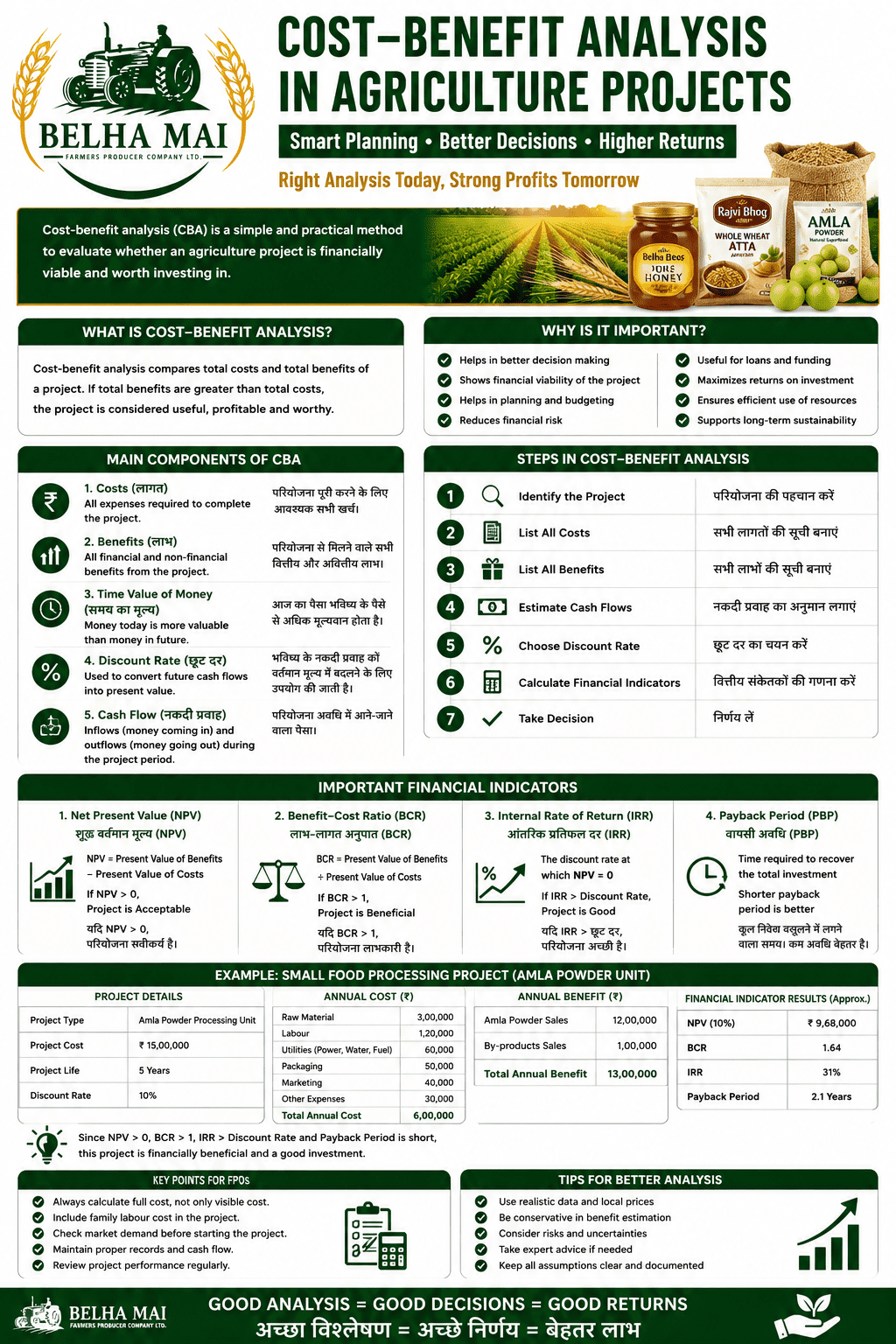
Cost-Benefit Analysis in Agriculture Projects is a practical method used to compare the total cost of a project with the total benefits expected from it. It helps farmers, FPOs, agri startups and rural entrepreneurs understand whether a project is worth investing in or not.
कृषि परियोजनाओं में लागत-लाभ विश्लेषण एक व्यावहारिक विधि है, जिसके माध्यम से किसी परियोजना की कुल लागत की तुलना उससे मिलने वाले कुल लाभों से की जाती है। यह किसानों, FPOs, कृषि स्टार्टअप्स और ग्रामीण उद्यमियों को यह समझने में मदद करता है कि कोई परियोजना निवेश के योग्य है या नहीं।
In agriculture, many projects look attractive in the beginning, but they may fail if costs are underestimated or benefits are overestimated. Cost-benefit analysis helps avoid emotional decisions and supports practical, data-based planning.
कृषि में कई परियोजनाएँ शुरुआत में आकर्षक दिखती हैं, लेकिन यदि लागत कम आँकी जाए या लाभ अधिक आँके जाएँ, तो वे असफल हो सकती हैं। लागत-लाभ विश्लेषण भावनात्मक निर्णयों से बचाता है और व्यावहारिक तथा आँकड़ों पर आधारित योजना बनाने में मदद करता है।
For FPOs, Cost-Benefit Analysis in Agriculture Projects is very important before starting a processing unit, warehouse, cold room, farm machinery service, nursery, honey processing unit, amla processing unit, mango value addition unit or export-oriented business.
FPOs के लिए कृषि परियोजनाओं में लागत-लाभ विश्लेषण processing unit, warehouse, cold room, farm machinery service, nursery, honey processing unit, amla processing unit, mango value addition unit या export-oriented business शुरू करने से पहले बहुत महत्वपूर्ण है।
Why Cost-Benefit Analysis Is Important
Cost-benefit analysis is important because every agriculture project requires money, time, land, labour, management and risk-taking capacity. Before investing, the FPO must know whether the expected return justifies the cost.
लागत-लाभ विश्लेषण इसलिए महत्वपूर्ण है क्योंकि हर कृषि परियोजना में धन, समय, भूमि, श्रम, प्रबंधन और जोखिम उठाने की क्षमता की आवश्यकता होती है। निवेश से पहले FPO को यह जानना चाहिए कि अपेक्षित return लागत के अनुसार उचित है या नहीं।
Without proper analysis, an FPO may invest in machinery, building or processing capacity that remains underutilised. This can create financial pressure and reduce member confidence.
सही विश्लेषण के बिना FPO ऐसी machinery, building या processing capacity में निवेश कर सकता है जिसका पूरा उपयोग न हो। इससे वित्तीय दबाव पैदा हो सकता है और सदस्यों का विश्वास कम हो सकता है।
A good analysis helps the organisation decide whether to start the project, delay the project, reduce project size, change the business model or search for better funding support.
अच्छा विश्लेषण संगठन को यह तय करने में मदद करता है कि project शुरू करना है, उसे कुछ समय के लिए रोकना है, project size कम करना है, business model बदलना है या बेहतर funding support तलाशना है।
What Is Cost in Agriculture Projects
Cost means all expenses required to start and run the project. In agriculture projects, cost may include land preparation, civil work, machinery, raw material, labour, electricity, water, packaging, transport, license, testing, marketing, interest and maintenance.
लागत का अर्थ परियोजना शुरू करने और चलाने के लिए आवश्यक सभी खर्चों से है। कृषि परियोजनाओं में लागत में land preparation, civil work, machinery, raw material, labour, electricity, water, packaging, transport, license, testing, marketing, interest और maintenance शामिल हो सकते हैं।
Many project reports fail because they include only visible costs and ignore hidden costs. Hidden costs may include wastage, repair, insurance, training, working capital, compliance, storage loss and delayed payment risk.
कई project reports इसलिए कमजोर होती हैं क्योंकि उनमें केवल दिखाई देने वाली लागत शामिल होती है और hidden costs को अनदेखा कर दिया जाता है। Hidden costs में wastage, repair, insurance, training, working capital, compliance, storage loss और delayed payment risk शामिल हो सकते हैं।
A realistic cost estimate should include both one-time investment and recurring expenses. This gives a clearer picture of the project’s financial requirement.
वास्तविक लागत अनुमान में one-time investment और recurring expenses दोनों शामिल होने चाहिए। इससे project की वित्तीय आवश्यकता की स्पष्ट तस्वीर मिलती है।
What Is Benefit in Agriculture Projects
Benefit means the value that the project is expected to generate. Benefits may include higher sales, better price, reduced wastage, lower transport cost, better storage, improved quality, additional income, employment and farmer benefit.
लाभ का अर्थ उस मूल्य से है जो project से पैदा होने की अपेक्षा की जाती है। लाभों में higher sales, better price, reduced wastage, lower transport cost, better storage, improved quality, additional income, employment और farmer benefit शामिल हो सकते हैं।
In agriculture projects, benefits are not always limited to direct profit. A warehouse may reduce post-harvest losses, a processing unit may create value addition, and a farm machinery bank may reduce cultivation cost for farmers.
कृषि परियोजनाओं में लाभ हमेशा केवल सीधे profit तक सीमित नहीं होते। Warehouse post-harvest losses कम कर सकता है, processing unit value addition कर सकता है और farm machinery bank किसानों की cultivation cost कम कर सकता है।
However, benefits should be estimated carefully. Overestimating benefits can make a weak project look strong on paper but fail in real life.
हालाँकि लाभों का अनुमान सावधानी से लगाना चाहिए। लाभों को अधिक आँकने से कमजोर project कागज पर मजबूत दिख सकता है, लेकिन वास्तविक जीवन में असफल हो सकता है।
Identify the Project Clearly
The first step in Cost-Benefit Analysis in Agriculture Projects is to clearly identify the project. The FPO should define what project it wants to start, where it will be located, who will benefit and what problem it will solve.
कृषि परियोजनाओं में लागत-लाभ विश्लेषण का पहला कदम project की स्पष्ट पहचान करना है। FPO को यह तय करना चाहिए कि वह कौन-सा project शुरू करना चाहता है, वह कहाँ स्थित होगा, उससे किसे लाभ मिलेगा और वह किस समस्या का समाधान करेगा।
For example, an amla powder unit is different from a cold storage project. A honey processing plant is different from a farm machinery bank. Each project has different costs, benefits, risks and revenue models.
उदाहरण के लिए, amla powder unit cold storage project से अलग है। Honey processing plant farm machinery bank से अलग है। हर project की लागत, लाभ, जोखिम और revenue model अलग होते हैं।
Clear project identification prevents confusion and helps prepare realistic calculations.
Project की स्पष्ट पहचान भ्रम को रोकती है और वास्तविक calculations तैयार करने में मदद करती है।
List All Project Costs
The second step is to list all project costs. The FPO should prepare a complete list of capital costs and operating costs.
दूसरा कदम सभी project costs की सूची बनाना है। FPO को capital costs और operating costs की पूरी सूची तैयार करनी चाहिए।
Capital costs may include land development, building, machinery, installation, electrical work, vehicles, furniture and equipment. Operating costs may include raw material, labour, packaging, electricity, transport, marketing, interest and maintenance.
Capital costs में land development, building, machinery, installation, electrical work, vehicles, furniture और equipment शामिल हो सकते हैं। Operating costs में raw material, labour, packaging, electricity, transport, marketing, interest और maintenance शामिल हो सकते हैं।
Every cost should be supported by quotations, estimates or realistic assumptions. Guesswork should be avoided as much as possible.
हर लागत को quotations, estimates या वास्तविक assumptions से support करना चाहिए। अनुमान के आधार पर बिना प्रमाण के calculation करने से जहाँ तक संभव हो बचना चाहिए।
List All Expected Benefits
The third step is to list all expected benefits. Benefits should be divided into direct financial benefits and indirect benefits.
तीसरा कदम सभी expected benefits की सूची बनाना है। लाभों को direct financial benefits और indirect benefits में बाँटना चाहिए।
Direct benefits may include sales income, service charges, processing margin, rental income, storage charges and by-product income. Indirect benefits may include reduced wastage, better farmer price, employment generation and improved market access.
Direct benefits में sales income, service charges, processing margin, rental income, storage charges और by-product income शामिल हो सकते हैं। Indirect benefits में reduced wastage, better farmer price, employment generation और improved market access शामिल हो सकते हैं।
For FPOs, farmer benefit should also be considered. A project is stronger when it improves both business revenue and farmer income.
FPOs के लिए farmer benefit को भी ध्यान में रखना चाहिए। कोई project तब अधिक मजबूत होता है जब वह business revenue और farmer income दोनों को सुधारता है।
Estimate Cash Flow
Cash flow means the movement of money into and out of the project over time. A project may be profitable overall, but if cash flow is weak, the FPO may face difficulty in daily operations.
Cash flow का अर्थ समय के साथ project में money के आने और जाने से है। कोई project कुल मिलाकर profitable हो सकता है, लेकिन यदि cash flow कमजोर है, तो FPO को दैनिक संचालन में कठिनाई हो सकती है।
The FPO should estimate monthly and yearly cash inflow and cash outflow. This helps understand when money will be needed and when income will be received.
FPO को monthly और yearly cash inflow तथा cash outflow का अनुमान लगाना चाहिए। इससे यह समझने में मदद मिलती है कि money कब चाहिए होगा और income कब प्राप्त होगी।
Cash flow planning is especially important in agriculture because income may be seasonal, while expenses may continue throughout the year.
कृषि में cash flow planning विशेष रूप से महत्वपूर्ण है, क्योंकि income seasonal हो सकती है जबकि expenses पूरे वर्ष चलते रह सकते हैं।
Understand Time Value of Money
Time value of money means that money available today is more valuable than the same amount of money received in the future. This is because money today can be invested, used or saved immediately.
Time value of money का अर्थ है कि आज उपलब्ध धन भविष्य में मिलने वाले समान धन से अधिक मूल्यवान होता है। ऐसा इसलिए है क्योंकि आज का धन तुरंत invest, use या save किया जा सकता है।
Agriculture projects often give returns over several years. Therefore, future benefits should be compared carefully with present costs.
कृषि परियोजनाएँ अक्सर कई वर्षों में return देती हैं। इसलिए भविष्य में मिलने वाले benefits की तुलना present costs से सावधानीपूर्वक करनी चाहिए।
This concept is important while calculating financial indicators like Net Present Value and Benefit-Cost Ratio.
यह concept Net Present Value और Benefit-Cost Ratio जैसे financial indicators की calculation में महत्वपूर्ण होता है।
Net Present Value
Net Present Value, commonly called NPV, measures the present value of benefits after subtracting the present value of costs. If NPV is positive, the project is generally considered financially acceptable.
Net Present Value, जिसे NPV कहा जाता है, costs के present value को घटाने के बाद benefits के present value को मापता है। यदि NPV positive है, तो project को सामान्यतः financially acceptable माना जाता है।
NPV helps understand whether future income from the project is strong enough to justify today’s investment.
NPV यह समझने में मदद करता है कि project से future income आज के investment को justify करने के लिए पर्याप्त है या नहीं।
For FPOs, NPV can be useful while evaluating processing units, warehouses, nurseries, cold rooms and machinery projects.
FPOs के लिए NPV processing units, warehouses, nurseries, cold rooms और machinery projects को evaluate करने में उपयोगी हो सकता है।
Benefit-Cost Ratio
Benefit-Cost Ratio, commonly called BCR, compares the present value of benefits with the present value of costs. If BCR is greater than one, the project is generally considered beneficial.
Benefit-Cost Ratio, जिसे BCR कहा जाता है, benefits के present value की तुलना costs के present value से करता है। यदि BCR one से अधिक है, तो project को सामान्यतः beneficial माना जाता है।
A BCR of 1.5 means that for every one rupee invested, the project is expected to generate benefits worth one rupee and fifty paise.
यदि BCR 1.5 है, तो इसका अर्थ है कि हर एक रुपये के investment पर project से एक रुपये पचास पैसे के benefits मिलने की अपेक्षा है।
BCR is easy to understand and useful for comparing different agriculture projects.
BCR समझने में सरल है और अलग-अलग agriculture projects की तुलना करने में उपयोगी है।
Internal Rate of Return
Internal Rate of Return, commonly called IRR, shows the rate of return expected from the project. If IRR is higher than the cost of capital or discount rate, the project is usually considered attractive.
Internal Rate of Return, जिसे IRR कहा जाता है, project से expected rate of return दिखाता है। यदि IRR cost of capital या discount rate से अधिक है, तो project सामान्यतः attractive माना जाता है।
IRR helps compare the profitability of different projects. A project with higher IRR may be financially stronger, but risk and practical feasibility should also be checked.
IRR अलग-अलग projects की profitability की तुलना करने में मदद करता है। Higher IRR वाला project financially stronger हो सकता है, लेकिन risk और practical feasibility भी जाँचनी चाहिए।
FPOs should not select a project only because IRR is high. They should also look at market demand, working capital, management capacity and farmer benefit.
FPOs को केवल IRR high होने के कारण project select नहीं करना चाहिए। उन्हें market demand, working capital, management capacity और farmer benefit भी देखना चाहिए।
Payback Period
Payback period means the time required to recover the initial investment. A shorter payback period is generally preferred because the investment returns faster.
Payback period का अर्थ initial investment को recover करने में लगने वाले समय से है। छोटा payback period सामान्यतः बेहतर माना जाता है क्योंकि investment जल्दी वापस आता है।
For example, if an FPO invests ₹10 lakh in a small processing unit and recovers the investment in three years, the payback period is three years.
उदाहरण के लिए, यदि कोई FPO small processing unit में ₹10 lakh invest करता है और investment तीन वर्षों में recover कर लेता है, तो payback period तीन वर्ष होगा।
However, payback period does not show full long-term profitability. It should be used along with NPV, BCR and cash flow analysis.
हालाँकि payback period पूरी long-term profitability नहीं दिखाता। इसे NPV, BCR और cash flow analysis के साथ उपयोग करना चाहिए।
Example of Cost-Benefit Analysis
Suppose an FPO wants to start an amla powder processing unit. The project cost includes machinery, building repair, electricity connection, packaging material, working capital and license expenses.
मान लीजिए कोई FPO amla powder processing unit शुरू करना चाहता है। Project cost में machinery, building repair, electricity connection, packaging material, working capital और license expenses शामिल हैं।
The benefits may include amla powder sales, by-product sales, reduced wastage of raw amla, better farmer price and employment generation in the village.
इससे मिलने वाले benefits में amla powder sales, by-product sales, raw amla की wastage में कमी, farmers को बेहतर price और गाँव में employment generation शामिल हो सकते हैं।
If the expected income is higher than total cost and the payback period is reasonable, the project may be considered financially useful.
यदि expected income total cost से अधिक है और payback period reasonable है, तो project को financially useful माना जा सकता है।
Include Hidden Costs
Hidden costs are often ignored in agriculture project planning. These costs can quietly reduce profit and make a project weaker than expected.
Agriculture project planning में hidden costs को अक्सर अनदेखा कर दिया जाता है। ये costs चुपचाप profit कम कर सकती हैं और project को अपेक्षा से कमजोर बना सकती हैं।
Hidden costs may include repair, spare parts, wastage, staff training, transport delays, unsold stock, quality rejection, compliance cost, packaging loss and interest during delay.
Hidden costs में repair, spare parts, wastage, staff training, transport delays, unsold stock, quality rejection, compliance cost, packaging loss और delay के दौरान interest शामिल हो सकते हैं।
A good cost-benefit analysis should include a reasonable buffer for such hidden and unexpected expenses.
अच्छे cost-benefit analysis में ऐसी hidden और unexpected expenses के लिए reasonable buffer शामिल होना चाहिए।
Consider Market Demand
A project should not be approved only because machinery is available or subsidy is possible. Market demand is one of the most important parts of cost-benefit analysis.
किसी project को केवल इसलिए approve नहीं करना चाहिए कि machinery उपलब्ध है या subsidy मिल सकती है। Market demand cost-benefit analysis का सबसे महत्वपूर्ण हिस्सा है।
If there is no clear buyer, no local demand and no market linkage, even a technically good project may fail.
यदि clear buyer, local demand और market linkage नहीं है, तो technically good project भी fail हो सकता है।
Before investing, the FPO should study buyers, price range, competition, product quality requirements and possible sales channels.
Investment से पहले FPO को buyers, price range, competition, product quality requirements और possible sales channels का अध्ययन करना चाहिए।
Consider Farmer Benefit
For FPOs, cost-benefit analysis should not only look at business profit. It should also measure how the project benefits member farmers.
FPOs के लिए cost-benefit analysis को केवल business profit नहीं देखना चाहिए। उसे यह भी मापना चाहिए कि project member farmers को कैसे benefit देता है।
Farmer benefit may include better procurement price, reduced post-harvest loss, lower input cost, local employment, access to processing and better market linkage.
Farmer benefit में better procurement price, reduced post-harvest loss, lower input cost, local employment, processing access और better market linkage शामिल हो सकते हैं।
A project that improves both FPO income and farmer income is more valuable for rural development.
जो project FPO income और farmer income दोनों को सुधारता है, वह rural development के लिए अधिक मूल्यवान होता है।
Consider Risk
Every agriculture project has risk. Risks may include price fall, raw material shortage, crop failure, pest attack, poor market demand, buyer default, machinery breakdown and policy change.
हर agriculture project में risk होता है। Risks में price fall, raw material shortage, crop failure, pest attack, poor market demand, buyer default, machinery breakdown और policy change शामिल हो सकते हैं।
Cost-benefit analysis should include a risk review. The FPO should ask what will happen if sales are lower than expected or costs are higher than expected.
Cost-benefit analysis में risk review शामिल होना चाहिए। FPO को यह पूछना चाहिए कि यदि sales expected से कम हों या costs expected से अधिक हों तो क्या होगा।
Risk planning helps the FPO prepare backup options and avoid sudden financial stress.
Risk planning FPO को backup options तैयार करने और अचानक financial stress से बचने में मदद करती है।
Sensitivity Analysis
Sensitivity analysis means checking how the project result changes when important assumptions change. For example, what happens if raw material cost increases by ten percent or sales price decreases by ten percent.
Sensitivity analysis का अर्थ है यह जाँचना कि important assumptions बदलने पर project result कैसे बदलता है। उदाहरण के लिए, यदि raw material cost दस प्रतिशत बढ़ जाए या sales price दस प्रतिशत घट जाए, तो क्या होगा।
This analysis helps the FPO understand whether the project is strong or risky. A project that fails with a small change in cost or price may be financially weak.
यह analysis FPO को यह समझने में मदद करता है कि project strong है या risky। जो project cost या price में छोटे बदलाव से fail हो जाता है, वह financially weak हो सकता है।
Sensitivity analysis is especially useful for food processing, storage, export and machinery-based projects.
Sensitivity analysis food processing, storage, export और machinery-based projects के लिए विशेष रूप से उपयोगी है।
Cost-Benefit Analysis for Food Processing
Food processing projects require careful cost-benefit analysis because they include machinery, labour, electricity, packaging, testing, licenses, marketing and working capital.
Food processing projects के लिए सावधानीपूर्वक cost-benefit analysis आवश्यक है क्योंकि इनमें machinery, labour, electricity, packaging, testing, licenses, marketing और working capital शामिल होते हैं।
Products such as Rajvi Bhog atta, dalia, suji, Belha Bees honey, amla powder, amla candy, mango pulp and dehydrated mango need product-wise costing and benefit estimation.
Rajvi Bhog atta, dalia, suji, Belha Bees honey, amla powder, amla candy, mango pulp और dehydrated mango जैसे products के लिए product-wise costing और benefit estimation आवश्यक है।
Food processing can be profitable when raw material supply, quality control, packaging, pricing and market linkage are properly planned.
Food processing तब profitable हो सकता है जब raw material supply, quality control, packaging, pricing और market linkage की सही योजना बनाई जाए।
Cost-Benefit Analysis for Farm Machinery
Farm machinery projects are common for FPOs. These may include tractors, super seeders, direct seeded rice machines, laser land levellers, harvesters and other equipment.
Farm machinery projects FPOs के लिए common होते हैं। इनमें tractors, super seeders, direct seeded rice machines, laser land levellers, harvesters और अन्य equipment शामिल हो सकते हैं।
The cost includes machinery purchase, fuel, driver, repair, maintenance, insurance and storage. Benefits include rental income, reduced farmer cost, timely field operation and improved productivity.
इसकी लागत में machinery purchase, fuel, driver, repair, maintenance, insurance और storage शामिल होते हैं। इसके लाभों में rental income, reduced farmer cost, timely field operation और improved productivity शामिल होते हैं।
A machinery project becomes successful only when enough farmers use the service regularly and the rental price covers all operating costs.
Machinery project तभी सफल होता है जब पर्याप्त किसान नियमित रूप से service का उपयोग करें और rental price सभी operating costs को cover करे।
Cost-Benefit Analysis for Storage Projects
Storage projects such as warehouses, cold rooms and packhouses can reduce post-harvest losses and improve market timing. However, they require high investment and proper utilisation.
Warehouses, cold rooms और packhouses जैसे storage projects post-harvest losses कम कर सकते हैं और market timing सुधार सकते हैं। हालाँकि इनमें high investment और proper utilisation की आवश्यकता होती है।
Costs include building, equipment, electricity, labour, maintenance, insurance and working capital. Benefits include storage charges, reduced distress sale, better price and quality preservation.
Costs में building, equipment, electricity, labour, maintenance, insurance और working capital शामिल होते हैं। Benefits में storage charges, reduced distress sale, better price और quality preservation शामिल होते हैं।
Before investing in storage, the FPO should check crop volume, storage demand, seasonality, buyer network and operating cost.
Storage में investment से पहले FPO को crop volume, storage demand, seasonality, buyer network और operating cost check करनी चाहिए।
Role in DPR Preparation
Cost-benefit analysis is an important part of a Detailed Project Report. Banks, government departments, NABARD, funding agencies and investors want to see whether the project is financially viable.
Cost-benefit analysis Detailed Project Report का एक महत्वपूर्ण हिस्सा है। Banks, government departments, NABARD, funding agencies और investors यह देखना चाहते हैं कि project financially viable है या नहीं।
A DPR should include project cost, revenue estimate, operating cost, cash flow, NPV, BCR, payback period, risk analysis and farmer benefit.
DPR में project cost, revenue estimate, operating cost, cash flow, NPV, BCR, payback period, risk analysis और farmer benefit शामिल होना चाहिए।
A strong cost-benefit analysis improves the chances of project approval and funding support.
मजबूत cost-benefit analysis project approval और funding support की संभावना बढ़ाता है।
Common Mistakes in Cost-Benefit Analysis
One common mistake is underestimating costs. Many project reports include machinery cost but ignore working capital, repair, electricity, staff, packaging and marketing cost.
एक सामान्य गलती costs को कम आँकना है। कई project reports में machinery cost शामिल होती है, लेकिन working capital, repair, electricity, staff, packaging और marketing cost को अनदेखा कर दिया जाता है।
Another mistake is overestimating benefits. High sales numbers without real buyers or market linkage can make the project unrealistic.
दूसरी गलती benefits को अधिक आँकना है। Real buyers या market linkage के बिना high sales numbers project को unrealistic बना सकते हैं।
A third mistake is ignoring risk. Agriculture is affected by weather, price, pests, policy, quality and market changes, so risk must be included in planning.
तीसरी गलती risk को ignore करना है। Agriculture weather, price, pests, policy, quality और market changes से प्रभावित होती है, इसलिए planning में risk शामिल होना चाहिए।
Belha Mai FPO Vision for Project Analysis
Belha Mai Farmers Producer Company Ltd. understands that every agriculture project should be planned with clear numbers, farmer benefit and market demand. Good analysis leads to good decisions.
Belha Mai Farmers Producer Company Ltd. समझता है कि हर agriculture project को clear numbers, farmer benefit और market demand के आधार पर plan करना चाहिए। अच्छा analysis अच्छे decisions की ओर ले जाता है।
For Belha Mai FPO, cost-benefit analysis can support decisions related to Rajvi Bhog food products, Belha Bees honey, amla processing, mango value addition, high-tech nursery, farm machinery, storage and export readiness.
Belha Mai FPO के लिए cost-benefit analysis Rajvi Bhog food products, Belha Bees honey, amla processing, mango value addition, high-tech nursery, farm machinery, storage और export readiness से जुड़े decisions को support कर सकता है।
The aim should be to invest in projects that are financially viable, useful for farmers, practical to operate and capable of creating long-term rural value.
लक्ष्य ऐसे projects में invest करना होना चाहिए जो financially viable हों, farmers के लिए उपयोगी हों, operate करने में practical हों और long-term rural value create कर सकें।
Conclusion
Cost-Benefit Analysis in Agriculture Projects helps farmers, FPOs and agri businesses make better investment decisions. It compares total costs with expected benefits and shows whether a project is financially useful.
कृषि परियोजनाओं में लागत-लाभ विश्लेषण farmers, FPOs और agri businesses को बेहतर investment decisions लेने में मदद करता है। यह total costs की तुलना expected benefits से करता है और बताता है कि project financially useful है या नहीं।
A good analysis should include project cost, operating cost, expected revenue, cash flow, NPV, BCR, IRR, payback period, market demand, risk and farmer benefit.
अच्छे analysis में project cost, operating cost, expected revenue, cash flow, NPV, BCR, IRR, payback period, market demand, risk और farmer benefit शामिल होना चाहिए।
In the future of the Food Processing Industry in India, FPOs that use cost-benefit analysis before investing will be better prepared to build profitable and sustainable agriculture businesses.
Food Processing Industry in India के भविष्य में वे FPOs profitable और sustainable agriculture businesses बनाने के लिए बेहतर तैयार होंगे जो investment से पहले cost-benefit analysis का उपयोग करेंगे।
FAQ
What is Cost-Benefit Analysis in Agriculture Projects?
Cost-Benefit Analysis in Agriculture Projects is a method of comparing total project costs with expected benefits to decide whether the project is financially useful.
कृषि परियोजनाओं में लागत-लाभ विश्लेषण एक ऐसी विधि है जिसमें total project costs की तुलना expected benefits से की जाती है ताकि यह तय किया जा सके कि project financially useful है या नहीं।
Why is cost-benefit analysis important for FPOs?
Cost-benefit analysis is important for FPOs because it helps them avoid wrong investments, prepare strong DPRs, access funding and select financially viable projects.
लागत-लाभ विश्लेषण FPOs के लिए महत्वपूर्ण है क्योंकि यह उन्हें wrong investments से बचने, strong DPRs तैयार करने, funding प्राप्त करने और financially viable projects चुनने में मदद करता है।
What costs should be included in agriculture projects?
Agriculture project costs should include capital cost, operating cost, raw material, labour, machinery, packaging, electricity, transport, maintenance, working capital and compliance cost.
Agriculture project costs में capital cost, operating cost, raw material, labour, machinery, packaging, electricity, transport, maintenance, working capital और compliance cost शामिल होनी चाहिए।
What is Benefit-Cost Ratio?
Benefit-Cost Ratio compares the present value of project benefits with the present value of project costs. If it is greater than one, the project is generally considered beneficial.
Benefit-Cost Ratio project benefits के present value की तुलना project costs के present value से करता है। यदि यह one से अधिक है, तो project को सामान्यतः beneficial माना जाता है।
What is payback period?
Payback period is the time required to recover the initial investment from project earnings.
Payback period वह समय है जिसमें project earnings के माध्यम से initial investment recover हो जाता है।
What is the biggest mistake in cost-benefit analysis?
The biggest mistake is underestimating costs, overestimating benefits and ignoring market demand, risk and working capital requirements.
सबसे बड़ी गलती costs को कम आँकना, benefits को अधिक आँकना और market demand, risk तथा working capital requirements को ignore करना है।
Internal Links Section
👉 Food Processing Industry in India: Complete Guide
👉 Financial Management in FPOs
👉 How FPOs Can Access Government Funding
👉 How to Build a Profitable Agri Business Model
👉 Funding Options for Agri Startups in India
👉 Benefits of Food Processing for Farmers
👉 Role of NABARD in Rural Development
External Authority Links
👉 Agriculture Infrastructure Fund
👉 Ministry of Food Processing Industries
👉 Ministry of Agriculture & Farmers Welfare
Follow Belha Mai FPO for More Updates
Stay connected with Belha Mai Farmers Producer Company Ltd. for more updates on agriculture, food processing, farmer development, FPO awareness, market linkage, value addition, rural entrepreneurship and sustainable farming.
कृषि, खाद्य प्रसंस्करण, किसान विकास, FPO जागरूकता, बाजार संपर्क, मूल्य संवर्धन, ग्रामीण उद्यमिता और सतत खेती से जुड़ी जानकारी के लिए Belha Mai Farmers Producer Company Ltd. से जुड़े रहें।
👉 Website
👉 YouTube
Belha Mai FPO is committed to supporting farmers through better information, technology, market linkage, value addition, FPO awareness and rural development.
Belha Mai FPO बेहतर जानकारी, तकनीक, बाजार संपर्क, मूल्य संवर्धन, FPO जागरूकता और ग्रामीण विकास के माध्यम से किसानों को सहयोग देने के लिए प्रतिबद्ध है।