Introduction
How Chemical Fertilizers Affect Soil Health is an important topic for Indian agriculture, farmer income, sustainable farming, food security, and long-term soil productivity. Chemical fertilizers have played a major role in increasing agricultural production, especially when farmers need quick nutrient support for crops. However, when chemical fertilizers are used excessively, repeatedly, or without soil testing, they can create serious soil health problems.
The issue is not that chemical fertilizers are always harmful. The real concern is unbalanced and unscientific use. Many farmers apply fertilizers based on habit, market advice, or general practice instead of actual soil requirement. This can lead to nutrient imbalance, reduced organic matter, disturbed microbial activity, soil acidity or alkalinity, and declining long-term productivity.
Healthy soil is the foundation of profitable agriculture. Farmers need to understand how chemical fertilizers affect soil health so they can use them responsibly along with organic matter, bio-inputs, soil testing, crop rotation, green manuring, and integrated nutrient management. Farmer Producer Organizations can play an important role in helping farmers adopt balanced and sustainable soil care practices.
How Chemical Fertilizers Affect Soil Health and Why It Matters
How Chemical Fertilizers Affect Soil Health matters because soil is not just dirt. Soil is a living system made of minerals, organic matter, water, air, roots, earthworms, and microorganisms. It supports crop growth, stores nutrients, holds moisture, and protects long-term farm productivity.
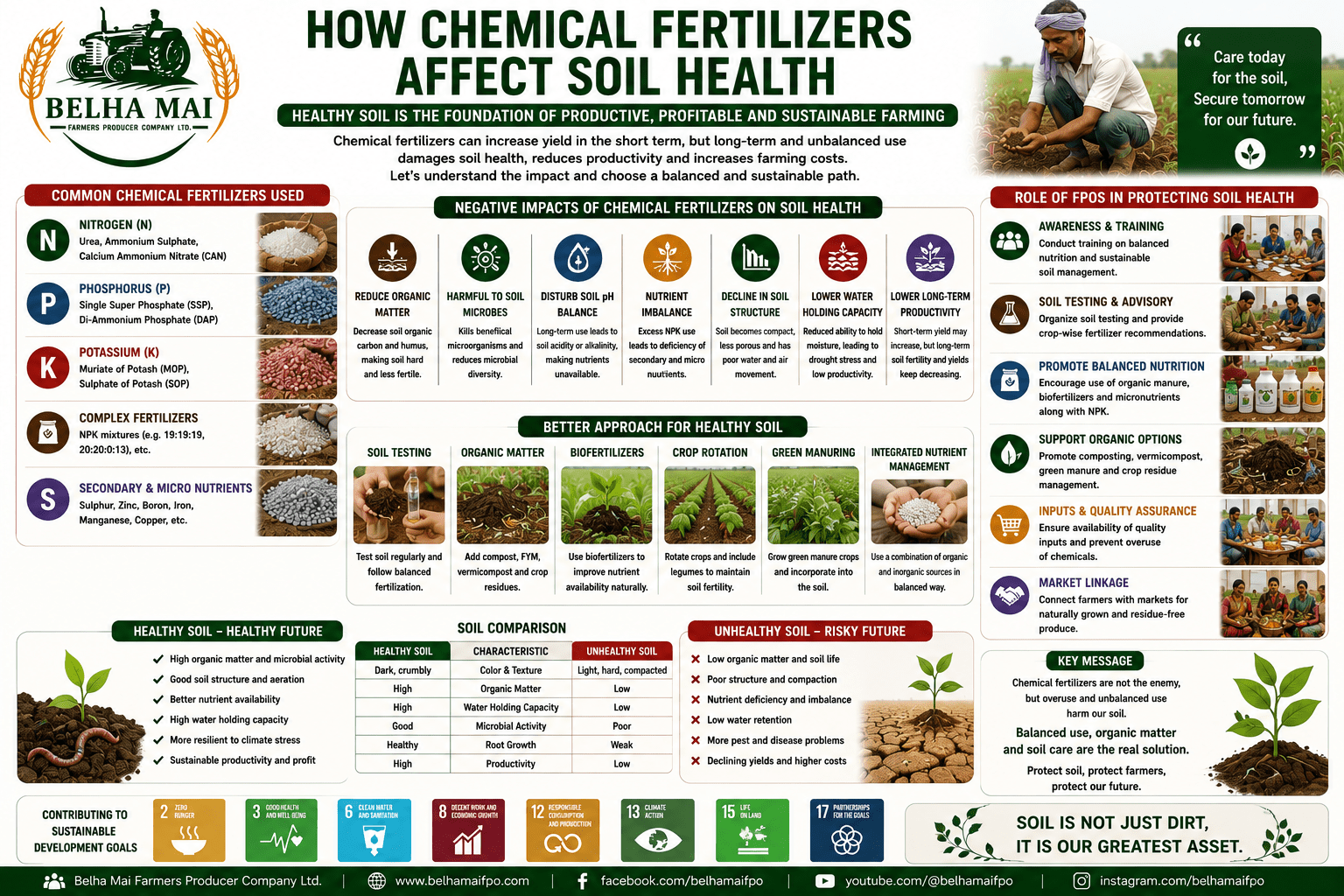
Chemical fertilizers provide nutrients such as nitrogen, phosphorus, and potassium. These nutrients are useful for crop growth when used in the right quantity and at the right time. But when used without balance, they can disturb soil quality and reduce natural fertility over time.
Farmers may see short-term yield benefits from fertilizers, but if soil health declines, farming becomes more expensive and risky. This is why fertilizer use must be linked with soil testing, organic matter, and long-term soil restoration.
How Chemical Fertilizers Affect Soil Health Through Nutrient Imbalance
Nutrient imbalance is one of the biggest problems caused by unbalanced fertilizer use. Many farmers focus heavily on nitrogen-based fertilizers while ignoring phosphorus, potassium, sulphur, zinc, boron, iron, and other micronutrients.
Crops need a balanced supply of nutrients. If one nutrient is overused and another is deficient, crop growth suffers. Farmers may continue applying more fertilizer, but the crop may not respond properly because the soil balance is disturbed.
Soil testing helps identify actual nutrient requirements. Balanced fertilizer use based on soil health reports can improve crop productivity and reduce unnecessary input costs.
How Chemical Fertilizers Affect Soil Health Through Declining Organic Matter
Chemical fertilizers provide nutrients, but they do not add organic matter to the soil. Organic matter is essential for soil structure, water retention, microbial activity, nutrient cycling, and long-term fertility.
When farmers depend only on chemical fertilizers and do not add compost, farmyard manure, green manure, crop residue, or organic inputs, soil organic matter can decline over time. This makes soil hard, less fertile, and less capable of holding water.
Restoring organic matter is necessary for healthy soil. Fertilizers should be used with organic matter, not as a replacement for it.
How Chemical Fertilizers Affect Soil Health Through Soil Microbes
Healthy soil contains millions of beneficial microorganisms. These microbes help decompose organic matter, release nutrients, improve soil structure, and support plant health.
Excessive use of chemical fertilizers, especially without organic matter, can disturb microbial balance. Soil microbes need organic material and a suitable environment to survive. If soil becomes chemically stressed, dry, compacted, or low in organic carbon, microbial activity declines.
When microbial life reduces, soil becomes less naturally fertile. Farmers may then need more external inputs to maintain production. This increases cost and reduces sustainability.
How Chemical Fertilizers Affect Soil Health Through Soil pH Changes
Soil pH affects nutrient availability. Some fertilizers, when used continuously and excessively, can increase soil acidity or alkalinity depending on soil type, fertilizer type, irrigation water, and local conditions.
If soil becomes too acidic or too alkaline, important nutrients may become unavailable to crops even when they are present in the soil. This can cause deficiency symptoms and reduce yield.
Regular soil testing is essential to monitor pH. Corrective measures such as organic matter addition, balanced fertilization, gypsum, lime, or other soil amendments should be used only with expert guidance and soil reports.
How Chemical Fertilizers Affect Soil Health Through Lower Water-Holding Capacity
Soil with low organic matter cannot hold water properly. Chemical fertilizers alone cannot improve water retention. When soil organic matter declines, water drains away quickly or evaporates faster.
Poor water-holding capacity increases drought stress. Farmers may need more irrigation, and crops may suffer during dry spells. This becomes a major problem under climate change and irregular rainfall.
Organic matter, compost, mulching, crop residue, and soil cover can improve water retention. Balanced fertilizer use must be combined with soil organic carbon improvement.
How Chemical Fertilizers Affect Soil Health Through Soil Structure Decline
Soil structure affects root growth, water movement, air circulation, and microbial activity. Healthy soil should be crumbly, porous, and biologically active.
Excessive chemical fertilizer use without organic matter can weaken soil structure over time. Soil may become compacted, crusted, or less porous. This reduces root growth and water infiltration.
Good soil structure can be restored through compost, farmyard manure, crop rotation, green manuring, reduced excessive tillage, and better residue management.
How Chemical Fertilizers Affect Soil Health Through Increased Input Dependency
When soil health declines, farmers often become more dependent on fertilizers and pesticides. The crop may need higher input doses to produce the same yield because natural soil fertility becomes weak.
This increases the cost of cultivation. Farmers may spend more every season but receive lower net profit. Over time, farming becomes less sustainable.
The solution is to rebuild soil fertility. Farmers should use fertilizers scientifically while improving organic matter, microbial life, and natural nutrient cycling.
How Chemical Fertilizers Affect Soil Health Through Reduced Long-Term Productivity
Chemical fertilizers can increase yield in the short term when used correctly. But long-term productivity depends on soil health. If soil structure, organic matter, microbes, and nutrient balance decline, productivity may become unstable.
Farmers may notice that the same field gives lower response despite higher input use. This is a warning sign of soil fatigue and declining soil health.
Long-term productivity requires integrated nutrient management, soil testing, organic matter addition, crop rotation, and responsible input use.
How Chemical Fertilizers Affect Soil Health Through Secondary and Micronutrient Deficiency
Many farmers apply major fertilizers but ignore secondary nutrients and micronutrients. Over time, crops may suffer from deficiencies of sulphur, zinc, boron, iron, manganese, copper, and other nutrients.
Micronutrient deficiency can reduce crop quality, yield, and plant health. It may also affect human nutrition when food crops lack important minerals.
Soil testing and balanced nutrition are necessary to identify these deficiencies. FPOs can help farmers understand micronutrient management through training and advisory.
How Chemical Fertilizers Affect Soil Health Through Salt Accumulation
In some conditions, repeated use of fertilizers along with poor irrigation water and poor drainage can contribute to salt accumulation in soil. This can affect seed germination, root growth, nutrient uptake, and crop productivity.
Salinity problems are more common where irrigation water quality is poor or drainage is weak. Fertilizer misuse can worsen such problems.
Good water management, drainage, soil testing, organic matter addition, and crop selection are important for managing salt-related soil problems.
How Chemical Fertilizers Affect Soil Health Through Environmental Pressure
Unbalanced fertilizer use can also affect the environment beyond the field. Excess nutrients may leach into groundwater or run off into water bodies. This can create pollution and reduce resource quality.
Nitrogen losses can also contribute to environmental concerns. Farmers lose money when nutrients are wasted instead of being used by crops.
Efficient fertilizer use helps both farmers and the environment. Applying the right nutrient, in the right dose, at the right time, and in the right way is essential.
Chemical Fertilizers Are Not the Enemy
It is important to understand that chemical fertilizers are not the enemy. They can be useful tools when used responsibly. The problem is excessive, unbalanced, and repeated use without soil testing or organic matter.
Farmers need nutrients to grow crops. In many cases, chemical fertilizers are part of modern agriculture. But they should be used scientifically and combined with organic inputs, biofertilizers, compost, crop rotation, and soil health practices.
The right approach is balance. Fertilizers should support soil health, not replace soil health.
Need for Soil Testing Before Fertilizer Use
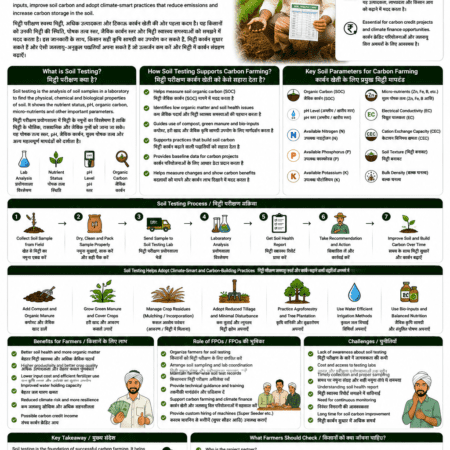
Soil testing is the first step toward responsible fertilizer use. Without soil testing, farmers may not know what their soil actually needs. This leads to overuse of some nutrients and neglect of others.
A soil test report can show pH, organic carbon, major nutrients, micronutrients, and other soil conditions. Based on this, farmers can apply fertilizers more accurately.
FPOs can organize soil testing campaigns and help farmers understand reports. Soil testing should become a regular practice, not a one-time activity.
Balanced Fertilization for Soil Health
Balanced fertilization means applying nutrients according to crop requirement and soil condition. It includes proper use of nitrogen, phosphorus, potassium, secondary nutrients, and micronutrients.
Balanced fertilization improves crop response and reduces waste. It also prevents nutrient imbalance and protects long-term soil productivity.
Farmers should avoid using fertilizers blindly. They should follow soil test-based recommendations and expert advisory.
Integrated Nutrient Management
Integrated nutrient management is one of the best approaches for protecting soil health. It combines chemical fertilizers, organic manures, compost, biofertilizers, crop residues, green manure, and crop rotation.
This approach gives crops the nutrients they need while also improving soil organic matter and microbial life. It balances short-term productivity with long-term sustainability.
FPOs can promote integrated nutrient management through training, input supply, demonstration plots, and farmer advisory.
Role of Organic Matter in Reducing Fertilizer Damage
Organic matter can reduce the negative impact of fertilizer overuse by improving soil structure, buffering pH changes, increasing microbial activity, and improving nutrient retention.
Compost, farmyard manure, green manure, vermicompost, crop residues, and mulching are practical ways to increase organic matter.
Farmers should not depend only on fertilizers. Organic matter must be regularly returned to the soil to maintain fertility and resilience.
Role of Biofertilizers in Soil Health
Biofertilizers contain beneficial microorganisms that help improve nutrient availability. They can support nitrogen fixation, phosphorus solubilization, and better nutrient cycling.
Biofertilizers are not a complete replacement for all fertilizers, but they can reduce dependency and support soil health when used correctly.
FPOs can help farmers access quality biofertilizers and learn proper application methods. Quality control is important because poor-quality bio-inputs may not give results.
Role of Crop Rotation in Fertilizer Balance
Crop rotation helps maintain soil fertility and reduce nutrient depletion. Repeatedly growing the same crop can increase demand for specific nutrients and create imbalance.
Rotating crops with pulses, legumes, millets, oilseeds, green manure crops, and vegetables can improve soil health. Legumes are especially useful because they support nitrogen fixation.
FPOs can help farmers plan crop rotation based on soil condition, market demand, and local farming systems.
Role of Green Manuring
Green manuring helps restore soil fertility by adding fresh biomass and improving organic matter. Green manure crops are grown and incorporated into the soil before flowering or at a suitable stage.
This practice improves soil structure, microbial activity, and nutrient availability. It also reduces soil fatigue.
Farmers can use green manuring as part of integrated nutrient management. FPOs can support seed availability and training.
Role of Compost and Vermicompost
Compost and vermicompost are important for balancing the effects of chemical fertilizer use. They add organic matter, improve soil life, and support nutrient cycling.
Regular application of compost can improve soil fertility over time. Vermicompost can also be used for crop growth and soil restoration.
FPOs can support compost production units and create local livelihood opportunities around organic input preparation.
Role of Natural Farming Practices
Natural farming practices can help reduce chemical dependency and restore soil health. These practices use local resources, bio-inputs, compost, mulching, crop diversity, and ecological pest management.
Farmers can gradually adopt natural farming elements according to local conditions. Sudden change without training or market support may create risk.
FPOs can organize demonstrations and guide farmers through step-by-step adoption.
Role of FPOs in Promoting Responsible Fertilizer Use
FPOs can play a major role in helping farmers use fertilizers responsibly. They can provide soil testing, training, advisory, quality inputs, organic alternatives, bio-inputs, and market linkage for sustainably produced crops.
FPOs can also prevent overuse by guiding farmers toward crop-specific and soil-specific nutrient management. They can help farmers understand that more fertilizer does not always mean more yield.
Responsible input use improves farmer income and protects soil for future generations.
FPO-Led Soil Health Campaigns
FPOs can organize soil health campaigns in villages. These campaigns can include farmer meetings, soil sample collection, expert training, demonstration plots, composting awareness, and balanced fertilizer advisory.
Such campaigns help farmers see soil health as a business issue, not only an environmental issue. Healthy soil means lower cost and better productivity.
A strong FPO can become a local soil health knowledge center for farmers.
Chemical Fertilizers and Farmer Income
Unbalanced fertilizer use can reduce farmer income by increasing input costs and reducing long-term productivity. Farmers may spend more but not receive proportionate yield benefits.
Balanced fertilizer use can improve income by reducing waste, improving crop response, and protecting soil health. The goal is not simply to reduce fertilizer use, but to use fertilizers wisely.
Farmer income improves when soil health, input efficiency, productivity, and market access work together.
Chemical Fertilizers and Food Security
Chemical fertilizers have helped increase food production, but food security cannot depend only on increasing fertilizer use. Long-term food security requires healthy soil.
If soil health declines, future production becomes risky. India needs both productivity and sustainability.
Balanced nutrient management, organic matter restoration, soil testing, and responsible fertilizer use are essential for maintaining food security.
Chemical Fertilizers and Sustainable Development Goals
Responsible fertilizer use is connected with Sustainable Development Goals. It supports SDG 2 Zero Hunger, SDG 3 Good Health, SDG 6 Clean Water, SDG 8 Decent Work, SDG 12 Responsible Production, SDG 13 Climate Action, SDG 15 Life on Land, and SDG 17 Partnerships.
When farmers use fertilizers wisely and protect soil health, agriculture becomes more sustainable. This supports both rural livelihoods and environmental protection.
FPOs can help connect soil health action with SDG-based rural development.
Belha Mai FPO and Soil Health Awareness
Belha Mai Farmers Producer Company Ltd. recognizes that soil health is essential for farmer prosperity, sustainable agriculture, and rural development. Farmers need access to the right information, quality inputs, soil testing, and balanced advisory.
Through FPO-led awareness, input services, farm support, training, value addition, and partnerships, farmers can move toward more responsible and sustainable soil management.
For Belha Mai FPO, protecting soil health means protecting farmer income, food security, and the future of rural agriculture.
Why Balanced Fertilizer Use Matters for India’s Future
India’s future agriculture must remain productive, profitable, and sustainable. Chemical fertilizers will continue to play a role, but their use must become more scientific and balanced.
Farmers need to shift from quantity-based input use to knowledge-based nutrient management. This means soil testing, crop-specific recommendations, organic matter addition, bio-inputs, and responsible application.
Balanced fertilizer use protects soil, saves money, improves crop response, and supports long-term national food security.
Conclusion
How Chemical Fertilizers Affect Soil Health can be understood through one clear message: fertilizers can support crops, but they cannot replace healthy soil. Excessive and unbalanced use can reduce organic matter, disturb microbes, change pH, create nutrient imbalance, lower water retention, and reduce long-term productivity.
The solution is balanced and scientific fertilizer use along with soil testing, compost, organic matter, biofertilizers, crop rotation, green manuring, and integrated nutrient management.
For Belha Mai Farmers Producer Company Ltd., soil health awareness is a key part of sustainable agriculture. Protecting soil means protecting farmers, protecting food security, and protecting the future.
FAQ
How Chemical Fertilizers Affect Soil Health?
Chemical fertilizers affect soil health when used excessively or without balance. They can reduce organic matter, disturb soil microbes, change soil pH, create nutrient imbalance, reduce water retention, weaken soil structure, and lower long-term productivity.
Are chemical fertilizers always harmful for soil?
No. Chemical fertilizers are not always harmful. They can support crop growth when used in the right quantity and based on soil testing. The problem is excessive, repeated, and unbalanced use without organic matter or soil health management.
How can farmers use chemical fertilizers safely?
Farmers can use chemical fertilizers safely by doing soil testing, following crop-specific recommendations, using balanced nutrients, adding compost and organic matter, using biofertilizers, rotating crops, and avoiding unnecessary overuse.
Why is soil testing important before fertilizer use?
Soil testing is important because it shows nutrient levels, pH, organic carbon, and soil condition. It helps farmers apply the right fertilizer in the right quantity and reduces wasteful input cost.
How can FPOs help farmers with fertilizer management?
FPOs can help farmers by organizing soil testing, providing advisory, supplying quality inputs, promoting balanced fertilization, supporting organic inputs, arranging training, and encouraging integrated nutrient management.
Why should CSR organizations support soil health and fertilizer awareness?
CSR organizations should support soil health and fertilizer awareness because it improves farmer income, reduces input waste, protects natural resources, supports food security, and promotes sustainable agriculture.
Internal Links Section
👉 SDG Goals — https://belhamaifpo.com/sdg-goals/
👉 Farmer Producer Organizations Complete Guide —https://belhamaifpo.com/farmer-producer-organisation/farmer-producer-organizations-fpos/
👉 Soil Health Challenges in Indian Agriculture —https://belhamaifpo.com/sdg-goals/soil-health-challenges-in-indian-agriculture/
👉 Importance of Organic Farming in Soil Restoration —https://belhamaifpo.com/sdg-goals/importance-of-organic-farming-in-soil-restoration/
👉 Why FPOs are Key to Sustainable Agriculture —https://belhamaifpo.com/sdg-goals/why-fpos-are-key-to-sustainable-agriculture/
👉 Linking Local Farming Practices to Global Development Goals — https://belhamaifpo.com/sdg-goals/linking-local-farming-practices-to-global-development-goals/
👉 How Agriculture Can Reduce Rural Poverty in India —https://belhamaifpo.com/sdg-goals/how-agriculture-can-reduce-rural-poverty-in-india/
👉 Impact of Mechanisation on Farmer Livelihoods — https://belhamaifpo.com/sdg-goals/impact-of-mechanisation-on-farmer-livelihoods/
👉 Role of Collective Farming in Increasing Farmer Income —https://belhamaifpo.com/sdg-goals/role-of-collective-farming-in-increasing-farmer-income/
👉 Farm Machinery Bank — https://belhamaifpo.com/farm-machinery-bank/
👉 Belha Mai FPO — https://belhamaifpo.com/
External Authority Links
👉 Soil Health Card Scheme — https://soilhealth.dac.gov.in/
👉 Ministry of Agriculture and Farmers Welfare — https://agriwelfare.gov.in/
👉 Indian Council of Agricultural Research — https://icar.org.in/
👉 National Centre of Organic and Natural Farming — https://nconf.dac.gov.in/
👉 United Nations Sustainable Development Goals — https://sdgs.un.org/goals
👉 National Bank for Agriculture and Rural Development — https://www.nabard.org/
👉 Small Farmers’ Agribusiness Consortium — https://sfacindia.com/
Follow Belha Mai FPO for More Updates
Website: https://belhamaifpo.com/
Facebook: https://www.facebook.com/profile.php?id=61561043486818
YouTube: https://www.youtube.com/channel/UC9ZvojoTMCa7mU1-Q_Bh60A
LinkedIn: https://www.linkedin.com/in/abhay-singh-ab5568280/
Instagram: https://instagram.com/belhamaifpo
Belha Mai Farmers Producer Company Ltd. supports farmers through better information, technology, market linkage, value addition, FPO awareness, rural development, women empowerment, soil health, organic farming, and sustainable agriculture.