Introduction
Impact of Mechanisation on Farmer Livelihoods is an important topic for modern agriculture, farmer income, rural development, climate resilience, and sustainable farming. Agriculture is changing rapidly, and farmers need better tools to manage rising labour costs, time-sensitive operations, climate uncertainty, and productivity challenges.
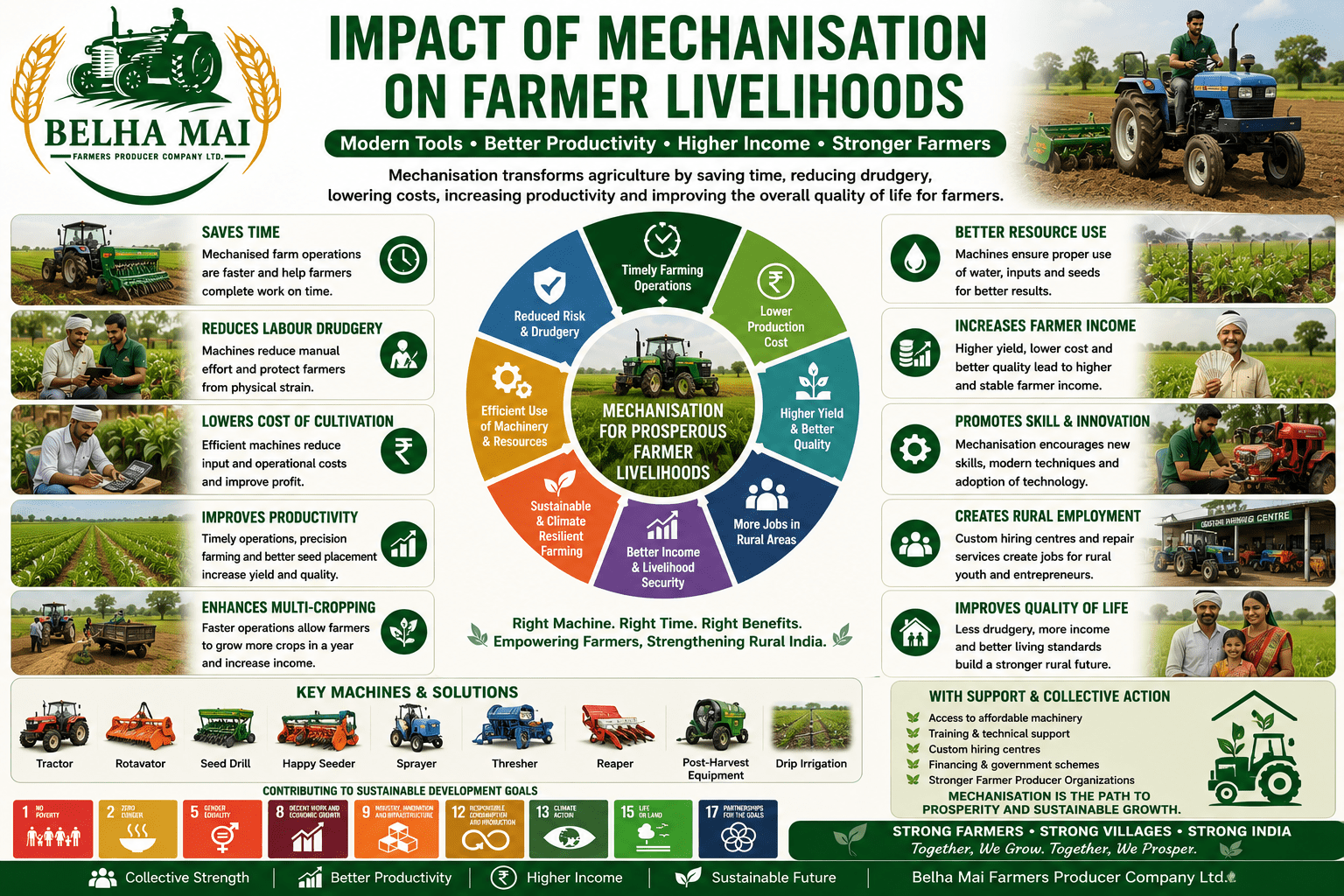
Mechanisation means the use of machines, tools, and equipment in farming activities such as land preparation, sowing, irrigation, spraying, harvesting, threshing, residue management, transport, and post-harvest handling. For farmers, mechanisation is not only about machines. It is about saving time, reducing physical labour, improving efficiency, increasing productivity, and improving livelihood security.
Small and marginal farmers often cannot afford expensive machinery individually. This is where Farmer Producer Organizations, custom hiring centres, and Farm Machinery Banks can play a major role. Through shared machinery services, mechanisation can become affordable and accessible for small farmers.
Impact of Mechanisation on Farmer Livelihoods Through Time Saving
Impact of Mechanisation on Farmer Livelihoods begins with time saving. Agriculture is highly time-sensitive. Sowing, irrigation, spraying, harvesting, and post-harvest activities must often be completed within a short period.
Machines help farmers complete work faster. A task that may take several days through manual labour can sometimes be completed in a few hours with the right machine. This is especially important during peak farming seasons when labour is limited and weather conditions can change quickly.
Time saving helps farmers manage crops better. Timely sowing and harvesting can improve crop performance, reduce losses, and increase income. Therefore, mechanisation directly supports livelihood improvement.
Impact of Mechanisation on Farmer Livelihoods Through Reduced Labour Burden
Farming requires hard physical labour. Activities such as ploughing, sowing, weeding, spraying, harvesting, threshing, and loading can be physically demanding. This burden is especially heavy for small farmers, women, elderly farmers, and landless workers involved in farm operations.
Mechanisation reduces labour drudgery by replacing or supporting manual work. Machines reduce physical strain and allow farmers to complete operations with less effort.
Reducing labour burden improves quality of life. Farmers can manage larger areas more efficiently, reduce health strain, and use their time for other productive activities such as livestock, processing, marketing, or income diversification.
Impact of Mechanisation on Farmer Livelihoods Through Lower Cultivation Costs
Labour cost is rising in many rural areas. When labour is unavailable or expensive, farmers face delays and higher production costs. Mechanisation can reduce the cost of cultivation by making farm operations faster and more efficient.
Machines can reduce repeated manual work, improve input application, save fuel and water when used properly, and reduce crop losses. Shared machinery services can further reduce the burden because farmers do not need to purchase costly machines individually.
Lower cost of cultivation increases net farmer income. Even if market prices remain the same, farmers can earn more when production costs are reduced. This makes mechanisation an important tool for livelihood improvement.
Impact of Mechanisation on Farmer Livelihoods Through Better Productivity
Mechanisation can improve productivity by ensuring timely and precise farm operations. Proper land preparation, seed placement, irrigation, spraying, and harvesting can all improve crop performance.
Machines such as seed drills, planters, sprayers, rotavators, harvesters, threshers, and irrigation equipment help farmers complete operations with better uniformity and accuracy. This can improve crop stand, reduce wastage, and enhance yield quality.
Better productivity means more output from the same land. For small farmers, this is very important because landholding size is limited. Mechanisation helps them use their land more efficiently.
Impact of Mechanisation on Farmer Livelihoods Through Timely Farm Operations
Timeliness is one of the biggest advantages of mechanisation. Delayed sowing, delayed harvesting, delayed spraying, or delayed irrigation can reduce yield and increase crop risk.
Machines allow farmers to complete farm operations at the right time. For example, timely sowing can help crops use soil moisture better. Timely harvesting can reduce losses from weather, pests, and shattering. Timely spraying can control pests before they spread.
Timely operations improve both productivity and income stability. This is why mechanisation has a strong impact on farmer livelihoods.
Impact of Mechanisation on Farmer Livelihoods Through Improved Resource Use
Mechanisation can help farmers use resources more efficiently. Proper machines can improve seed placement, fertilizer application, irrigation, spraying, and residue management.
Efficient machinery can reduce wastage of seeds, water, fertilizers, pesticides, and labour. This lowers cost and reduces environmental stress. It also supports sustainable agriculture when machines are used responsibly.
Better resource use means better profitability. Farmers benefit because they spend less and produce more effectively. This connects mechanisation with both income improvement and sustainability.
Impact of Mechanisation on Farmer Livelihoods Through Shared Machinery Access
Small farmers often cannot buy tractors, seed drills, Super Seeders, sprayers, harvesters, threshers, or other machines because the cost is too high. Shared machinery access solves this challenge.
FPOs and Farm Machinery Banks can provide machinery on a rental or service basis. Farmers can use machines when needed without making heavy investment. This makes mechanisation inclusive.
Shared machinery access is one of the most practical ways to improve farmer livelihoods. It helps small farmers receive the benefits of modern equipment while keeping costs manageable.
Impact of Mechanisation on Farmer Livelihoods Through Farm Machinery Banks
Farm Machinery Banks are important for rural mechanisation. A Farm Machinery Bank keeps different machines that farmers can use on rent. It may be managed by an FPO, cooperative, entrepreneur, or community institution.
Such machinery banks can include tractors, rotavators, seed drills, sprayers, threshers, reapers, Super Seeders, Direct Seeded Rice machines, and other equipment depending on local farming needs.
Farm Machinery Banks create access, reduce cost, improve timely operations, and support local employment. They are especially useful for small and marginal farmers who cannot afford individual ownership.
Impact of Mechanisation on Farmer Livelihoods Through Reduced Crop Losses
Crop losses can happen due to delayed harvesting, poor handling, labour shortage, weather changes, pest attack, and inefficient post-harvest practices. Mechanisation can help reduce these losses.
Harvesters, threshers, dryers, grading machines, transport equipment, and post-harvest tools can improve crop handling and reduce wastage. Faster operations help farmers protect produce from sudden rain, over-maturity, pests, and quality decline.
Reduced crop loss means more marketable produce. More marketable produce means better income. This is another strong impact of mechanisation on farmer livelihoods.
Impact of Mechanisation on Farmer Livelihoods Through Multi-Cropping
Mechanisation can help farmers grow more than one crop in a year by reducing the time required between harvesting one crop and sowing the next crop. This is important for increasing farm income.
When machines complete land preparation and sowing quickly, farmers can use the available season more efficiently. Timely operations make multi-cropping and crop diversification more practical.
Multi-cropping can increase income from the same land. It can also reduce risk because farmers are not dependent on a single crop. Mechanisation supports this transition.
Impact of Mechanisation on Farmer Livelihoods Through Climate Resilience
Climate change has made farming more uncertain. Farmers face irregular rainfall, heat stress, shorter sowing windows, sudden weather events, and pest problems. Mechanisation can help farmers respond faster to climate risks.
When weather windows are short, machines allow farmers to sow, spray, irrigate, or harvest quickly. Some machines also support conservation agriculture and residue management.
For example, machines used for direct sowing or residue management can support climate-smart agriculture. Mechanisation can therefore help farmers adapt to changing climate conditions.
Impact of Mechanisation on Farmer Livelihoods Through Residue Management
Crop residue management is an important issue in agriculture. Burning crop residue harms soil health, air quality, and the environment. Farmers often burn residue because they lack affordable alternatives.
Machines such as Super Seeders, Happy Seeders, straw management systems, and mulchers can help manage crop residue without burning. These machines allow farmers to prepare fields and sow crops while managing residues more responsibly.
Residue management improves soil organic matter, reduces pollution, and supports sustainable farming. FPO-led access to such machines can create major environmental and livelihood benefits.
Impact of Mechanisation on Farmer Livelihoods Through Better Soil Health
Mechanisation can support soil health when the right machines are used properly. Conservation tillage, residue management, precision sowing, and balanced input application can improve long-term soil productivity.
Machines that reduce excessive tillage, manage residues, and improve seed placement can protect soil structure and reduce erosion. Responsible mechanisation can also support efficient water and fertilizer use.
Healthy soil supports better yields and stable farmer income. Therefore, mechanisation should be linked with sustainable soil management, not only speed and power.
Impact of Mechanisation on Farmer Livelihoods Through Women Empowerment
Women contribute significantly to agriculture, but they often carry a heavy burden of manual farm work. Mechanisation can reduce drudgery for women by making difficult tasks easier and faster.
Tools for weeding, harvesting, threshing, processing, carrying, and post-harvest handling can reduce physical strain on women. Mechanisation can also create new roles for women in machine-based processing, packaging, quality control, and enterprise activities.
When women’s workload reduces and income opportunities increase, household welfare improves. Mechanisation can therefore contribute to gender-inclusive rural development.
Impact of Mechanisation on Farmer Livelihoods Through Rural Employment
Mechanisation does not only replace labour; it can also create new types of rural employment. Machines require operators, mechanics, service providers, booking coordinators, fuel suppliers, transporters, trainers, and maintenance workers.
Farm Machinery Banks and custom hiring centres can create jobs for rural youth. Young people can work as machine operators, service managers, technicians, or agri-service entrepreneurs.
This creates skilled employment in villages. Mechanisation can help rural youth remain connected with agriculture while earning income through modern services.
Impact of Mechanisation on Farmer Livelihoods Through Skill Development
Mechanisation requires skill. Farmers and rural youth need training to operate, maintain, and manage machines properly. Without training, machines may not deliver full benefits.
Skill development in mechanisation includes machine operation, safety, repair, maintenance, fuel efficiency, field calibration, service scheduling, and business management.
Training creates better employment and better machine performance. It also helps farmers use technology responsibly. FPOs can play an important role in organizing such training.
Impact of Mechanisation on Farmer Livelihoods Through FPOs
FPOs can make mechanisation more accessible and farmer-friendly. They can identify local machinery needs, create Farm Machinery Banks, manage rental services, coordinate bookings, train operators, and provide affordable services to members.
FPO-led mechanisation is especially useful because the institution already works with farmers. It understands cropping patterns, village needs, farmer affordability, and seasonal demand.
Through FPOs, mechanisation becomes a community asset rather than an individual luxury. This helps small and marginal farmers benefit from modern agricultural technology.
Impact of Mechanisation on Farmer Livelihoods Through Better Market Readiness
Mechanisation can also improve market readiness. Timely harvesting, cleaning, grading, drying, transport, and post-harvest handling improve product quality.
Better quality produce can receive better prices. It can also meet buyer expectations for institutional supply, processing units, retail chains, and export-oriented markets.
Mechanisation therefore supports not only production but also market linkage. Better market readiness improves farmer income and livelihood security.
Impact of Mechanisation on Farmer Livelihoods Through Post-Harvest Handling
Post-harvest losses reduce farmer income. Mechanised post-harvest tools can help in threshing, drying, cleaning, grading, packaging, and transport.
Post-harvest mechanisation improves efficiency and reduces wastage. It also supports value addition and processing. Rural workers can be trained for machine-based post-harvest activities.
This creates employment and improves farmer income. It also strengthens rural supply chains.
Impact of Mechanisation on Farmer Livelihoods Through Sustainable Agriculture
Mechanisation can support sustainable agriculture when machines are used for conservation, precision, resource efficiency, and timely operations. It should not be seen only as heavy machinery or increased fuel use.
Responsible mechanisation can reduce residue burning, save water, improve input efficiency, reduce losses, and support climate-resilient farming. It can also make sustainable practices easier to adopt.
The key is choosing the right machine for the right crop, soil, and farming system. FPOs can guide farmers in this direction.
Impact of Mechanisation on Farmer Livelihoods Through Financial Inclusion
Machines are expensive, and farmers need finance to access mechanisation. FPOs, banks, government schemes, CSR organizations, and development agencies can support machinery access through loans, subsidies, grants, and shared ownership models.
Financial support for mechanisation can help create Farm Machinery Banks, custom hiring centres, and rural service enterprises. This spreads the benefit across many farmers.
When finance is linked with shared machinery services, mechanisation becomes more inclusive and practical for small farmers.
Impact of Mechanisation on Farmer Livelihoods Through Partnerships
Mechanisation requires partnerships with government departments, banks, NABARD, SFAC, CSR organizations, equipment companies, training institutions, NGOs, and rural entrepreneurs.
Partnerships can bring machinery, training, finance, maintenance support, digital booking systems, and technical guidance. They can also help ensure that machines are used effectively.
For CSR and development agencies, supporting FPO-led mechanisation can create measurable impact in productivity, income, climate resilience, and rural employment.
Impact of Mechanisation on Farmer Livelihoods and SDGs
Mechanisation is connected with several Sustainable Development Goals. It supports SDG 1 through poverty reduction, SDG 2 through better agriculture, SDG 5 through reduced drudgery for women, SDG 8 through rural employment, SDG 9 through rural innovation, SDG 12 through responsible production, SDG 13 through climate action, and SDG 17 through partnerships.
When mechanisation is inclusive and sustainable, it becomes more than technology. It becomes a development tool.
FPO-led mechanisation can connect small farmers with modern agriculture while supporting long-term rural transformation.
Belha Mai FPO and Farm Mechanisation
Belha Mai Farmers Producer Company Ltd. is working to support farmers through collective action, input services, farm machinery, market linkage, value addition, women participation, digital outreach, and sustainable agriculture.
Farm mechanisation is an important part of this vision because it helps farmers save time, reduce labour burden, improve productivity, and manage farm operations more efficiently. Shared machinery access can help small farmers benefit from technology without purchasing costly machines individually.
For Belha Mai FPO, mechanisation is not only about machines. It is about stronger farmers, better income, sustainable farming, climate-conscious agriculture, and improved rural livelihoods.
Why Mechanisation Matters for India’s Rural Future
India’s agriculture must become more productive, efficient, sustainable, and farmer-friendly. Labour shortages, climate risks, rising costs, and small landholdings make mechanisation increasingly important.
However, mechanisation must be inclusive. Small farmers should not be left behind because they cannot afford machines. FPOs, custom hiring centres, and Farm Machinery Banks can solve this gap.
For India’s rural future, mechanisation can help farmers move from labour-intensive struggle to efficient, income-oriented, and sustainable agriculture.
Conclusion
Impact of Mechanisation on Farmer Livelihoods can be understood through one simple idea: the right machine at the right time can change a farmer’s income and quality of life. Mechanisation saves time, reduces labour burden, lowers cost, improves productivity, supports timely operations, reduces losses, and creates rural employment.
FPO-led mechanisation makes these benefits accessible to small and marginal farmers. Shared machinery services can help farmers use modern technology without heavy investment.
For Belha Mai Farmers Producer Company Ltd., mechanisation represents a practical pathway toward better farmer income, sustainable agriculture, climate resilience, and stronger rural livelihoods.
FAQ
What is the Impact of Mechanisation on Farmer Livelihoods?
The impact of mechanisation on farmer livelihoods includes time saving, reduced labour burden, lower cultivation costs, better productivity, timely farming operations, reduced crop losses, higher income, and improved quality of life.
How does mechanisation increase farmer income?
Mechanisation increases farmer income by reducing labour cost, improving productivity, saving time, reducing crop losses, improving resource use, and helping farmers complete farm operations at the right time.
Can small farmers benefit from mechanisation?
Yes. Small farmers can benefit from mechanisation through shared machinery services, Farm Machinery Banks, custom hiring centres, and FPO-led machinery access.
How do FPOs support farm mechanisation?
FPOs support farm mechanisation by creating machinery banks, offering rental services, coordinating machine use, training operators, and helping farmers access modern equipment at affordable rates.
Does mechanisation create rural employment?
Yes. Mechanisation creates rural employment for machine operators, mechanics, service providers, booking coordinators, trainers, transport workers, and agri-service entrepreneurs.
Why should CSR organizations support farm mechanisation?
CSR organizations should support farm mechanisation because it improves farmer income, reduces drudgery, supports climate-smart agriculture, creates rural employment, and helps small farmers access modern technology.
Internal Links Section
👉 SDG Goals — https://belhamaifpo.com/sdg-goals/
👉 Farmer Producer Organizations Complete Guide — https://belhamaifpo.com/farmer-producer-organisation/farmer-producer-organizations-fpos/
👉 How Agro-Processing Creates Rural Employment — https://belhamaifpo.com/sdg-goals/how-agro-processing-creates-rural-employment/
👉 Role of Collective Farming in Increasing Farmer Income —https://belhamaifpo.com/sdg-goals/role-of-collective-farming-in-increasing-farmer-income/
👉 How Agriculture Can Reduce Rural Poverty in India — https://belhamaifpo.com/sdg-goals/how-agriculture-can-reduce-rural-poverty-in-india/
👉 Why FPOs are Key to Sustainable Agriculture — https://belhamaifpo.com/sdg-goals/why-fpos-are-key-to-sustainable-agriculture/
👉 Role of FPOs in Achieving Rural Development in India — https://belhamaifpo.com/sdg-goals/role-of-fpos-in-achieving-rural-development-in-india/
👉 How Grassroots Institutions Drive Sustainable Change —https://belhamaifpo.com/sdg-goals/how-grassroots-institutions-drive-sustainable-change/
👉 Farm Machinery Bank — https://belhamaifpo.com/farm-machinery-bank/
👉 Belha Mai FPO — https://belhamaifpo.com/
External Authority Links
👉 Ministry of Agriculture and Farmers Welfare — https://agriwelfare.gov.in/
👉 Sub-Mission on Agricultural Mechanization — https://agrimachinery.nic.in/
👉 Small Farmers’ Agribusiness Consortium — https://sfacindia.com/
👉 National Bank for Agriculture and Rural Development — https://www.nabard.org/
👉 United Nations Sustainable Development Goals — https://sdgs.un.org/goals
👉 NITI Aayog SDG India Index — https://www.niti.gov.in/sdg-india-index
Follow Belha Mai FPO for More Updates
Website: https://belhamaifpo.com/
Facebook: https://www.facebook.com/profile.php?id=61561043486818
YouTube: https://www.youtube.com/channel/UC9ZvojoTMCa7mU1-Q_Bh60A
LinkedIn: https://www.linkedin.com/in/abhay-singh-ab5568280/
Instagram: https://instagram.com/belhamaifpo
Belha Mai Farmers Producer Company Ltd. supports farmers through better information, technology, market linkage, value addition, FPO awareness, rural development, and sustainable agriculture.