Introduction
How Agriculture Can Reduce Rural Poverty in India is one of the most important questions for rural development, sustainable livelihoods, and national economic growth. Agriculture is not only a source of food production. It is also the main livelihood base for millions of rural families. When agriculture becomes profitable, organized, sustainable, and market-linked, it can become a powerful tool for reducing rural poverty.
Rural poverty is closely connected with low farm income, small landholdings, high input costs, poor market access, lack of local employment, limited processing, weak infrastructure, and climate risk. Many rural families work hard, but they do not receive enough income because most of the value in agriculture moves away from the farmer.
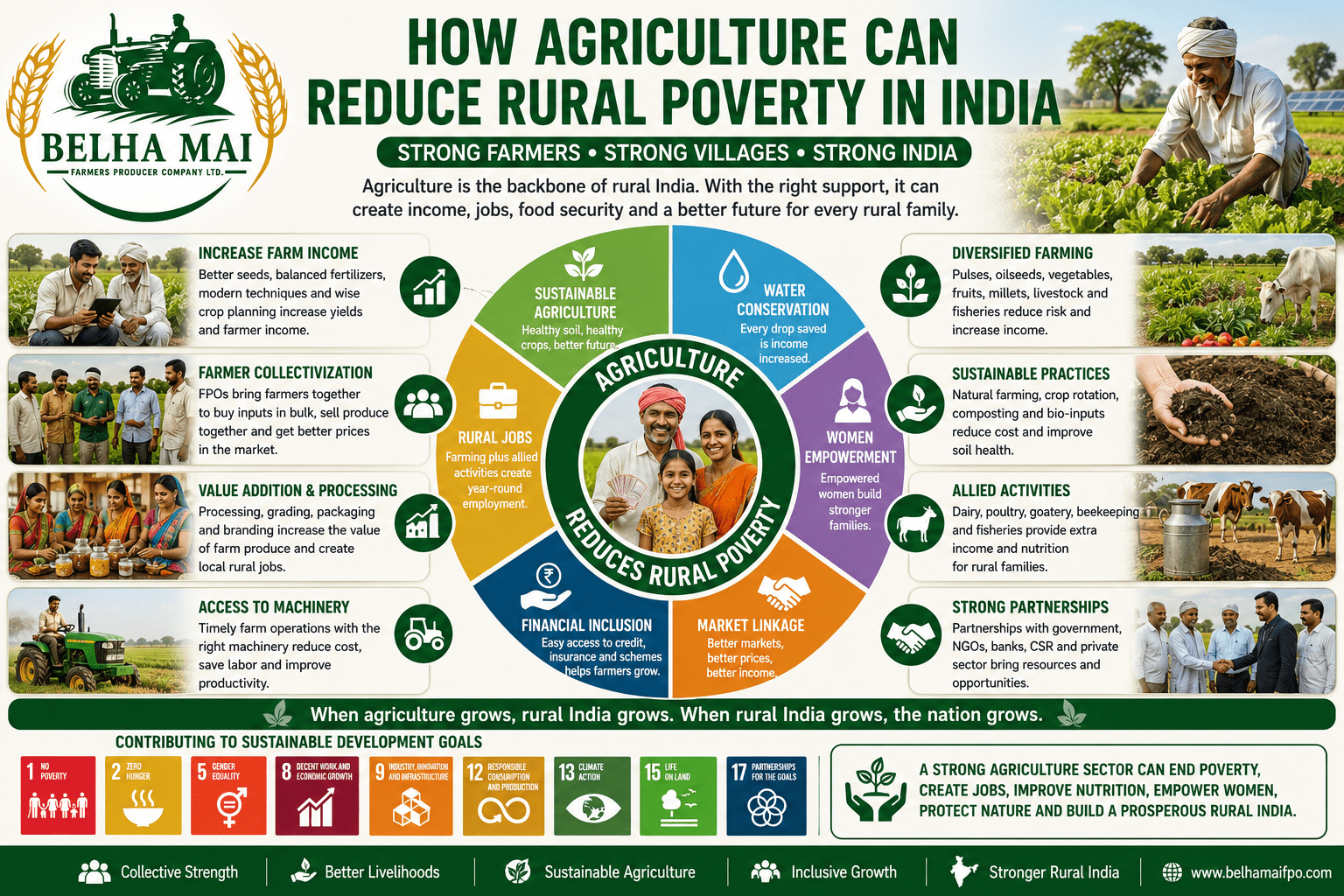
Agriculture can reduce rural poverty in India when farmers are supported with better technology, better prices, collective institutions, farm services, value addition, storage, processing, women participation, financial inclusion, and sustainable farming practices. Farmer Producer Organizations can play an important role in making this transformation practical at the grassroots level.
How Agriculture Can Reduce Rural Poverty in India Through Better Farmer Income
How Agriculture Can Reduce Rural Poverty in India begins with better farmer income. If farmers earn more from their crops, livestock, horticulture, beekeeping, fisheries, agroforestry, and value-added products, rural poverty can reduce directly.
Farmer income can improve through higher productivity, better crop planning, lower input costs, better quality produce, market linkage, storage, processing, and direct buyer connections. When farmers receive fair value for their work, rural households become more stable.
Better income supports education, health, nutrition, household savings, farm reinvestment, and debt reduction. This is why agriculture must be treated not only as a production activity, but also as an income-generating rural enterprise.
How Agriculture Can Reduce Rural Poverty in India Through Lower Input Costs
High input cost is one of the major reasons farmers remain poor. Seeds, fertilizers, pesticides, irrigation, labour, machinery, and transport can consume a large part of farmer income. If production costs are high and market prices are low, farmers may not earn enough even after a good harvest.
Agriculture can reduce rural poverty when farmers get access to quality inputs at reasonable prices. Balanced fertilizer use, soil testing, organic inputs, natural farming, bulk procurement, and shared farm services can reduce unnecessary expenses.
FPOs can help farmers reduce input costs by arranging bulk input purchase, providing advisory support, promoting responsible input use, and creating shared services. Lower cost means higher net income for farming families.
How Agriculture Can Reduce Rural Poverty in India Through Sustainable Farming
Sustainable farming is essential for long-term poverty reduction. If farming damages soil, water, biodiversity, and climate resilience, farmers may face higher costs and lower productivity in the future. Short-term gains cannot solve long-term rural poverty.
Sustainable agriculture includes soil health management, crop rotation, organic matter improvement, natural farming, water conservation, agroforestry, balanced fertilizer use, integrated pest management, and climate-resilient farming.
When farmers protect natural resources, they protect their future income. Sustainable farming reduces risk, improves productivity, and supports long-term livelihood security. This makes it an important part of poverty reduction.
How Agriculture Can Reduce Rural Poverty in India Through Market Linkages
Many farmers remain poor because they do not get fair prices. They often sell produce to local traders immediately after harvest due to lack of storage, transport, price information, or buyer access. This results in distress selling.
Agriculture can reduce rural poverty when farmers are connected with better markets. These markets may include mandis, wholesalers, processors, retailers, institutional buyers, food companies, exporters, and direct consumers.
FPOs can aggregate produce, maintain quality, negotiate with buyers, arrange transport, and build long-term market relationships. Better market linkage improves price realization and strengthens rural income.
How Agriculture Can Reduce Rural Poverty in India Through Value Addition
Selling raw produce gives farmers limited income. Value addition helps farmers earn more from the same crop by converting it into processed, packaged, branded, or quality-graded products.
Value addition can include cleaning, grading, sorting, milling, dehydration, pulping, packaging, honey processing, fruit processing, flour production, millet products, spice processing, and branded food products.
When value addition happens near the village, more income remains in the rural economy. It also creates jobs for women, youth, machine operators, packaging workers, logistics providers, and marketing teams. This makes value addition a powerful poverty reduction tool.
How Agriculture Can Reduce Rural Poverty in India Through Rural Employment
Agriculture can reduce rural poverty when it creates year-round employment. Traditional farming is often seasonal, but agriculture-based enterprises can generate regular work throughout the year.
Rural employment can be created through input centers, farm machinery services, nurseries, livestock, beekeeping, fisheries, food processing, packaging units, storage centers, logistics, digital marketing, and rural retail.
When local employment increases, migration pressure reduces. Rural youth and women can earn closer to home. This strengthens families and improves village-level economic stability.
How Agriculture Can Reduce Rural Poverty in India Through Women Empowerment
Women play a major role in Indian agriculture. They work in sowing, weeding, harvesting, cleaning, grading, livestock care, seed preservation, processing, and post-harvest management. However, their contribution is often not formally recognized.
Agriculture can reduce rural poverty more effectively when women are included in training, decision-making, FPO membership, processing units, packaging activities, leadership roles, and income-generating enterprises.
Women’s income improves family welfare. It supports children’s education, nutrition, health, savings, and household stability. Therefore, women empowerment in agriculture is directly connected with rural poverty reduction.
How Agriculture Can Reduce Rural Poverty in India Through Farmer Collectivization
Small farmers often cannot access good markets, finance, machinery, storage, and processing individually. Their production volume is low and their bargaining power is weak. Farmer collectivization helps solve this problem.
Farmer Producer Organizations bring farmers together into a formal structure. Through collective action, farmers can buy inputs, access machinery, aggregate produce, negotiate prices, create value-added products, and connect with institutions.
Collectivization gives small farmers the strength of scale. It helps them participate in the larger agricultural economy and improves their ability to reduce poverty through organized farming.
How Agriculture Can Reduce Rural Poverty in India Through Diversified Farming
Dependence on one crop can increase risk. If the crop fails or prices fall, farmer income suffers. Diversified farming can reduce this risk and create multiple income streams.
Diversification may include horticulture, vegetables, pulses, millets, oilseeds, dairy, goatery, poultry, beekeeping, fisheries, agroforestry, medicinal plants, and value-added products.
When farmers earn from multiple sources, their income becomes more stable. Diversified agriculture supports nutrition, resilience, employment, and long-term poverty reduction.
How Agriculture Can Reduce Rural Poverty in India Through Allied Activities
Allied activities are very important for rural poverty reduction. Dairy, poultry, goatery, beekeeping, fisheries, mushroom cultivation, nursery development, and agroforestry can provide additional income beyond seasonal crop farming.
These activities are especially useful for small and marginal farmers because they can generate regular cash flow. They also create opportunities for women and youth.
FPOs can support allied activities through training, input supply, aggregation, processing, branding, and market linkage. This helps rural families build stronger livelihood systems.
How Agriculture Can Reduce Rural Poverty in India Through Farm Machinery Access
Modern farm machinery can improve efficiency, reduce labour burden, save time, and improve productivity. But small farmers often cannot afford expensive machines individually.
Agriculture can reduce rural poverty when farmers get access to shared machinery through FPOs, custom hiring centers, or farm machinery banks. Machines such as tractors, seed drills, Super Seeders, sprayers, rotavators, and harvest equipment can support timely farm operations.
Shared machinery services reduce cost and improve productivity. They also create local employment for operators, mechanics, coordinators, and service providers.
How Agriculture Can Reduce Rural Poverty in India Through Financial Inclusion
Farmers need finance for seeds, irrigation, livestock, machinery, processing, packaging, storage, and business expansion. Without access to formal finance, they may depend on informal credit or traders.
Agriculture can reduce rural poverty when farmers are linked with banks, credit schemes, insurance, working capital, government support, and financial literacy. FPOs can help farmers improve documentation and access institutional finance.
Financial inclusion gives farmers the ability to invest in productivity, diversification, and enterprise. It reduces dependence on exploitative borrowing and supports long-term economic stability.
How Agriculture Can Reduce Rural Poverty in India Through Government Scheme Access
India has many schemes for agriculture, horticulture, food processing, irrigation, farm mechanisation, storage, credit, training, and rural enterprise. But many farmers do not benefit fully because of lack of awareness or documentation challenges.
Agriculture can reduce rural poverty when these schemes reach the right farmers. Grassroots institutions such as FPOs can help farmers understand schemes, prepare documents, coordinate with departments, and access benefits.
Better scheme access improves productivity, reduces cost, creates infrastructure, and strengthens livelihoods. This makes last-mile delivery very important for rural poverty reduction.
How Agriculture Can Reduce Rural Poverty in India Through Food Processing
Food processing is one of the strongest ways agriculture can create rural prosperity. Processing converts raw produce into higher-value products and creates local jobs.
Processing activities can include milling, fruit processing, vegetable processing, honey processing, dehydration, pulping, grading, packaging, and branded food production. These activities improve shelf life, reduce wastage, and increase market value.
When processing units are established near production areas, farmers get better market opportunities and rural people get employment. This helps agriculture become a driver of local economic growth.
How Agriculture Can Reduce Rural Poverty in India Through Better Storage and Infrastructure
Lack of storage is a major reason farmers sell produce immediately at low prices. Without warehouses, cold rooms, packhouses, grading centers, and collection points, farmers cannot wait for better prices or serve larger buyers.
Agriculture can reduce rural poverty when rural infrastructure improves. Storage and aggregation facilities reduce wastage, improve quality, and increase bargaining power.
FPOs can create common infrastructure that benefits many farmers. Such infrastructure becomes a rural asset and supports long-term economic development.
How Agriculture Can Reduce Rural Poverty in India Through Climate Resilience
Climate change is increasing risks for farmers. Irregular rainfall, heat waves, droughts, floods, pest attacks, and crop failures can push rural families into poverty.
Agriculture can reduce rural poverty only when it becomes climate-resilient. Farmers need climate-smart practices such as crop diversification, water conservation, soil health improvement, agroforestry, weather advisory, and resilient crops.
FPOs can help farmers prepare for climate risks by sharing timely information, organizing training, and connecting them with climate-resilient technologies and practices.
How Agriculture Can Reduce Rural Poverty in India Through Youth Participation
Rural youth often move away from agriculture because they see it as low-income and uncertain. But agriculture can become attractive when it is linked with enterprise, technology, processing, branding, logistics, and digital markets.
Youth can participate in agri-services, farm machinery, e-commerce, food processing, digital advisory, market linkage, branding, accounting, packaging, and rural startups.
Agriculture can reduce rural poverty when youth see opportunity in rural enterprise. This creates new leadership and strengthens the future of villages.
How Agriculture Can Reduce Rural Poverty in India Through Partnerships
Agriculture needs partnerships to create large-scale poverty reduction. Farmers need support from government departments, banks, CSR organizations, NGOs, research institutions, universities, technology providers, processors, exporters, and buyers.
Partnerships can bring finance, infrastructure, knowledge, market access, training, quality systems, and business mentoring. FPOs can act as grassroots platforms for such partnerships.
When partnerships are connected with local farming communities, agricultural development becomes more practical and measurable. This is important for CSR and grant agencies looking for rural impact.
How Agriculture Can Reduce Rural Poverty in India and SDGs
Agriculture is closely connected with Sustainable Development Goals. It supports SDG 1 No Poverty, SDG 2 Zero Hunger, SDG 5 Gender Equality, SDG 8 Decent Work, SDG 12 Responsible Production, SDG 13 Climate Action, SDG 15 Life on Land, and SDG 17 Partnerships.
This means agricultural development is not only a national priority. It is also part of a global development vision. When agriculture improves rural livelihoods, it contributes to multiple development goals at the same time.
FPOs and grassroots institutions can help connect local agriculture with these larger goals by organizing farmers and building sustainable rural development models.
Belha Mai FPO and Agriculture-Led Poverty Reduction
Belha Mai Farmers Producer Company Ltd. is working to support farmers through collective strength, input services, farm machinery, market linkage, value addition, women participation, digital outreach, and sustainable agriculture.
The organization’s work reflects the idea that agriculture can reduce poverty when farmers receive better services, better markets, better knowledge, and better institutional support. Through FPO-led action, rural development becomes more organized and practical.
For Belha Mai FPO, agriculture is not only crop production. It is a pathway for farmer income, rural enterprise, women empowerment, sustainable livelihoods, and long-term village development.
Why Agriculture-Led Poverty Reduction Matters for India
India’s rural future depends on the prosperity of farmers. If agriculture remains weak, rural poverty will remain difficult to reduce. But if agriculture becomes profitable, diversified, sustainable, and enterprise-oriented, villages can become stronger.
Agriculture-led poverty reduction matters because it reaches rural families directly. It creates food, income, employment, enterprise, and local economic activity. It also supports national food security and sustainable development.
For India, strong agriculture means strong villages. Strong villages mean a stronger nation.
Conclusion
How Agriculture Can Reduce Rural Poverty in India can be understood through one clear idea: agriculture must move from survival farming to income-oriented rural enterprise. Farmers need better income, lower input costs, sustainable practices, diversified livelihoods, market linkages, value addition, rural employment, women participation, and strong institutions.
Agriculture can reduce rural poverty when farmers are supported not only as producers, but also as entrepreneurs, value chain participants, and community leaders.
For Belha Mai Farmers Producer Company Ltd., this vision is deeply connected with FPO-led rural transformation, where agriculture becomes a tool for prosperity, sustainability, and inclusive development.
FAQ
How Agriculture Can Reduce Rural Poverty in India?
Agriculture can reduce rural poverty in India by improving farmer income, reducing input costs, creating rural employment, supporting value addition, empowering women, improving market access, and promoting sustainable farming practices.
Why is agriculture important for rural poverty reduction?
Agriculture is important for rural poverty reduction because a large part of rural India depends on farming and allied activities for income, employment, food security, and livelihood stability.
How can FPOs help agriculture reduce poverty?
FPOs can help agriculture reduce poverty by organizing farmers, reducing input costs, improving market linkages, supporting value addition, creating rural jobs, providing farm services, and connecting farmers with schemes and partners.
How does value addition reduce rural poverty?
Value addition reduces rural poverty by increasing the value of farm produce through processing, grading, packaging, branding, and marketing. It also creates local employment and keeps more income within the rural economy.
Can sustainable agriculture reduce poverty?
Yes. Sustainable agriculture can reduce poverty by protecting soil, conserving water, reducing input dependency, improving long-term productivity, reducing climate risk, and supporting stable farmer income.
Why should CSR organizations support agriculture-led poverty reduction?
CSR organizations should support agriculture-led poverty reduction because agriculture directly affects rural livelihoods. Supporting farmers through FPOs, value addition, climate resilience, women empowerment, and market linkage can create measurable grassroots impact.
Internal Links Section
👉 SDG Goals — https://belhamaifpo.com/sdg-goals/
👉 Farmer Producer Organizations Complete Guide — https://belhamaifpo.com/farmer-producer-organisation/farmer-producer-organizations-fpos/
👉 How FPOs Reduce Poverty in Rural India — https://belhamaifpo.com/sdg-goals/how-fpos-reduce-poverty-in-rural-india/
👉 Why FPOs are Key to Sustainable Agriculture —https://belhamaifpo.com/sdg-goals/why-fpos-are-key-to-sustainable-agriculture/
👉 Linking Local Farming Practices to Global Development Goals —https://belhamaifpo.com/sdg-goals/linking-local-farming-practices-to-global-development-goals/
👉 Belha Mai FPO — https://belhamaifpo.com/
External Authority Links
👉 United Nations Sustainable Development Goals — https://sdgs.un.org/goals
👉 NITI Aayog SDG India Index —https://www.niti.gov.in/sdg-india-index
👉 Ministry of Agriculture and Farmers Welfare — https://agriwelfare.gov.in/
👉 Small Farmers’ Agribusiness Consortium — https://sfacindia.com/
👉 National Bank for Agriculture and Rural Development — https://www.nabard.org/
Follow Belha Mai FPO for More Updates
Website: https://belhamaifpo.com/
Facebook: https://www.facebook.com/profile.php?id=61561043486818
YouTube: https://www.youtube.com/channel/UC9ZvojoTMCa7mU1-Q_Bh60A
LinkedIn:https://www.linkedin.com/in/abhay-singh-ab5568280/
Instagram: https://instagram.com/belhamaifpo
Belha Mai Farmers Producer Company Ltd. supports farmers through better information, technology, market linkage, value addition, FPO awareness, rural development, and sustainable agriculture.