Introduction
Supply chain challenges in agriculture are among the biggest reasons why farmers often do not receive fair prices for their produce. A farmer may grow a good crop, but if the crop is not collected, graded, stored, transported, processed and sold properly, the final income remains low. Agriculture does not end at production. The journey from farm to consumer is equally important.
परिचय
कृषि आपूर्ति श्रृंखला की चुनौतियां उन बड़े कारणों में से एक हैं जिनकी वजह से किसानों को अपनी उपज का उचित मूल्य नहीं मिल पाता। किसान अच्छी फसल उगा सकता है, लेकिन यदि फसल का collection, grading, storage, transport, processing और selling सही तरीके से नहीं होता, तो अंतिम आय कम रह जाती है। कृषि केवल production पर खत्म नहीं होती। खेत से consumer तक की यात्रा भी उतनी ही महत्वपूर्ण है।
What agriculture supply chain means
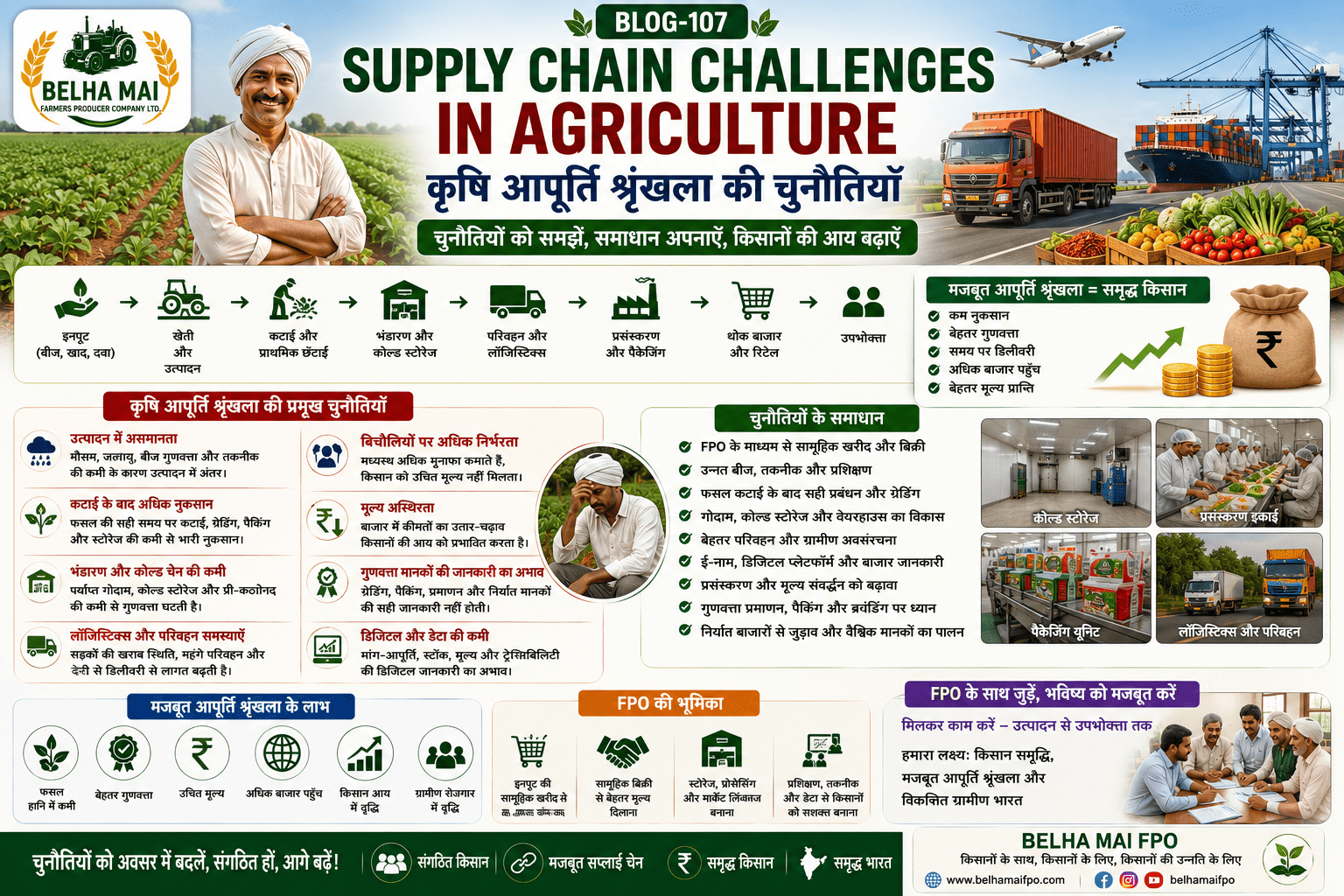
Agriculture supply chain means the complete journey of farm produce from seed and input supply to production, harvesting, aggregation, storage, grading, packaging, transport, processing, wholesale, retail and final consumer. If any part of this chain is weak, farmer income and crop quality are affected.
Agriculture supply chain का अर्थ
Agriculture supply chain का मतलब है farm produce की पूरी journey, जिसमें seed और input supply से लेकर production, harvesting, aggregation, storage, grading, packaging, transport, processing, wholesale, retail और final consumer तक की प्रक्रिया शामिल है। यदि इस chain का कोई भी हिस्सा कमजोर होता है, तो farmer income और crop quality प्रभावित होती है।
Supply chain affects farmer income
Supply chain challenges in agriculture directly affect farmer income. Farmers generally focus on growing crops, but the price they receive depends on market access, transport cost, storage availability, buyer demand, quality standards and bargaining power. If the supply chain is weak, the farmer loses value.
Supply chain किसान आय को प्रभावित करती है
कृषि आपूर्ति श्रृंखला की चुनौतियां सीधे farmer income को प्रभावित करती हैं। किसान सामान्य रूप से crop production पर ध्यान देता है, लेकिन उसे मिलने वाला price market access, transport cost, storage availability, buyer demand, quality standards और bargaining power पर निर्भर करता है। यदि supply chain कमजोर है, तो किसान value खो देता है।
Production uncertainty creates supply chain problems
Agriculture production depends on weather, water, soil, seed quality, pest control and farmer capacity. When production is uncertain, supply planning becomes difficult. Buyers need consistent quantity, but farmers may face crop loss, low yield or quality variation due to climate and input challenges.
Production uncertainty supply chain problems बनाती है
Agriculture production weather, water, soil, seed quality, pest control और farmer capacity पर depend करती है। जब production uncertain होता है, तो supply planning कठिन हो जाती है। Buyers को consistent quantity चाहिए, लेकिन farmers climate और input challenges के कारण crop loss, low yield या quality variation face कर सकते हैं।
Small quantities weaken farmer bargaining power
Small farmers often produce limited quantities. When each farmer sells separately, the quantity is too small to attract large buyers. This creates dependency on local traders. Supply chain challenges in agriculture become more serious for small farmers because they cannot individually meet bulk buyer requirements.
कम मात्रा farmer bargaining power कमजोर करती है
छोटे किसान अक्सर limited quantities produce करते हैं। जब हर farmer अलग-अलग बेचता है, तो quantity large buyers को attract करने के लिए बहुत कम होती है। इससे local traders पर dependency बढ़ती है। छोटे किसानों के लिए कृषि आपूर्ति श्रृंखला की चुनौतियां अधिक गंभीर हो जाती हैं क्योंकि वे individually bulk buyer requirements पूरी नहीं कर सकते।
Aggregation is a major missing link
Aggregation means collecting produce from many farmers and creating a marketable quantity. Without aggregation, farmers remain scattered and weak in the market. FPOs can solve this problem by collecting produce, maintaining records, grading and supplying larger volumes to buyers.
Aggregation एक बड़ी missing link है
Aggregation का मतलब है कई farmers की produce collect करके marketable quantity बनाना। Aggregation के बिना farmers scattered और market में weak रहते हैं। FPO produce collect करके, records maintain करके, grading करके और buyers को larger volumes supply करके इस problem को solve कर सकते हैं।
Post-harvest losses reduce value
Post-harvest losses are a major part of supply chain challenges in agriculture. Losses occur after harvesting due to poor handling, improper drying, moisture, pest attack, bad packaging, unsafe storage, rough transport and delayed selling. These losses reduce both quantity and quality.
Post-harvest losses value घटाते हैं
Post-harvest losses कृषि आपूर्ति श्रृंखला की चुनौतियां का बड़ा हिस्सा हैं। Harvesting के बाद poor handling, improper drying, moisture, pest attack, bad packaging, unsafe storage, rough transport और delayed selling के कारण losses होते हैं। ये losses quantity और quality दोनों घटाते हैं।
Lack of storage forces distress selling
Storage gives farmers the power to wait. Without storage, farmers are forced to sell immediately after harvest, often when market prices are low. Lack of rural warehouses, cold rooms, packhouses and scientific storage weakens farmer bargaining power.
Storage की कमी distress selling कराती है
Storage किसान को रुकने की शक्ति देता है। Storage न होने पर किसान harvest के तुरंत बाद बेचने के लिए मजबूर होता है, जब market prices अक्सर low होते हैं। Rural warehouses, cold rooms, packhouses और scientific storage की कमी farmer bargaining power कमजोर करती है।
Cold chain gaps affect perishable crops
Fruits, vegetables, flowers, dairy products, mango, amla and other perishable products need cold chain support. Without pre-cooling, cold storage and refrigerated transport, produce loses freshness quickly. Cold chain gaps are one of the most serious supply chain challenges in agriculture.
Cold chain gaps perishable crops को प्रभावित करते हैं
Fruits, vegetables, flowers, dairy products, mango, amla और अन्य perishable products को cold chain support चाहिए। Pre-cooling, cold storage और refrigerated transport के बिना produce जल्दी freshness खो देती है। Cold chain gaps कृषि आपूर्ति श्रृंखला की सबसे गंभीर चुनौतियों में से एक हैं।
Poor transport increases losses
Transport is not just movement from one place to another. Poor roads, unsuitable vehicles, overloading, rough handling and long delays can damage produce. In fruits and vegetables, transport damage can reduce quality and price very quickly.
खराब transport losses बढ़ाता है
Transport केवल एक जगह से दूसरी जगह movement नहीं है। Poor roads, unsuitable vehicles, overloading, rough handling और long delays produce को damage कर सकते हैं। Fruits और vegetables में transport damage quality और price बहुत जल्दी reduce कर सकता है।
Logistics cost reduces farmer share
High logistics cost reduces the farmer’s share in the final consumer price. If transport, loading, unloading, storage and commission costs are high, the farmer receives less even when the consumer pays more. Better logistics can improve farmer income.
Logistics cost farmer share कम करती है
High logistics cost final consumer price में farmer share कम कर देती है। यदि transport, loading, unloading, storage और commission costs high हैं, तो consumer ज्यादा pay करने के बाद भी farmer को कम मिलता है। Better logistics farmer income सुधार सकती है।
Lack of grading reduces price
Grading separates produce according to size, quality, maturity, colour and condition. Without grading, better and lower-quality produce are sold together. Buyers then offer an average price. Supply chain challenges in agriculture often begin when produce is not graded properly.
Grading की कमी price घटाती है
Grading produce को size, quality, maturity, colour और condition के अनुसार separate करती है। Grading के बिना better और lower-quality produce एक साथ बेची जाती है। Buyers फिर average price देते हैं। कृषि आपूर्ति श्रृंखला की चुनौतियां अक्सर तब शुरू होती हैं जब produce properly graded नहीं होती।
Packaging problems damage produce
Good packaging protects produce during handling, storage and transport. Poor packaging causes bruising, breakage, contamination, moisture damage and quality loss. Export and premium markets require proper packaging, but many farmers do not have access to it.
Packaging problems produce को नुकसान पहुंचाते हैं
Good packaging handling, storage और transport के दौरान produce को protect करती है। Poor packaging bruising, breakage, contamination, moisture damage और quality loss करती है। Export और premium markets proper packaging मांगते हैं, लेकिन कई farmers को इसकी access नहीं होती।
Quality inconsistency affects buyer trust
Buyers prefer consistent quality. If one lot is good and another lot is poor, buyers lose confidence. Quality inconsistency is one of the key supply chain challenges in agriculture. Farmer training, grading, testing and FPO-level quality control can reduce this problem.
Quality inconsistency buyer trust घटाती है
Buyers consistent quality पसंद करते हैं। यदि एक lot अच्छी है और दूसरी poor है, तो buyers confidence खो देते हैं। Quality inconsistency कृषि आपूर्ति श्रृंखला की मुख्य चुनौतियों में से एक है। Farmer training, grading, testing और FPO-level quality control इस problem को कम कर सकते हैं।
Market information gap
Many farmers sell without knowing current market price, demand trend or buyer requirement. This information gap weakens bargaining power. Digital tools, FPO alerts, mandi price platforms and buyer networks can help farmers make better selling decisions.
Market information gap
कई किसान current market price, demand trend या buyer requirement जाने बिना sell करते हैं। यह information gap bargaining power कमजोर करता है। Digital tools, FPO alerts, mandi price platforms और buyer networks farmers को better selling decisions लेने में मदद कर सकते हैं।
Middlemen dependency
Middlemen are often necessary where farmers lack transport, storage, information and buyer access. But excessive dependency can reduce farmer share. Strong FPOs, digital marketplaces, direct buyer linkage and better logistics can give farmers more options.
Middlemen dependency
जहां farmers के पास transport, storage, information और buyer access नहीं होता, वहां middlemen अक्सर necessary होते हैं। लेकिन excessive dependency farmer share कम कर सकती है। Strong FPOs, digital marketplaces, direct buyer linkage और better logistics farmers को more options दे सकते हैं।
Price gap between farmer and consumer
A common problem in agriculture is that consumers pay high prices, but farmers receive low prices. This happens due to transport cost, storage loss, commissions, retail margins, wastage and weak farmer bargaining power. Supply chain improvement can reduce this gap.
Farmer और consumer price gap
Agriculture में common problem यह है कि consumers high prices pay करते हैं, लेकिन farmers को low prices मिलते हैं। यह transport cost, storage loss, commissions, retail margins, wastage और weak farmer bargaining power के कारण होता है। Supply chain improvement इस gap को कम कर सकता है।
Processing gap limits income
Processing converts raw produce into higher-value products. Without processing, farmers sell raw crops at lower margins. Processing of grains, fruits, vegetables, millets, honey, amla and mango can increase income and reduce wastage.
Processing gap income limit करता है
Processing raw produce को higher-value products में बदलती है। Processing के बिना farmers raw crops low margins पर बेचते हैं। Grains, fruits, vegetables, millets, honey, amla और mango की processing income बढ़ा सकती है और wastage कम कर सकती है।
Value addition is a solution
Value addition is one of the strongest solutions to supply chain challenges in agriculture. Farmers and FPOs can earn better by cleaning, grading, milling, drying, pulping, packaging, branding and selling processed products. Value addition keeps more value in rural areas.
Value addition एक समाधान है
Value addition कृषि आपूर्ति श्रृंखला की चुनौतियां का मजबूत समाधान है। Farmers और FPOs cleaning, grading, milling, drying, pulping, packaging, branding और processed products selling से बेहतर earn कर सकते हैं। Value addition rural areas में अधिक value रखता है।
Weak rural infrastructure
Rural infrastructure plays an important role in supply chains. Poor roads, lack of electricity, weak internet, limited storage, absence of packhouses and lack of processing units make the agriculture supply chain weak. Infrastructure investment is essential.
कमजोर rural infrastructure
Rural infrastructure supply chains में important role निभाता है। Poor roads, lack of electricity, weak internet, limited storage, packhouses की कमी और processing units की absence agriculture supply chain को weak बनाती है। Infrastructure investment essential है।
Digital gap in supply chain
Modern supply chains need digital records, inventory tracking, quality data, buyer communication, payment tracking and traceability. Many farmers and small FPOs still lack digital capacity. This creates transparency and planning gaps.
Supply chain में digital gap
Modern supply chains को digital records, inventory tracking, quality data, buyer communication, payment tracking और traceability चाहिए। कई farmers और small FPOs में अभी भी digital capacity की कमी है। इससे transparency और planning gaps बनते हैं।
Payment delays affect farmers
Farmers need timely payment because they have household expenses, loan repayment, labour cost and next crop investment. Payment delays create financial stress. A good supply chain must include transparent and timely payment systems.
Payment delays farmers को प्रभावित करते हैं
Farmers को timely payment चाहिए क्योंकि उनके household expenses, loan repayment, labour cost और next crop investment होते हैं। Payment delays financial stress पैदा करते हैं। Good supply chain में transparent और timely payment systems होने चाहिए।
Credit gap affects supply chain participation
Farmers often need working capital for harvesting, grading, packaging, transport and storage. Without credit, they sell immediately. Access to affordable credit can help farmers participate better in supply chains and avoid distress selling.
Credit gap supply chain participation को प्रभावित करता है
Farmers को harvesting, grading, packaging, transport और storage के लिए working capital चाहिए होता है। Credit न होने पर वे immediately sell करते हैं। Affordable credit farmers को supply chains में बेहतर participate करने और distress selling से बचने में मदद कर सकता है।
Farmer training is necessary
Farmers need training on quality standards, harvesting stage, drying, grading, packaging, storage, transport and buyer requirements. Without training, farmers may produce good crops but fail to meet market standards. Training is essential for supply chain improvement.
Farmer training जरूरी है
Farmers को quality standards, harvesting stage, drying, grading, packaging, storage, transport और buyer requirements पर training चाहिए। Training के बिना farmers good crops produce कर सकते हैं, लेकिन market standards meet नहीं कर पाते। Supply chain improvement के लिए training essential है।
FPOs can solve aggregation problems
FPOs can collect produce from many farmers and create bulk quantity. This helps connect small farmers with processors, exporters, retailers and institutional buyers. Supply chain challenges in agriculture become easier to solve when farmers work collectively through FPOs.
FPO aggregation problems solve कर सकते हैं
FPO कई farmers से produce collect करके bulk quantity बना सकते हैं। इससे small farmers processors, exporters, retailers और institutional buyers से connect हो सकते हैं। Farmers जब FPOs के माध्यम से collectively work करते हैं, तो कृषि आपूर्ति श्रृंखला की चुनौतियां solve करना आसान हो जाता है।
FPOs can build storage and packhouse systems
FPOs can create collection centres, warehouses, cold rooms, packhouses, grading units and drying platforms. These facilities reduce losses and improve quality. Shared infrastructure is more practical for small farmers than individual investment.
FPO storage और packhouse systems बना सकते हैं
FPO collection centres, warehouses, cold rooms, packhouses, grading units और drying platforms बना सकते हैं। ये facilities losses कम करती हैं और quality improve करती हैं। Shared infrastructure small farmers के लिए individual investment की तुलना में more practical है।
FPOs improve buyer confidence
Buyers prefer organized suppliers who can provide quantity, quality, documentation and timely delivery. FPOs can maintain records, ensure grading, coordinate logistics and provide professional communication. This improves buyer confidence and repeat business.
FPO buyer confidence सुधारते हैं
Buyers organized suppliers को prefer करते हैं जो quantity, quality, documentation और timely delivery दे सकें। FPO records maintain कर सकते हैं, grading ensure कर सकते हैं, logistics coordinate कर सकते हैं और professional communication provide कर सकते हैं। इससे buyer confidence और repeat business improve होता है।
FPOs can support direct market linkage
Direct market linkage helps reduce unnecessary layers and improve farmer share. FPOs can connect farmers with processors, retail chains, exporters, online buyers, institutions and government procurement systems. This can improve price realization.
FPO direct market linkage support कर सकते हैं
Direct market linkage unnecessary layers को reduce करने और farmer share improve करने में मदद करता है। FPO farmers को processors, retail chains, exporters, online buyers, institutions और government procurement systems से connect कर सकते हैं। इससे price realization improve हो सकता है।
Technology can strengthen supply chains
Technology can help solve supply chain challenges in agriculture through digital inventory, GPS tracking, mobile apps, quality records, online buyer communication, digital payments and traceability. But technology must be simple and farmer-friendly.
Technology supply chains को मजबूत कर सकती है
Technology digital inventory, GPS tracking, mobile apps, quality records, online buyer communication, digital payments और traceability के माध्यम से कृषि आपूर्ति श्रृंखला की चुनौतियां solve करने में मदद कर सकती है। लेकिन technology simple और farmer-friendly होनी चाहिए।
Traceability supports premium markets
Traceability helps buyers know where produce came from, who produced it, what inputs were used and how it was handled. Premium markets, export buyers and institutional buyers increasingly prefer traceable products. FPOs can maintain traceability records.
Traceability premium markets को support करती है
Traceability buyers को बताती है कि produce कहां से आई, किसने produce किया, कौन से inputs use हुए और कैसे handle हुई। Premium markets, export buyers और institutional buyers increasingly traceable products prefer करते हैं। FPO traceability records maintain कर सकते हैं।
Export supply chains need discipline
Export markets need quality, documentation, packaging, residue control, cold chain and timely delivery. Small farmers can participate in export supply chains only when FPOs and institutions support them with aggregation, testing, packaging and buyer linkage.
Export supply chains को discipline चाहिए
Export markets को quality, documentation, packaging, residue control, cold chain और timely delivery चाहिए। Small farmers export supply chains में तभी participate कर सकते हैं जब FPOs और institutions उन्हें aggregation, testing, packaging और buyer linkage के साथ support करें।
Belha Mai FPO perspective
Belha Mai Farmers Producer Company Ltd. believes that supply chain challenges in agriculture must be solved through collective farmer systems. Small farmers need FPO-led aggregation, storage, grading, logistics, processing, digital records, value addition and direct buyer linkage. Without a strong supply chain, farmers cannot get full value for their hard work.
बेल्हा माई FPO का दृष्टिकोण
Belha Mai Farmers Producer Company Ltd. का मानना है कि कृषि आपूर्ति श्रृंखला की चुनौतियां collective farmer systems के माध्यम से solve होनी चाहिए। Small farmers को FPO-led aggregation, storage, grading, logistics, processing, digital records, value addition और direct buyer linkage चाहिए। Strong supply chain के बिना farmers अपनी मेहनत का full value नहीं प्राप्त कर सकते।
Conclusion
Supply chain challenges in agriculture reduce farmer income at many stages. Problems such as small quantities, lack of aggregation, poor storage, weak cold chain, transport damage, quality inconsistency, market information gap, middlemen dependency, payment delay and processing gaps all affect farmers. These challenges are especially serious for small and marginal farmers.
निष्कर्ष
कृषि आपूर्ति श्रृंखला की चुनौतियां कई stages पर farmer income को reduce करती हैं। Small quantities, aggregation की कमी, poor storage, weak cold chain, transport damage, quality inconsistency, market information gap, middlemen dependency, payment delay और processing gaps farmers को affect करते हैं। ये challenges especially small and marginal farmers के लिए serious हैं।
The way forward
The way forward is FPO aggregation, village-level collection centres, scientific storage, cold chain, grading, packaging, processing, digital records, better logistics, direct buyer linkage and farmer training. Supply chain challenges in agriculture can be reduced when farmers move from scattered selling to organized collective marketing.
आगे का रास्ता
आगे का रास्ता FPO aggregation, village-level collection centres, scientific storage, cold chain, grading, packaging, processing, digital records, better logistics, direct buyer linkage और farmer training है। कृषि आपूर्ति श्रृंखला की चुनौतियां तब कम हो सकती हैं जब farmers scattered selling से organized collective marketing की ओर बढ़ें।
FAQ in English
What are supply chain challenges in agriculture?
Supply chain challenges in agriculture are problems related to aggregation, storage, grading, packaging, transport, cold chain, processing, market linkage, payment and quality control.
Why do supply chain challenges reduce farmer income?
Supply chain challenges reduce farmer income by increasing losses, transport cost, quality damage, middlemen dependency and price gaps between farmers and consumers.
How does lack of storage affect farmers?
Lack of storage forces farmers to sell immediately after harvest, often at low prices, and increases the risk of moisture, pest and quality losses.
Why is cold chain important in agriculture?
Cold chain is important for fruits, vegetables, flowers, dairy and other perishable products because it protects freshness and reduces spoilage.
How can FPOs solve supply chain problems?
FPOs can solve supply chain problems through aggregation, storage, grading, packhouses, logistics, processing, direct buyer linkage and digital records.
What is the role of grading in agriculture supply chain?
Grading separates produce by quality, size and condition, helping farmers receive better prices for better-quality produce.
How does value addition help farmers?
Value addition helps farmers earn more by converting raw produce into processed, packaged and branded products.
What is the best solution for supply chain challenges in agriculture?
The best solution is collective farmer action through FPOs, supported by storage, cold chain, logistics, processing, digital systems, training and direct market linkage.
FAQ in Hindi
कृषि आपूर्ति श्रृंखला की चुनौतियां क्या हैं?
कृषि आपूर्ति श्रृंखला की चुनौतियां aggregation, storage, grading, packaging, transport, cold chain, processing, market linkage, payment और quality control से जुड़ी समस्याएं हैं।
Supply chain challenges farmer income क्यों घटाते हैं?
Supply chain challenges losses, transport cost, quality damage, middlemen dependency और farmer-consumer price gap बढ़ाकर farmer income घटाते हैं।
Storage की कमी farmers को कैसे प्रभावित करती है?
Storage की कमी farmers को harvest के तुरंत बाद low price पर sell करने के लिए मजबूर करती है और moisture, pest तथा quality losses का risk बढ़ाती है।
Agriculture में cold chain क्यों जरूरी है?
Cold chain fruits, vegetables, flowers, dairy और other perishable products के लिए important है क्योंकि यह freshness protect करती है और spoilage कम करती है।
FPO supply chain problems कैसे solve कर सकते हैं?
FPO aggregation, storage, grading, packhouses, logistics, processing, direct buyer linkage और digital records के माध्यम से supply chain problems solve कर सकते हैं।
Agriculture supply chain में grading की क्या भूमिका है?
Grading produce को quality, size और condition के अनुसार separate करती है, जिससे better-quality produce को better price मिल सकता है।
Value addition farmers की कैसे मदद करता है?
Value addition raw produce को processed, packaged और branded products में बदलकर farmers को अधिक income कमाने में मदद करता है।
कृषि आपूर्ति श्रृंखला की चुनौतियों का best solution क्या है?
Best solution FPOs के माध्यम से collective farmer action है, जिसे storage, cold chain, logistics, processing, digital systems, training और direct market linkage support करें।
Internal Links Section
👉 Why small farmers struggle in India
https://belhamaifpo.com/agriculture/why-small-farmers-struggle-in-india/
👉 Importance of agri-logistics in India
https://belhamaifpo.com/agriculture/agri-logistics-india/
👉 Lack of storage facilities in rural India
https://belhamaifpo.com/agriculture/rural-storage-problems-india/
👉 Post-harvest losses in agriculture
https://belhamaifpo.com/agriculture/post-harvest-losses-in-agriculture/
👉 How farmers can get better market prices
https://belhamaifpo.com/agriculture/better-market-prices-for-farmers/
👉 Agri-export opportunities from India
https://belhamaifpo.com/agriculture/agri-export-opportunities-india/
👉 Farmer Producer Organization
https://belhamaifpo.com/farmer-producer-organization/
👉 Agriculture
https://belhamaifpo.com/agriculture/
External Authority Links
👉 Ministry of Food Processing Industries
https://www.mofpi.gov.in/
👉 Warehousing Development and Regulatory Authority
https://wdra.gov.in/
👉 e-NAM National Agriculture Market
https://www.enam.gov.in/
👉 APEDA
https://apeda.gov.in/
👉 Small Farmers’ Agribusiness Consortium
https://sfacindia.com/
Follow Belha Mai FPO for More Updates
For more farmer awareness blogs, agriculture updates, FPO development content, product information and practical farming videos, please follow and connect with Belha Mai Farmers Producer Company Ltd.
👉 Website
https://belhamaifpo.com/
👉 Facebook Page
https://www.facebook.com/profile.php?id=61561043486818
👉 YouTube Channel
https://www.youtube.com/channel/UC9ZvojoTMCa7mU1-Q_Bh60A
👉 LinkedIn
https://www.linkedin.com/in/abhay-singh-ab5568280/
👉 Instagram
https://instagram.com/belhamaifpo
Belha Mai FPO is working to support farmers through better information, technology, market linkage, value addition, FPO awareness and rural development.