Introduction
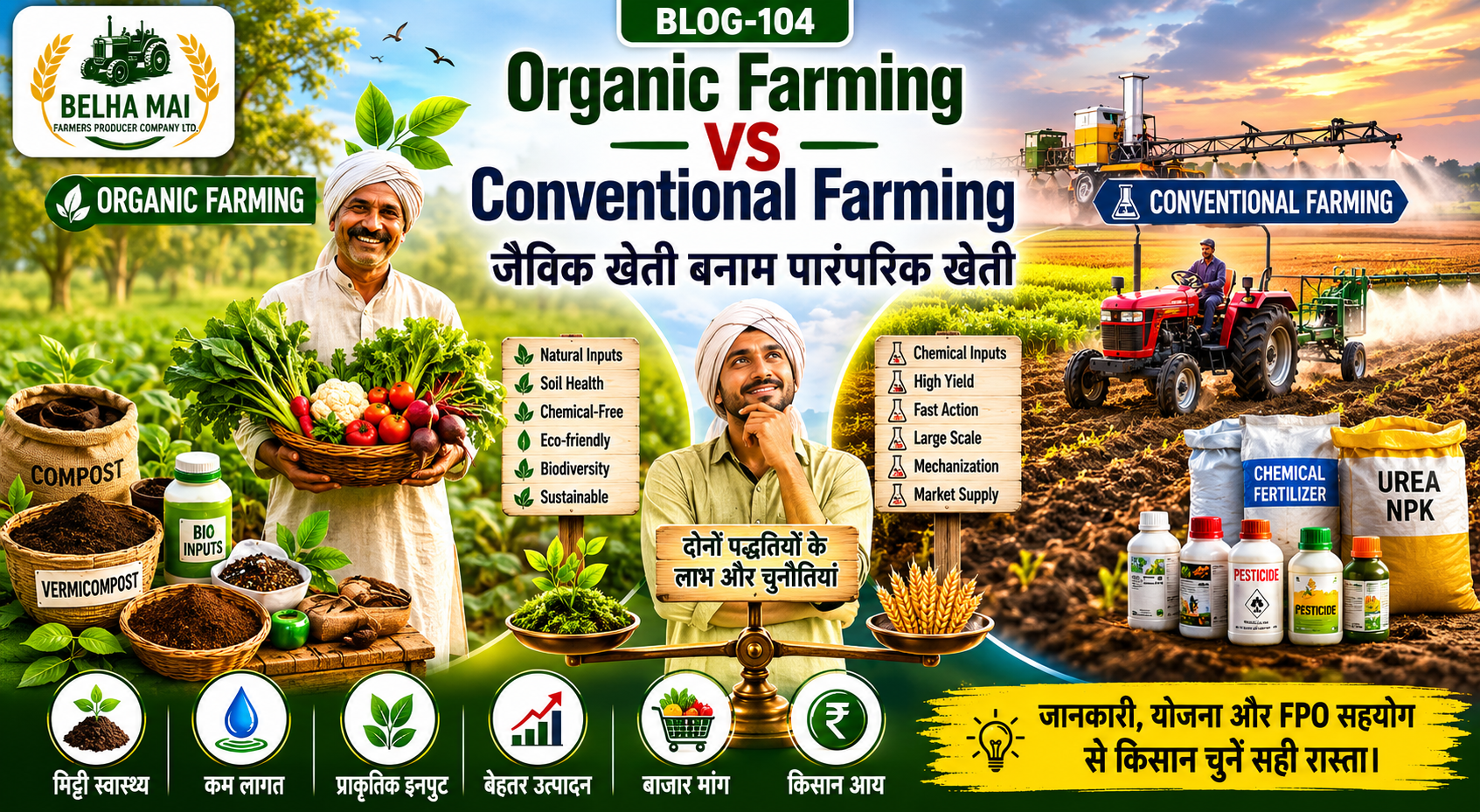
Organic farming vs conventional farming is one of the most discussed topics in Indian agriculture today. Many farmers want to know whether they should move towards organic farming or continue with conventional farming. The answer is not always simple because both systems have benefits, limitations, costs, risks and market requirements.
परिचय
जैविक खेती बनाम पारंपरिक खेती आज भारतीय कृषि में सबसे अधिक चर्चा वाले विषयों में से एक है। कई किसान जानना चाहते हैं कि उन्हें जैविक खेती की ओर बढ़ना चाहिए या पारंपरिक खेती जारी रखनी चाहिए। इसका उत्तर हमेशा सरल नहीं होता क्योंकि दोनों प्रणालियों के अपने लाभ, सीमाएं, लागत, जोखिम और बाजार आवश्यकताएं हैं।
What organic farming means
Organic farming is a method of farming that focuses on soil health, natural inputs, compost, vermicompost, bio-fertilizers, bio-pesticides, crop rotation, green manure and ecological balance. In organic farming, farmers try to reduce or avoid synthetic chemical fertilizers and pesticides and depend more on natural and biological systems.
जैविक खेती का अर्थ
जैविक खेती ऐसी खेती पद्धति है जिसमें मिट्टी स्वास्थ्य, प्राकृतिक इनपुट, कंपोस्ट, वर्मी कंपोस्ट, जैव उर्वरक, जैव कीटनाशक, फसल चक्र, हरी खाद और ecological balance पर ध्यान दिया जाता है। जैविक खेती में किसान synthetic chemical fertilizers और pesticides को कम या avoid करने की कोशिश करते हैं और natural तथा biological systems पर अधिक निर्भर रहते हैं।
What conventional farming means
Conventional farming is the commonly practiced farming system where farmers use improved seeds, chemical fertilizers, pesticides, irrigation, machinery and modern crop management to increase productivity. Conventional farming has helped increase food production, but excessive and unbalanced chemical use can create soil, water and cost-related problems.
पारंपरिक खेती का अर्थ
पारंपरिक खेती वह commonly practiced farming system है जिसमें किसान improved seeds, chemical fertilizers, pesticides, irrigation, machinery और modern crop management का उपयोग production बढ़ाने के लिए करते हैं। पारंपरिक खेती ने food production बढ़ाने में मदद की है, लेकिन अत्यधिक और असंतुलित chemical use मिट्टी, पानी और लागत से जुड़ी समस्याएं पैदा कर सकता है।
Organic farming vs conventional farming is not only a debate
Organic farming vs conventional farming should not be treated as only a debate of good versus bad. Farmers need practical knowledge. Organic farming can improve soil health and reduce chemical dependency, but it needs training, time, labour, market linkage and sometimes certification. Conventional farming can give higher short-term yield, but it needs balanced input use and soil protection.
जैविक खेती बनाम पारंपरिक खेती केवल बहस नहीं है
जैविक खेती बनाम पारंपरिक खेती को केवल अच्छा और बुरा की बहस नहीं बनाना चाहिए। किसानों को व्यावहारिक जानकारी चाहिए। जैविक खेती मिट्टी स्वास्थ्य सुधार सकती है और chemical dependency घटा सकती है, लेकिन इसके लिए training, time, labour, market linkage और कई बार certification चाहिए। पारंपरिक खेती short-term में अधिक yield दे सकती है, लेकिन इसमें balanced input use और soil protection जरूरी है।
Soil health comparison
In organic farming, soil health is the main focus. Compost, crop residue, green manure and bio-inputs help improve organic matter and microbial life. In conventional farming, soil health can remain good if fertilizers are balanced and organic matter is added. But if farmers use only chemical inputs without organic matter, soil health may decline over time.
मिट्टी स्वास्थ्य की तुलना
जैविक खेती में मिट्टी स्वास्थ्य मुख्य focus होता है। Compost, crop residue, green manure और bio-inputs organic matter और microbial life सुधारते हैं। पारंपरिक खेती में भी मिट्टी स्वास्थ्य अच्छा रह सकता है यदि fertilizers balanced हों और organic matter जोड़ा जाए। लेकिन यदि किसान केवल chemical inputs पर निर्भर रहें और organic matter न डालें, तो समय के साथ मिट्टी स्वास्थ्य घट सकता है।
Input cost comparison
Organic farming can reduce dependence on purchased chemical inputs if farmers prepare compost, vermicompost and bio-inputs locally. However, labour and management cost may increase. Conventional farming often depends on market-purchased fertilizers, pesticides and hybrid seeds, which can increase cash cost for farmers.
इनपुट लागत की तुलना
जैविक खेती purchased chemical inputs पर निर्भरता घटा सकती है यदि किसान compost, vermicompost और bio-inputs locally तैयार करें। हालांकि labour और management cost बढ़ सकती है। पारंपरिक खेती अक्सर market-purchased fertilizers, pesticides और hybrid seeds पर निर्भर होती है, जिससे किसानों की cash cost बढ़ सकती है।
Yield comparison
Organic farming vs conventional farming is often compared only on yield. Conventional farming may give higher yield in the short term, especially when soil fertility, irrigation and input use are good. Organic farming may take time to stabilize because soil biology and organic matter need time to improve. However, with good management, organic farming can produce stable and quality output over time.
उत्पादन की तुलना
जैविक खेती बनाम पारंपरिक खेती की तुलना अक्सर केवल yield पर की जाती है। पारंपरिक खेती short term में अधिक yield दे सकती है, खासकर जब soil fertility, irrigation और input use अच्छे हों। जैविक खेती को stabilize होने में समय लग सकता है क्योंकि soil biology और organic matter सुधारने में समय लगता है। लेकिन अच्छे management के साथ जैविक खेती लंबे समय में stable और quality output दे सकती है।
Quality and safety
Organic farming focuses on chemical-free or low-chemical production and is often preferred by health-conscious consumers. Conventional farming can also produce safe food if pesticides and fertilizers are used responsibly, in recommended doses and with proper waiting periods. Food safety depends on correct practice, not only on the farming label.
गुणवत्ता और सुरक्षा
जैविक खेती chemical-free या low-chemical production पर ध्यान देती है और health-conscious consumers इसे पसंद करते हैं। पारंपरिक खेती भी safe food produce कर सकती है यदि pesticides और fertilizers recommended dose में और proper waiting period के साथ उपयोग किए जाएं। Food safety सही practice पर निर्भर करती है, केवल farming label पर नहीं।
Pest management difference
In organic farming, pest management depends on biological control, neem-based products, botanical extracts, traps, crop rotation, resistant varieties and field hygiene. In conventional farming, chemical pesticides are commonly used for quick control. The best approach is responsible pest management that protects crops without unnecessary chemical misuse.
कीट प्रबंधन में अंतर
जैविक खेती में pest management biological control, neem-based products, botanical extracts, traps, crop rotation, resistant varieties और field hygiene पर निर्भर करता है। पारंपरिक खेती में quick control के लिए chemical pesticides का उपयोग सामान्य है। सबसे अच्छा तरीका responsible pest management है, जो crops की रक्षा करे लेकिन unnecessary chemical misuse न हो।
Water use comparison
Organic farming improves soil organic matter, which helps soil hold moisture better. This can reduce water stress over time. Conventional farming can use water efficiently if combined with drip irrigation, sprinkler irrigation, mulching and good irrigation scheduling. Both systems need water conservation.
पानी उपयोग की तुलना
जैविक खेती soil organic matter सुधारती है, जिससे मिट्टी moisture बेहतर पकड़ती है। इससे समय के साथ water stress कम हो सकता है। पारंपरिक खेती भी drip irrigation, sprinkler irrigation, mulching और good irrigation scheduling के साथ water efficiently use कर सकती है। दोनों systems को water conservation की जरूरत है।
Climate resilience
Organic farming vs conventional farming should also be understood from the climate change point of view. Organic and sustainable practices can improve soil carbon, water holding capacity and biodiversity, which support climate resilience. Conventional farming can also become climate-resilient if farmers use soil testing, balanced inputs, micro-irrigation, climate-resilient varieties and crop diversification.
जलवायु सहनशीलता
जैविक खेती बनाम पारंपरिक खेती को climate change के दृष्टिकोण से भी समझना चाहिए। Organic और sustainable practices soil carbon, water holding capacity और biodiversity सुधार सकती हैं, जिससे climate resilience बढ़ती है। पारंपरिक खेती भी climate-resilient बन सकती है यदि किसान soil testing, balanced inputs, micro-irrigation, climate-resilient varieties और crop diversification अपनाएं।
Market demand for organic produce
Organic produce can receive premium prices in some markets, especially among health-conscious consumers, urban buyers, export markets and specialty stores. But premium price is not automatic. Farmers need certification, trust, quality, traceability, packaging, branding and buyer linkage.
जैविक उत्पादों की बाजार मांग
Organic produce कुछ markets में premium price प्राप्त कर सकता है, खासकर health-conscious consumers, urban buyers, export markets और specialty stores के बीच। लेकिन premium price automatic नहीं मिलता। किसानों को certification, trust, quality, traceability, packaging, branding और buyer linkage चाहिए।
Market demand for conventional produce
Conventional farming supplies most of the food grain, vegetable, fruit and raw material demand. It is important for food security and large-scale supply. Farmers using conventional farming should focus on quality, residue safety, grading, storage, cost control and market linkage to improve income.
पारंपरिक उत्पादों की बाजार मांग
पारंपरिक खेती food grain, vegetable, fruit और raw material demand का बड़ा हिस्सा पूरा करती है। यह food security और large-scale supply के लिए महत्वपूर्ण है। Conventional farming करने वाले किसानों को income सुधारने के लिए quality, residue safety, grading, storage, cost control और market linkage पर ध्यान देना चाहिए।
Certification challenge in organic farming
Organic farming often needs certification if farmers want to sell in premium formal markets. Certification can be difficult for small farmers because it needs records, inspection, conversion period and cost. Group certification through FPOs can make certification more practical.
जैविक खेती में certification चुनौती
यदि किसान premium formal markets में बेचना चाहते हैं, तो organic farming में अक्सर certification की जरूरत होती है। छोटे किसानों के लिए certification कठिन हो सकता है क्योंकि इसमें records, inspection, conversion period और cost शामिल होते हैं। FPOs के माध्यम से group certification इसे अधिक practical बना सकता है।
Trust-based local organic selling
Some farmers sell organic produce locally through trust-based models without formal premium markets. This can work when buyers personally know the farmer and trust the method. However, for larger markets, formal systems, records and certification become more important.
भरोसे पर आधारित local organic selling
कुछ किसान formal premium markets के बिना trust-based models के माध्यम से organic produce locally बेचते हैं। यह तब काम कर सकता है जब buyers किसान को personally जानते हों और method पर trust करते हों। लेकिन बड़े markets के लिए formal systems, records और certification अधिक जरूरी हो जाते हैं।
Labour requirement
Organic farming may require more labour for composting, manual weed control, bio-input preparation and field monitoring. Conventional farming may reduce labour through herbicides, machinery and quick chemical pest control. Farmers should consider labour availability before choosing a system.
श्रम आवश्यकता
जैविक खेती में composting, manual weed control, bio-input preparation और field monitoring के लिए अधिक labour की जरूरत हो सकती है। पारंपरिक खेती herbicides, machinery और quick chemical pest control के माध्यम से labour कम कर सकती है। किसानों को system चुनने से पहले labour availability देखनी चाहिए।
Knowledge requirement
Organic farming vs conventional farming both require knowledge. Organic farming needs knowledge of soil biology, composting, crop rotation, pest cycles and market systems. Conventional farming needs knowledge of correct fertilizer dose, pesticide safety, irrigation, soil testing and input timing. Knowledge is the key in both systems.
ज्ञान की आवश्यकता
जैविक खेती बनाम पारंपरिक खेती दोनों में knowledge जरूरी है। जैविक खेती में soil biology, composting, crop rotation, pest cycles और market systems का ज्ञान चाहिए। पारंपरिक खेती में correct fertilizer dose, pesticide safety, irrigation, soil testing और input timing का ज्ञान चाहिए। दोनों systems में knowledge ही key है।
Risk for small farmers
Small farmers cannot afford failed experiments. If a small farmer shifts fully to organic farming without training, market linkage and transition planning, income may fall temporarily. Similarly, if a farmer continues conventional farming with rising input cost and poor soil health, profit may decline. Farmers need gradual and informed decisions.
छोटे किसानों के लिए जोखिम
छोटे किसान failed experiments afford नहीं कर सकते। यदि छोटा किसान training, market linkage और transition planning के बिना पूरी तरह organic farming में चला जाए, तो income temporarily घट सकती है। इसी तरह यदि किसान rising input cost और poor soil health के साथ conventional farming जारी रखे, तो profit घट सकता है। किसानों को gradual और informed decisions चाहिए।
Gradual transition can be safer
For many farmers, a gradual transition is safer than sudden change. Farmers can begin with one plot, composting, soil testing, crop rotation, bio-inputs, reduced chemical use and better record keeping. This allows them to learn before expanding.
धीरे-धीरे बदलाव सुरक्षित हो सकता है
कई किसानों के लिए sudden change की तुलना में gradual transition अधिक सुरक्षित है। किसान एक plot से शुरुआत कर सकते हैं, composting, soil testing, crop rotation, bio-inputs, reduced chemical use और better record keeping अपना सकते हैं। इससे वे विस्तार से पहले सीख सकते हैं।
Integrated approach may be practical
Organic farming vs conventional farming does not always need an extreme choice. Many farmers can adopt an integrated approach. They can reduce unnecessary chemical use, add compost, use soil testing, adopt IPM, save water, rotate crops and improve soil health while maintaining productivity.
integrated approach व्यावहारिक हो सकता है
जैविक खेती बनाम पारंपरिक खेती में हमेशा extreme choice की जरूरत नहीं होती। कई किसान integrated approach अपना सकते हैं। वे unnecessary chemical use घटा सकते हैं, compost जोड़ सकते हैं, soil testing अपना सकते हैं, IPM use कर सकते हैं, water save कर सकते हैं, crop rotation कर सकते हैं और productivity बनाए रखते हुए soil health सुधार सकते हैं।
Role of soil testing
Soil testing is important in both organic and conventional systems. In organic farming, soil testing shows whether soil health is improving. In conventional farming, soil testing prevents overuse or wrong use of fertilizers. Soil testing should become a regular habit for farmers.
मिट्टी परीक्षण की भूमिका
Soil testing organic और conventional दोनों systems में महत्वपूर्ण है। Organic farming में soil testing दिखाता है कि soil health सुधर रही है या नहीं। Conventional farming में soil testing fertilizers के overuse या wrong use को रोकता है। Soil testing किसानों की regular habit बननी चाहिए।
Role of FPOs
FPOs can help farmers understand organic farming vs conventional farming in a practical way. They can organize training, soil testing, input supply, bio-input production, market linkage, group certification, buyer connection, storage and value addition. FPOs can reduce the risk of individual farmers.
FPOs की भूमिका
FPOs किसानों को जैविक खेती बनाम पारंपरिक खेती व्यावहारिक तरीके से समझाने में मदद कर सकते हैं। वे training, soil testing, input supply, bio-input production, market linkage, group certification, buyer connection, storage और value addition organize कर सकते हैं। FPOs individual farmers का risk कम कर सकते हैं।
FPOs can support bio-input production
A Bio-Input Resource Centre can help farmers access bio-fertilizers, bio-pesticides, compost, vermicompost and natural farming inputs locally. This can reduce cost and improve availability. FPO-led bio-input systems can make organic and sustainable farming more practical.
FPO bio-input production support कर सकते हैं
Bio-Input Resource Centre किसानों को bio-fertilizers, bio-pesticides, compost, vermicompost और natural farming inputs locally उपलब्ध कराने में मदद कर सकता है। इससे cost घट सकती है और availability बढ़ सकती है। FPO-led bio-input systems organic और sustainable farming को अधिक practical बना सकते हैं।
Value addition in both systems
Both organic and conventional farming can benefit from value addition. Organic produce can be branded for premium buyers if quality and trust are maintained. Conventional produce can also gain value through cleaning, grading, processing, packaging and branding.
दोनों systems में value addition
Organic और conventional दोनों farming systems value addition से benefit ले सकते हैं। Organic produce premium buyers के लिए branded हो सकता है यदि quality और trust maintain हो। Conventional produce भी cleaning, grading, processing, packaging और branding से value gain कर सकता है।
Farmer income is the final test
Organic farming vs conventional farming should finally be judged by farmer income, soil health, risk, cost and market access. A farming system is successful only when it improves farmer livelihood while protecting land and resources. Farmers need practical models, not slogans.
किसान आय अंतिम कसौटी है
जैविक खेती बनाम पारंपरिक खेती को अंत में farmer income, soil health, risk, cost और market access के आधार पर देखना चाहिए। कोई farming system तभी सफल है जब वह farmer livelihood सुधारते हुए land और resources की रक्षा करे। किसानों को slogans नहीं, practical models चाहिए।
Belha Mai FPO perspective
Belha Mai Farmers Producer Company Ltd. believes that organic farming vs conventional farming should be explained honestly to farmers. Farmers should not be forced into any model without training, market linkage and financial planning. The best approach is scientific, soil-focused, market-linked and farmer-first agriculture.
बेल्हा माई FPO का दृष्टिकोण
Belha Mai Farmers Producer Company Ltd. का मानना है कि जैविक खेती बनाम पारंपरिक खेती किसानों को ईमानदारी से समझाना चाहिए। Farmers को training, market linkage और financial planning के बिना किसी model में force नहीं करना चाहिए। सबसे अच्छा approach scientific, soil-focused, market-linked और farmer-first agriculture है।
Conclusion
Organic farming vs conventional farming is not a simple choice of one system against another. Organic farming supports soil health, biodiversity and chemical reduction, while conventional farming supports large-scale production and quick nutrient management. Farmers should choose based on soil condition, crop, water availability, labour, cost, market demand and FPO support.
निष्कर्ष
जैविक खेती बनाम पारंपरिक खेती एक system को दूसरे के खिलाफ चुनने का सरल सवाल नहीं है। Organic farming soil health, biodiversity और chemical reduction को support करती है, जबकि conventional farming large-scale production और quick nutrient management को support करती है। किसानों को soil condition, crop, water availability, labour, cost, market demand और FPO support के आधार पर निर्णय लेना चाहिए।
The way forward
The way forward is balanced farming, soil testing, composting, bio-inputs, responsible fertilizer use, integrated pest management, water conservation, crop rotation, farmer training, certification support, value addition and FPO-led market linkage. Organic farming vs conventional farming should lead farmers towards better knowledge, better soil and better income.
आगे का रास्ता
आगे का रास्ता balanced farming, soil testing, composting, bio-inputs, responsible fertilizer use, integrated pest management, water conservation, crop rotation, farmer training, certification support, value addition और FPO-led market linkage है। जैविक खेती बनाम पारंपरिक खेती किसानों को better knowledge, better soil और better income की ओर ले जानी चाहिए।
FAQ in English
What is organic farming vs conventional farming?
Organic farming vs conventional farming means comparing natural input-based farming with chemical input-based farming in terms of soil health, yield, cost, quality, market demand and farmer income.
Which is better, organic farming or conventional farming?
There is no single answer. Organic farming may improve soil health and premium market value, while conventional farming may give higher short-term productivity. Farmers should choose based on local conditions and market linkage.
Does organic farming give lower yield?
Organic farming may give lower yield during transition, but with good soil management, composting, crop rotation and market linkage, it can become stable over time.
Is conventional farming harmful?
Conventional farming is not harmful when inputs are used responsibly and scientifically. Problems arise when chemical fertilizers and pesticides are used excessively or without guidance.
Can small farmers adopt organic farming?
Yes, small farmers can adopt organic farming gradually with training, composting, bio-inputs, FPO support, market linkage and risk planning.
Why is certification important in organic farming?
Certification helps farmers sell organic produce in formal premium markets. It builds trust and supports better buyer acceptance.
Can FPOs help in organic farming?
Yes, FPOs can support training, bio-input supply, soil testing, group certification, market linkage, branding and value addition.
What is the best approach for Indian farmers?
The best approach is balanced and scientific farming that protects soil, reduces unnecessary cost, improves quality and connects farmers with better markets.
FAQ in Hindi
जैविक खेती बनाम पारंपरिक खेती क्या है?
जैविक खेती बनाम पारंपरिक खेती का मतलब है natural input-based farming और chemical input-based farming की soil health, yield, cost, quality, market demand और farmer income के आधार पर तुलना।
जैविक खेती बेहतर है या पारंपरिक खेती?
इसका एक ही उत्तर नहीं है। Organic farming soil health और premium market value सुधार सकती है, जबकि conventional farming short-term productivity अधिक दे सकती है। Farmers को local conditions और market linkage के आधार पर निर्णय लेना चाहिए।
क्या जैविक खेती में उत्पादन कम होता है?
Transition period में organic farming में yield कम हो सकती है, लेकिन अच्छे soil management, composting, crop rotation और market linkage के साथ यह समय के साथ stable हो सकती है।
क्या पारंपरिक खेती हानिकारक है?
Conventional farming तब harmful नहीं है जब inputs responsibly और scientifically use किए जाएं। समस्या तब आती है जब chemical fertilizers और pesticides excessive या बिना guidance के use होते हैं।
क्या छोटे किसान जैविक खेती अपना सकते हैं?
हाँ, छोटे किसान training, composting, bio-inputs, FPO support, market linkage और risk planning के साथ धीरे-धीरे organic farming अपना सकते हैं।
Organic farming में certification क्यों जरूरी है?
Certification farmers को formal premium markets में organic produce sell करने में मदद करता है। यह trust बनाता है और buyer acceptance बढ़ाता है।
क्या FPO organic farming में मदद कर सकते हैं?
हाँ, FPO training, bio-input supply, soil testing, group certification, market linkage, branding और value addition में मदद कर सकते हैं।
भारतीय किसानों के लिए सबसे अच्छा approach क्या है?
सबसे अच्छा approach balanced और scientific farming है, जो soil protect करे, unnecessary cost घटाए, quality improve करे और farmers को better markets से जोड़े।
Internal Links Section
👉 Why small farmers struggle in India
https://belhamaifpo.com/agriculture/why-small-farmers-struggle-in-india/
👉 Indian Agriculture and Farmer Development: Complete Guide
https://belhamaifpo.com/agriculture/indian-agriculture-and-farmer-development/
👉 Sustainable agriculture practices in India
https://belhamaifpo.com/agriculture/sustainable-agriculture-india/
👉 Soil degradation in India: causes and solutions
https://belhamaifpo.com/agriculture/soil-degradation-in-india-causes-and-solutions/
👉 Irrigation problems in Indian agriculture
https://belhamaifpo.com/agriculture/irrigation-problems-in-indian-agriculture/
👉 How farmers can get better market prices
https://belhamaifpo.com/agriculture/better-market-prices-for-farmers/
👉 Role of technology in modern farming
https://belhamaifpo.com/agriculture/technology-in-modern-farming/
👉 Farmer Producer Organization
https://belhamaifpo.com/farmer-producer-organization/
👉 Agriculture
https://belhamaifpo.com/agriculture/
External Authority Links
👉 Paramparagat Krishi Vikas Yojana
https://pgsindia-ncof.gov.in/
👉 National Centre for Organic and Natural Farming
https://nconf.dac.gov.in/
👉 Soil Health Card
https://soilhealth.dac.gov.in/
👉 Department of Agriculture & Farmers Welfare
https://agriwelfare.gov.in/
👉 Small Farmers’ Agribusiness Consortium
https://sfacindia.com/
Follow Belha Mai FPO for More Updates
For more farmer awareness blogs, agriculture updates, FPO development content, product information and practical farming videos, please follow and connect with Belha Mai Farmers Producer Company Ltd.
👉 Website
https://belhamaifpo.com/
👉 Facebook Page
https://www.facebook.com/profile.php?id=61561043486818
👉 YouTube Channel
https://www.youtube.com/channel/UC9ZvojoTMCa7mU1-Q_Bh60A
👉 LinkedIn
https://www.linkedin.com/in/abhay-singh-ab5568280/
👉 Instagram
https://instagram.com/belhamaifpo
Belha Mai FPO is working to support farmers through better information, technology, market linkage, value addition, FPO awareness and rural development.