
6
Introduction
Amla grading and sorting process is one of the most important stages in modern post-harvest management and value-chain development. Scientific grading and sorting help improve:
- product quality,
- market value,
- processing efficiency,
- shelf life,
- and farmer income.
In most traditional systems across India, amla fruits are still sold without proper scientific grading and sorting. Farmers usually sell mixed-quality produce directly in mandis where:
- traders dominate pricing,
- processors purchase through intermediaries,
- and farmers receive lower returns despite bearing orchard expenses throughout the year.
Because of poor grading systems:
- high-quality fruits often get mixed with lower-grade produce,
- processors face inconsistency,
- export opportunities become limited,
- and post-harvest losses increase significantly.
Modern buyers increasingly demand:
- uniform fruit size,
- clean produce,
- hygienic handling,
- and standardized quality.
Scientific grading and sorting systems are now essential for:
- fresh fruit marketing,
- juice manufacturing,
- dehydration,
- nutraceutical industries,
- wellness products,
- and export-oriented processing.
In this blog, we will understand:
- amla grading and sorting process,
- grading standards,
- step-by-step sorting methods,
- manual vs machine grading,
- role of pack houses,
- cold storage importance,
- post-harvest challenges,
- and how FPOs can transform the amla value chain through scientific infrastructure.
👉 Learn More on Amla farming in India: complete guide for Farmers, Processing & Business Opportunities : https://belhamaifpo.com/farmer-producer-organisation/amla-farming-in-india/
Why Amla Grading and Sorting Process Is Important
One of the biggest advantages of the amla grading and sorting process is that it creates:
- quality consistency,
- better market acceptance,
- premium pricing,
- and improved processing efficiency.
Scientific grading helps:
- processors receive uniform raw material,
- retailers improve presentation quality,
- and exporters meet international standards.
Without grading:
- prices remain low,
- wastage increases,
- and farmers lose value.
👉 Up grade yourself on Export potential of amla from India : https://belhamaifpo.com/agriculture/export-potential-of-amla-from-india/
What Is Grading?
Grading means classifying fruits according to:
- size,
- weight,
- maturity,
- appearance,
- and quality standards.
Large and premium-quality fruits generally receive better prices in the market.
What Is Sorting?
Sorting means separating:
- damaged fruits,
- diseased fruits,
- immature fruits,
- cracked fruits,
- and inferior produce
from healthy marketable fruits.
Proper sorting improves:
- shelf life,
- hygiene,
- processing quality,
- and market value.
Major Objectives of Amla Grading and Sorting Process
1. Better Price Realization
One of the most important objectives of the amla grading and sorting process is improving farmer price realization.
Uniform and premium-quality fruits receive better prices in:
- mandis,
- supermarkets,
- export markets,
- and processing industries.
2. Reduction in Post-Harvest Losses
Sorting damaged fruits helps reduce:
- spoilage,
- fungal growth,
- and storage losses.
This significantly improves post-harvest management efficiency.
3. Improved Processing Efficiency
Processors prefer graded fruits for:
- juice extraction,
- dehydration,
- powder manufacturing,
- nutraceutical processing,
- and herbal wellness products.
Uniform fruits improve:
- extraction efficiency,
- product consistency,
- and processing speed.
4. Export Competitiveness
International buyers demand:
- standardized quality,
- uniform fruit size,
- hygienic handling,
- and traceability.
Scientific grading is essential for export-oriented value addition.
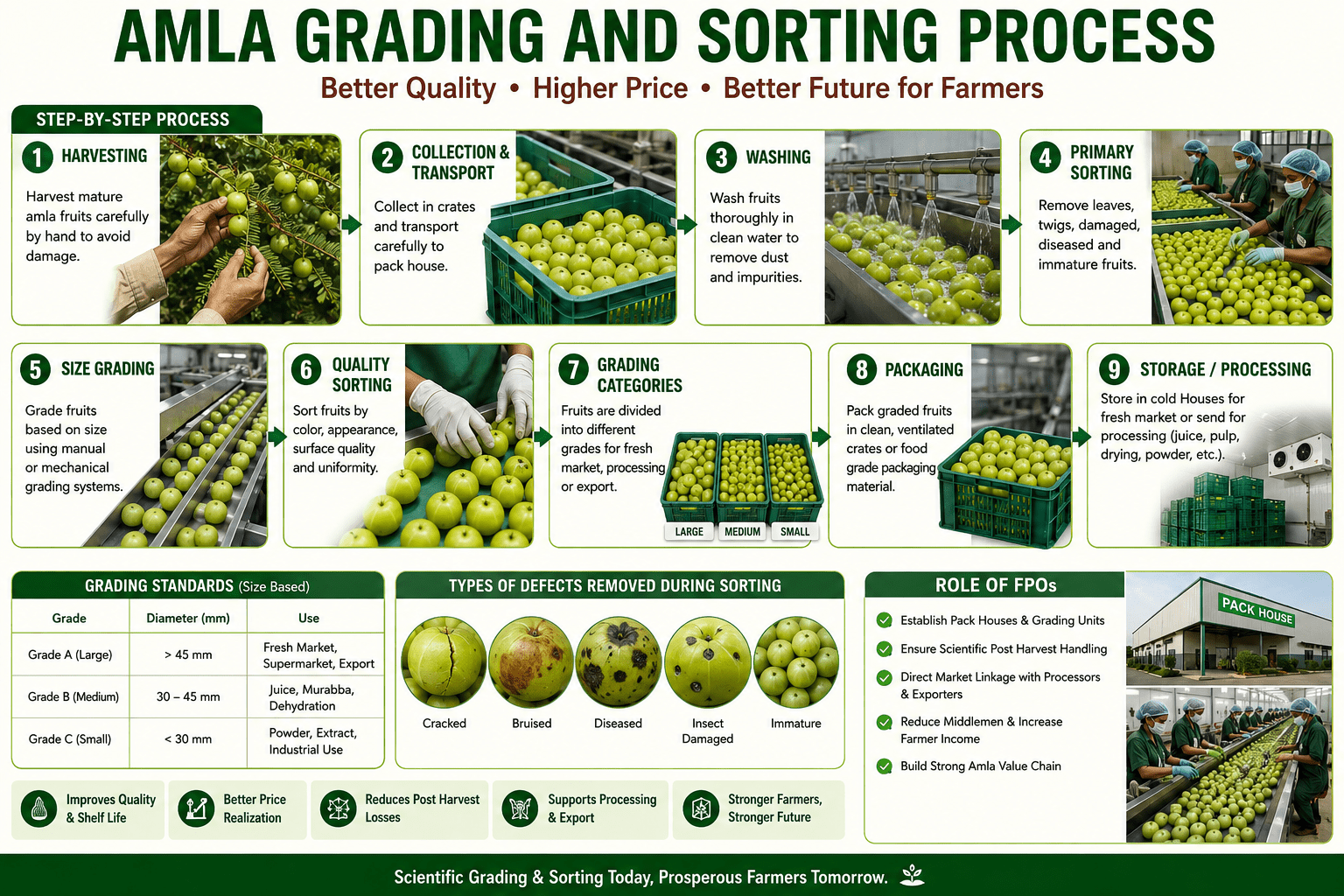
Step-by-Step Amla Grading and Sorting Process
1. Proper Harvesting
The amla grading and sorting process begins with scientific harvesting.
Only:
- mature,
- healthy,
- and damage-free fruits
should be harvested.
Improper harvesting causes:
- bruising,
- cracking,
- and quality deterioration.
Modern harvesting tools and scientific handling can significantly reduce damage.
2. Collection and Transportation
After harvesting:
- fruits are collected in crates,
- transported carefully,
- and moved to pack houses or sorting centers.
Rough handling during transportation causes:
- bruising,
- moisture loss,
- and reduced shelf life.
3. Washing and Cleaning
Fruits are washed to remove:
- dust,
- dirt,
- pesticide residues,
- and field impurities.
Scientific washing improves:
- hygiene,
- appearance,
- and market acceptability.
4. Primary Sorting
At this stage:
- damaged fruits,
- diseased fruits,
- cracked fruits,
- and immature produce
are separated.
This improves:
- quality consistency,
- storage performance,
- and processing quality.
5. Size Grading
Fruits are classified according to:
- diameter,
- weight,
- and market standards.
Generally:
Large Fruits
Used for:
- fresh fruit markets,
- premium retail,
- and high-value processing.
Medium Fruits
Used for:
- juice processing,
- murabba,
- candy,
- and dehydration.
Small or Lower Grade Fruits
Used for:
- powder manufacturing,
- extraction,
- and industrial processing.
6. Color and Appearance Sorting
Fruits are further checked for:
- color uniformity,
- surface defects,
- blemishes,
- and visual quality.
Better appearance improves:
- retail acceptance,
- branding,
- and export potential.
7. Packaging
After grading:
- fruits are packed in crates,
- cartons,
- or food-grade containers.
Scientific packaging reduces:
- transportation damage,
- spoilage,
- and moisture loss.
8. Cold Storage or Processing
Graded fruits are either:
- stored scientifically,
- or immediately processed.
Cold storage helps:
- stabilize prices,
- extend shelf life,
- and reduce distress selling.
Manual vs Machine-Based Amla Grading and Sorting Process
Manual Grading
Traditionally, most grading in India is done manually.
Advantages
- low investment,
- easy operation.
Limitations
- slow process,
- inconsistent quality,
- labor dependency,
- and higher chances of human error.
Machine-Based Grading
Modern grading systems use:
- conveyor lines,
- roller graders,
- sorting belts,
- and automated machinery.
Advantages
- faster operation,
- accurate grading,
- uniform quality,
- reduced labor cost,
- and export-level standardization.
Role of Pack Houses in Amla Grading and Sorting Process
Pack houses are extremely important in modern post-harvest management.
A scientific pack house generally includes:
- washing systems,
- sorting tables,
- grading lines,
- packaging sections,
- and temporary cold storage.
Pack houses help:
- improve hygiene,
- standardize quality,
- and reduce post-harvest losses.
Importance of Cold Storage
Fresh amla has limited shelf life.
Without cold storage:
- farmers are forced into distress selling,
- prices collapse during peak harvest,
- and post-harvest losses increase.
Cold storage helps:
- stabilize supply,
- improve market timing,
- and strengthen farmer bargaining power.
Major Problems in India’s Amla Post-Harvest System
Most amla-growing clusters still lack:
- grading systems,
- pack houses,
- cold storage,
- dehydration facilities,
- and scientific handling infrastructure.
As a result:
- farmers sell mixed-quality produce,
- traders dominate pricing,
- and wastage remains high.
👉 Learn more on Role of FPOs in amla value chain : https://belhamaifpo.com/agriculture/role-of-fpos-in-amla-value-chain/
The Trader and Vapari Problem
One of the biggest structural issues in India’s amla economy is trader domination.
In many regions:
- Vapari lease orchards,
- traders control mandi systems,
- and processors procure through intermediaries.
Meanwhile:
- orchard owners bear yearly cultivation expenses,
- but major trading profits are captured by middlemen within a few weeks of seasonal trading.
Farmers often receive the smallest share despite doing most of the work.
Why Scientific Infrastructure Can Transform Farmer Income
Scientific grading and sorting infrastructure can:
- improve quality,
- reduce losses,
- increase price realization,
- and improve market linkage.
Modern post-harvest systems also support:
- export competitiveness,
- nutraceutical processing,
- and wellness product manufacturing.
Role of FPOs in Amla Grading and Sorting Process
Farmer Producer Organizations (FPOs) can fundamentally transform the current trader-dominated system.
Infrastructure Development
FPOs can establish:
- pack houses,
- grading lines,
- sorting systems,
- cold storage,
- and dehydration units.
Collective Marketing
FPOs help farmers:
- aggregate produce,
- negotiate better prices,
- and reduce dependency on intermediaries.
Direct Processor Linkage
FPOs can directly connect with:
- processors,
- exporters,
- nutraceutical companies,
- and wellness brands.
This improves:
- transparency,
- farmer bargaining power,
- and price realization.
Farmer-Owned Value Addition
FPOs can move farmers into:
- juice manufacturing,
- powder processing,
- dehydration,
- kombucha,
- and herbal wellness products.
This allows farmers to capture a larger share of value addition profits.
Pratapgarh’s Emerging Role in Amla Infrastructure Development
Pratapgarh is widely recognized as one of India’s most important amla-growing regions and is known as the traditional Amla Capital of India.
The district is recognized:
- under SFURTI Yojana by MSME as an Amla Cluster,
- and under NHB cluster development initiatives.
This creates huge opportunities for:
- integrated post-harvest infrastructure,
- grading systems,
- dehydration,
- processing,
- and export-oriented value addition.
👉 Learn about Amla supply chain in India explained : https://belhamaifpo.com/uncategorized/amla-supply-chain-india-explained/
Belha Mai Farmer Producer Company’s Initiative
Belha Mai Farmer Producer Company is actively working toward:
- cold storage,
- pack houses,
- grading and sorting systems,
- dehydration units,
- and integrated post-harvest infrastructure.
The organization currently has:
- 176 amla orchard owners as shareholders.
This initiative has the potential to significantly improve:
- farmer income,
- market linkage,
- and value-chain efficiency.
Conclusion
Amla grading and sorting process is one of the most important components of modern post-harvest management and value-chain development.
Scientific grading helps:
- improve quality,
- reduce losses,
- increase market value,
- strengthen export opportunities,
- and improve farmer income.
However, India’s amla industry still faces major challenges related to:
- weak infrastructure,
- trader domination,
- and poor post-harvest systems.
FPO-led infrastructure development, scientific pack houses, modern grading lines, and farmer-owned value addition can completely transform the amla economy by:
- reducing post-harvest losses,
- stabilizing prices,
- improving bargaining power,
- and ensuring better returns for farmers.
The work being undertaken in Pratapgarh by Belha Mai Farmer Producer Company represents an important step toward building a modern and farmer-led amla post-harvest ecosystem in India.
Some great resource links:
👉 https://nduat.org/ , https://ayush.gov.in/