Post-Harvest Management of Amla


Introduction
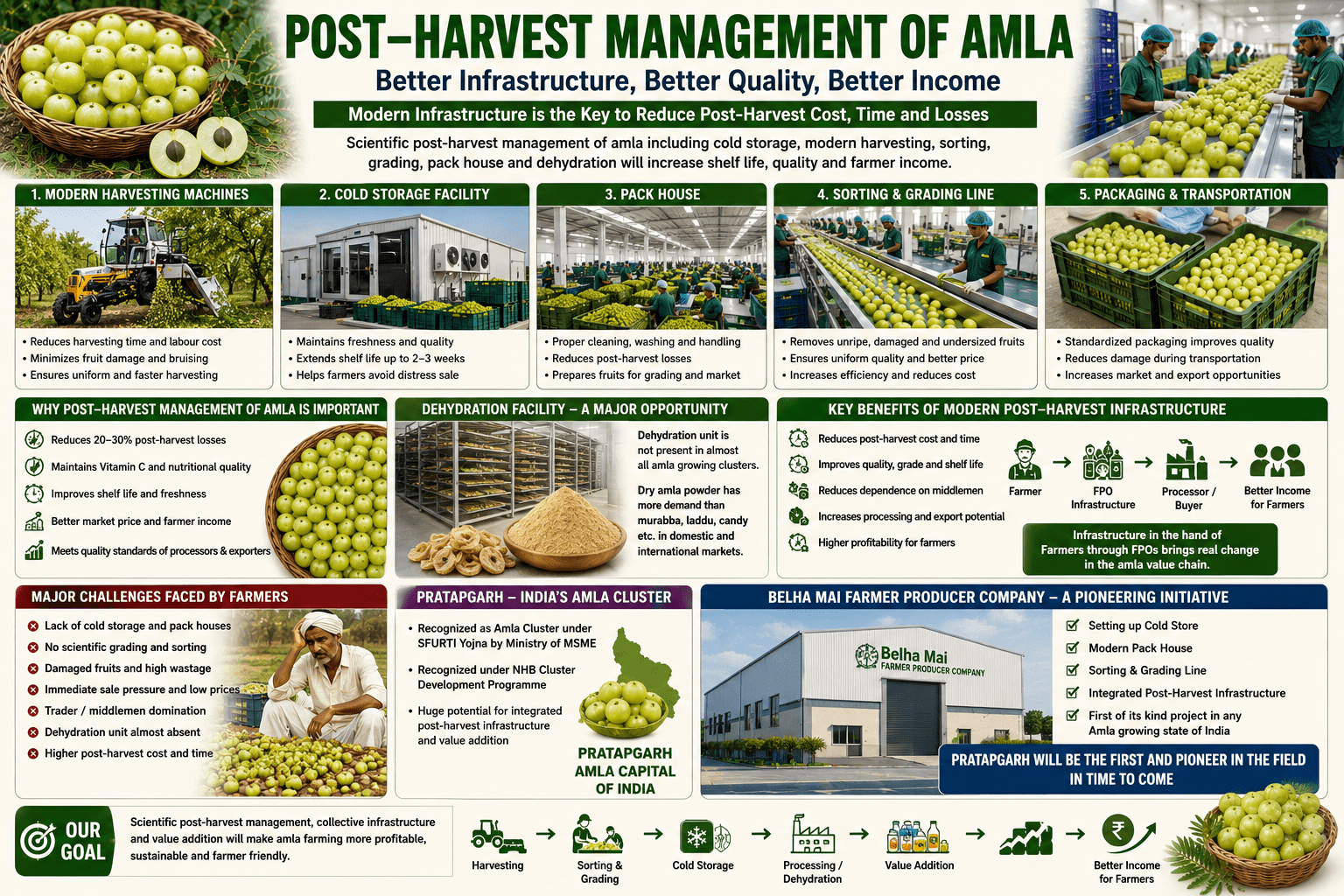
Post-harvest management of amla is one of the most critical factors affecting farmer income, fruit quality, shelf life, and overall profitability in India’s amla industry. Even after years of careful orchard management, farmers often suffer major financial losses due to poor harvesting systems, lack of storage infrastructure, inadequate grading facilities, and trader-controlled marketing channels.
Amla (Indian Gooseberry) is highly perishable after harvesting. Improper handling leads to:
- moisture loss,
- bruising,
- fungal infection,
- reduced Vitamin C content,
- poor market quality,
- and distress sales.
In India, especially in major amla-growing belts like Pratapgarh, post-harvest infrastructure is still highly underdeveloped despite the region being recognized as one of the largest amla clusters in the country.
In this blog, we will understand:
- post-harvest management of amla,
- grading and sorting,
- storage systems,
- cold chain infrastructure,
- dehydration opportunities,
- farmer challenges,
- role of FPOs,
- and how modern infrastructure can transform the amla economy.
Why Post-Harvest Management of Amla Is Important


Proper post-harvest management of amla helps in:
- reducing losses,
- maintaining fruit quality,
- improving shelf life,
- increasing processing efficiency,
- reducing transportation damage,
- and improving farmer price realization.
Amla is widely used for:
- Murabba
- Candy
- Juice
- Pickles
- Chyawanprash
- Herbal supplements
- Ayurvedic medicines
- Dry amla powder
Today, processing industries demand uniform, clean, and properly graded fruits. Without scientific post-harvest systems, farmers lose both quality and market value.
👉 Learn about Amla farming in India: complete guide for Farmers, Processing & Business Opportunities : https://belhamaifpo.com/farmer-producer-organisation/amla-farming-in-india/
Major Problems in Post-Harvest Management of Amla
1. Lack of Cold Storage Facilities


One of the biggest problems in the Indian amla sector is the absence of dedicated cold storage infrastructure near orchards.
As a result:
- farmers are forced into distress sales,
- traders dominate pricing,
- and fruits quickly lose freshness.
Cold storage can:
- extend shelf life,
- reduce wastage,
- improve processing planning,
- and help farmers avoid immediate low-price selling.
👉 Learn about Amla farming profit per acre in India : https://belhamaifpo.com/agriculture/amla-farming-profit-per-acre-in-india-cost-income-complete-business-guide/
2. Absence of Modern Pack Houses
Modern pack houses are still missing in almost all major amla-growing clusters in India.
A proper pack house includes:
- cleaning systems,
- washing units,
- grading lines,
- sorting systems,
- packaging sections,
- and loading facilities.
Without pack houses:
- fruits are mixed randomly,
- quality becomes inconsistent,
- export opportunities decline,
- and transportation losses increase.
3. Lack of Sorting and Grading Lines


Scientific sorting and grading lines are essential for:
- uniform quality,
- better pricing,
- processing efficiency,
- and export readiness.
Most farmers currently sell mixed-grade fruits in mandis where traders exploit quality differences to suppress prices.
Modern grading systems help separate fruits based on:
- size,
- weight,
- appearance,
- and processing quality.
This increases overall value realization.
👉 Learn more about Amla harvesting techniques and best practices : https://belhamaifpo.com/farmer-producer-organisation/amla-harvesting-techniques-and-best-practices/
4. Lack of Modern Harvesting Equipment
Traditional harvesting methods often damage fruits and increase post-harvest losses.
Modern harvesting machines and tools can:
- reduce labor dependency,
- minimize fruit bruising,
- improve harvesting speed,
- and maintain better quality.
Mechanized and scientific harvesting will become increasingly important as labor shortages rise in agriculture.
5. Dehydration Infrastructure Is Almost Absent
One of the most neglected sectors in India’s amla industry is dehydration and dry powder processing.
Why Dehydration Is Important
Dry amla powder today has rapidly growing demand in:
- Ayurveda,
- herbal supplements,
- nutraceutical industries,
- health products,
- and export markets.
In many cases, dry amla powder has:
- higher demand,
- longer shelf life,
- easier transportation,
- and better profitability
than traditional products like:
- Murabba
- Laddu
- Candy
However, dehydration facilities are almost absent in most amla-growing clusters of India.
This is causing a huge missed opportunity for farmers and FPOs.
The Harsh Ground Reality for Orchard Owners
Despite India’s huge amla production, orchard owners remain under tremendous financial pressure.
In states like:
- Uttar Pradesh
- Punjab
- Haryana
- Uttarakhand
- Chhattisgarh
many farmers are forced to lease orchards to Vapari or Khatik traders during harvest season.
The system usually works like this:
Farmer → Vapari → Mandi Trader → Processor → Consumer
What Happens
- Farmers bear yearly orchard expenses
- Traders control harvesting and mandi sales
- Farmers lose pricing power
- Post-harvest infrastructure remains weak
- Most profits go to intermediaries
This exploitative system continues mainly because farmers lack:
- storage,
- grading,
- processing,
- transportation,
- and direct market linkage infrastructure.
Pratapgarh: India’s Emerging Amla Infrastructure Hub
Pratapgarh has long been known as the traditional Amla Capital of India.
The district has now gained further importance because:
- the SFURTI Yojana under the Ministry of MSME recognizes Pratapgarh as an Amla Cluster,
- and the National Horticulture Board (NHB) also recognizes the region under cluster development initiatives.
This recognition creates a massive opportunity for integrated post-harvest infrastructure development.
Belha Mai Farmer Producer Company’s Pioneering Initiative

Belha Mai Farmer Producer Company is playing a critical role in transforming the post-harvest ecosystem of amla in Pratapgarh.
The organization is working toward establishing:
- cold storage infrastructure,
- modern pack houses,
- sorting and grading lines,
- and integrated post-harvest systems for farmers.
This initiative is highly significant because such integrated infrastructure is currently absent in almost all major amla-growing states of India.
Pratapgarh has the potential to become:
- a pioneer in scientific amla post-harvest management,
- a model horticulture cluster,
- and a national example of FPO-led infrastructure development.
How FPOs Can Transform Post-Harvest Management of Amla


Farmer Producer Organizations (FPOs) can completely reshape the amla value chain.
Role of FPOs
Collective Infrastructure Development
FPOs can establish:
- cold stores,
- pack houses,
- dehydration units,
- grading systems,
- and transportation networks.
Reduction in Post-Harvest Losses
Scientific handling significantly reduces wastage.
Better Market Linkage
FPOs can directly connect with:
- processors,
- exporters,
- retailers,
- and nutraceutical companies.
Value Addition
FPOs can manufacture:
- dry amla powder,
- candy,
- juice,
- herbal products,
- and nutraceutical ingredients.
Increased Farmer Share
The maximum value remains within farming communities instead of moving to traders and intermediaries.
Future Scope of Amla Post-Harvest Industry
India’s herbal and nutraceutical industry is growing rapidly.
Demand for:
- dry amla powder,
- herbal ingredients,
- natural Vitamin C products,
- and functional foods
is expected to rise significantly in coming years.
This creates massive opportunities for:
- FPO-led processing,
- dehydration units,
- export-oriented value addition,
- and integrated cluster development.
Regions like Pratapgarh can become global hubs for scientific amla processing if infrastructure development continues.
Conclusion
Post-harvest management of amla is no longer just a technical issue — it is directly connected to farmer income, market control, and the future sustainability of India’s amla industry.
Lack of cold storage, modern harvesting systems, sorting and grading lines, dehydration units, and pack houses has allowed traders and intermediaries to dominate the value chain while orchard owners continue facing financial distress.
However, integrated infrastructure development led by Farmer Producer Organizations can completely transform this system.
The pioneering initiatives being developed in Pratapgarh by Belha Mai Farmer Producer Company have the potential to become a landmark model for India’s amla sector.
If supported properly, Pratapgarh could emerge as the first scientifically integrated amla post-harvest cluster in India and set a new benchmark for farmer-led horticulture infrastructure development.
Some Helpful links: