Introduction
Mango farming is one of the most important long-term horticulture opportunities in India. Unlike seasonal crops, mango is an orchard-based crop. Once the orchard is established properly, it can provide income for many years. However, profit per acre in mango farming depends on many factors such as variety, plant spacing, orchard age, yield, climate, irrigation, pest management, market price, harvesting method, grading, packaging, transport, and market linkage.
India is one of the major mango-producing countries, and Uttar Pradesh is among the leading mango-producing states. APEDA mentions Uttar Pradesh as a major mango-growing state and records India as a prominent exporter of fresh mangoes. This creates strong opportunities for farmers, FPOs, aggregators, processors, and exporters.
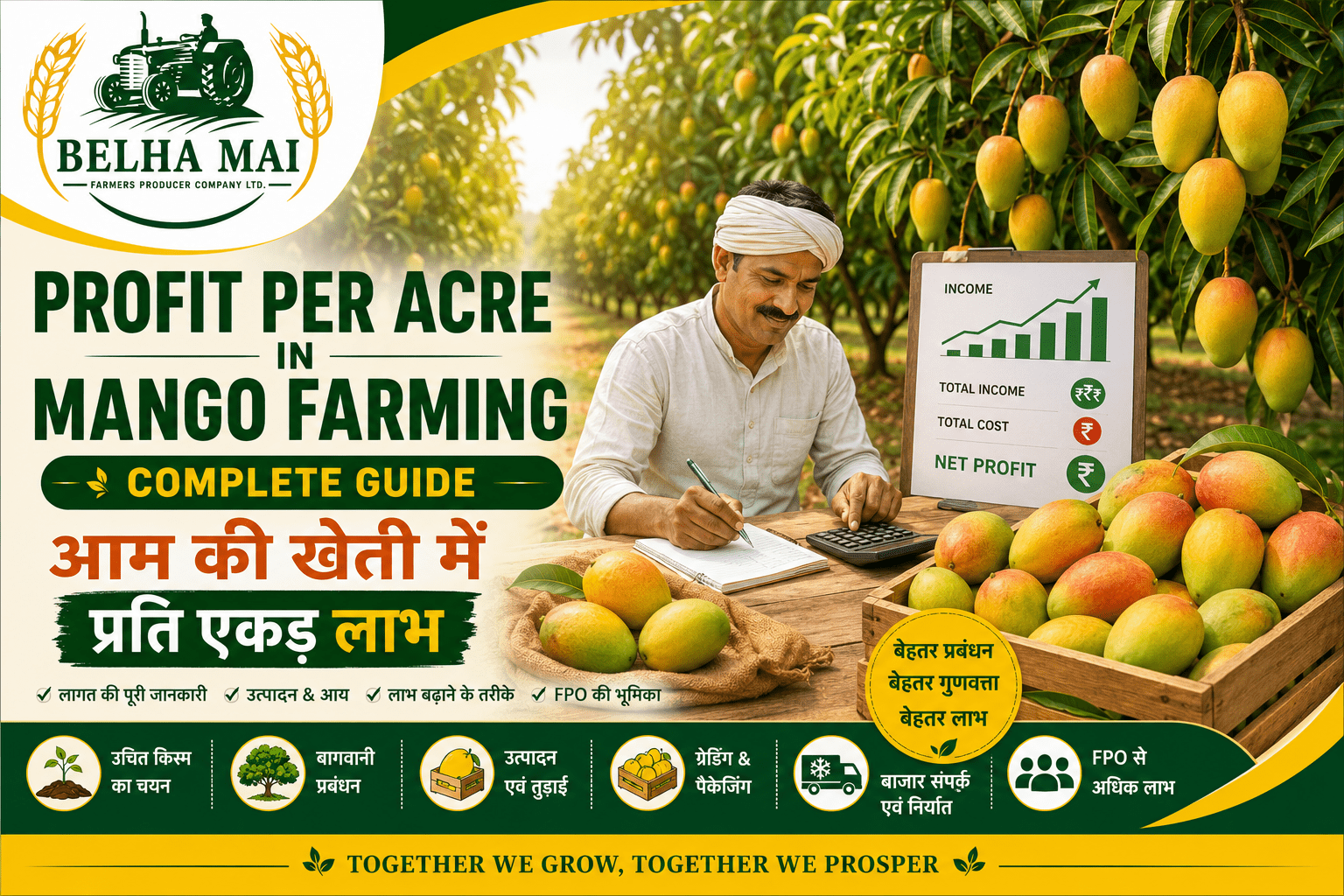
आम की खेती में प्रति एकड़ लाभ
आम की खेती भारत में एक महत्वपूर्ण लंबी अवधि की बागवानी फसल है। यह सामान्य मौसमी फसल की तरह नहीं है। यदि आम का बाग सही तरीके से लगाया और प्रबंधित किया जाए, तो यह कई वर्षों तक किसानों को आय दे सकता है।
आम की खेती में प्रति एकड़ लाभ कई बातों पर निर्भर करता है, जैसे किस्म, पौधों की दूरी, बाग की उम्र, उत्पादन, जलवायु, सिंचाई, कीट-रोग प्रबंधन, बाजार भाव, तुड़ाई का तरीका, ग्रेडिंग, पैकेजिंग, परिवहन और बाजार संपर्क।
Why Mango Farming Profit Varies
Profit in mango farming is not fixed. Two farmers in the same district can earn different income from the same crop. The reason is simple: mango is not only about production, it is also about quality and marketing.
A farmer who sells mixed-quality mangoes in the local mandi may get a lower price. But a farmer or FPO that sorts, grades, packs, and sells to better buyers can get a better price. Export-quality mangoes, branded mangoes, processed mango products, and direct institutional supply can increase the value of the crop.
Weather is also a major factor. Mango flowering and fruit setting are sensitive stages. Recent reports have shown that heat stress and temperature fluctuations can severely affect mango yield and quality, especially in premium mango belts.
आम की खेती में लाभ अलग-अलग क्यों होता है?
आम की खेती में लाभ हर किसान के लिए एक जैसा नहीं होता। एक ही जिले के दो किसान भी अलग-अलग कमाई कर सकते हैं। इसका कारण यह है कि आम की खेती केवल उत्पादन पर निर्भर नहीं करती, बल्कि गुणवत्ता और बाजार संपर्क पर भी निर्भर करती है।
जो किसान बिना ग्रेडिंग के आम स्थानीय मंडी में बेचता है, उसे कम दाम मिल सकते हैं। लेकिन जो किसान या FPO आम की छंटाई, ग्रेडिंग, पैकिंग और बेहतर खरीदारों तक बिक्री करता है, उसे बेहतर दाम मिल सकते हैं।
Main Cost Factors in Mango Farming
The major cost components in mango farming include land preparation, planting material, pit digging, organic manure, fertilizers, irrigation, labour, pruning, plant protection, harvesting, packaging, and transport.
In the initial years, the farmer spends more on orchard establishment and earns little or no income from mango. Regular commercial yield generally starts after the orchard becomes mature, depending on variety and planting system. Traditional orchards take more time, while high-density systems may start giving returns earlier if managed scientifically.
Recent government communication has also highlighted improved mango management practices such as canopy management, high-density planting, balanced nutrient and water management, and climate-resilient technologies for regular flowering.
आम की खेती में मुख्य लागत
आम की खेती में मुख्य लागत इन चीजों पर आती है:
भूमि की तैयारी,
पौध सामग्री,
गड्ढा खुदाई,
जैविक खाद,
उर्वरक,
सिंचाई,
मजदूरी,
कटाई-छंटाई,
कीट और रोग प्रबंधन,
तुड़ाई,
पैकिंग,
और परिवहन।
शुरुआती वर्षों में किसान को बाग लगाने पर खर्च करना पड़ता है, लेकिन आम से कमाई कम नहीं होती। बाग परिपक्व होने के बाद ही अच्छा उत्पादन शुरू होता है।
Mango Yield per Acre
Mango yield per acre depends on variety, tree age, spacing, pruning, soil health, irrigation, nutrition, flowering, pest control, and weather. Traditional mango orchards usually have fewer trees per acre, while high-density mango orchards have more trees per acre.
ICAR-linked horticulture literature explains that mango varieties differ in shelf life and climate suitability, and fruit quality depends strongly on climatic and weather conditions.
In simple terms, farmers should not calculate profit only by counting the number of trees. They should calculate:
number of fruit-bearing trees,
average yield per tree,
total marketable yield,
percentage of damaged fruit,
grading quality,
and selling price per kg.
आम का प्रति एकड़ उत्पादन
आम का प्रति एकड़ उत्पादन किस्म, पौधे की उम्र, पौध दूरी, कटाई-छंटाई, मिट्टी की सेहत, सिंचाई, पोषण, फूल आने की स्थिति, कीट नियंत्रण और मौसम पर निर्भर करता है।
किसान को केवल पेड़ों की संख्या देखकर लाभ नहीं निकालना चाहिए। सही गणना के लिए इन बातों को देखना चाहिए:
कितने पेड़ फल दे रहे हैं,
प्रति पेड़ औसत उत्पादन कितना है,
कुल बिक्री योग्य उत्पादन कितना है,
कितना फल खराब या कम गुणवत्ता वाला है,
ग्रेडिंग के बाद कितनी मात्रा बचती है,
और प्रति किलो बिक्री भाव कितना है।
Simple Profit Formula for Mango Farming
Farmers can use this simple formula:
Gross Income = Total Saleable Mango Quantity × Average Selling Price
Net Profit = Gross Income – Total Cost
Example:
If one acre produces 4,000 kg saleable mangoes and the average selling price is ₹25 per kg:
Gross Income = 4,000 × ₹25 = ₹1,00,000
If total annual cost is ₹35,000:
Net Profit = ₹1,00,000 – ₹35,000 = ₹65,000 per acre
This is only a sample calculation. Actual income may be lower or higher depending on yield, price, quality, location, variety, and market linkage.
आम की खेती में लाभ निकालने का आसान फार्मूला
किसान यह आसान फार्मूला इस्तेमाल कर सकते हैं:
कुल आय = बिक्री योग्य आम की मात्रा × औसत बिक्री मूल्य
शुद्ध लाभ = कुल आय – कुल लागत
उदाहरण:
यदि एक एकड़ से 4,000 किलो बिक्री योग्य आम मिलता है और औसत भाव ₹25 प्रति किलो है:
कुल आय = 4,000 × ₹25 = ₹1,00,000
यदि कुल वार्षिक लागत ₹35,000 है:
शुद्ध लाभ = ₹1,00,000 – ₹35,000 = ₹65,000 प्रति एकड़
यह केवल उदाहरण है। वास्तविक लाभ उत्पादन, भाव, गुणवत्ता, स्थान, किस्म और बाजार संपर्क पर निर्भर करेगा।
How Farmers Can Increase Profit per Acre
Farmers can improve mango profit by focusing on quality, not only quantity. Better orchard management can increase fruit size, reduce disease, improve colour, reduce damage, and increase market value.
Important steps include:
using quality planting material,
proper spacing,
regular pruning,
soil testing,
balanced nutrition,
organic manure,
mulching,
timely irrigation,
integrated pest management,
proper harvesting,
grading,
sorting,
packaging,
and direct market linkage.
ICAR-CISH has a strong research background in mango and subtropical horticulture, and it started as the Central Mango Research Station in 1972. Such institutions are important sources for scientific orchard management knowledge.
प्रति एकड़ लाभ कैसे बढ़ाएं?
किसान आम की खेती में लाभ बढ़ाने के लिए केवल उत्पादन पर ध्यान न दें, बल्कि गुणवत्ता पर भी ध्यान दें। अच्छी गुणवत्ता का आम बेहतर दाम देता है।
लाभ बढ़ाने के लिए किसान इन बातों पर ध्यान दें:
अच्छी पौध सामग्री,
उचित दूरी,
नियमित कटाई-छंटाई,
मिट्टी परीक्षण,
संतुलित पोषण,
जैविक खाद,
मल्चिंग,
समय पर सिंचाई,
समेकित कीट प्रबंधन,
सही समय पर तुड़ाई,
ग्रेडिंग,
छंटाई,
पैकेजिंग,
और सीधे बाजार से संपर्क।
Role of FPO in Increasing Mango Farmer Income
Small farmers usually sell mangoes individually. Because of this, they often have weak bargaining power. FPOs can change this situation by aggregating produce from many farmers and selling in bulk.
An FPO can help mango farmers through:
common input purchase,
nursery support,
training,
soil testing,
orchard advisory,
aggregation,
grading,
packaging,
transport,
branding,
processing,
and buyer linkage.
For Belha Mai Farmers Producer Company Ltd., mango cluster development can create income opportunities through fresh mango marketing, Dasheri and Langra mango branding, mango pulp, aamchur powder, dried mango, pickle, and export-oriented packaging.
आम किसानों की आय बढ़ाने में FPO की भूमिका
छोटे किसान अक्सर अपना आम अकेले बेचते हैं। इससे उनकी सौदेबाजी शक्ति कमजोर रहती है। FPO इस स्थिति को बदल सकता है।
FPO कई किसानों से आम इकट्ठा करके बड़ी मात्रा में बेच सकता है। इससे बेहतर खरीदारों से संपर्क बनता है और किसानों को बेहतर दाम मिल सकते हैं।
FPO आम किसानों की मदद कर सकता है:
इनपुट खरीद,
नर्सरी सहायता,
ट्रेनिंग,
मिट्टी परीक्षण,
बाग सलाह,
एग्रीगेशन,
ग्रेडिंग,
पैकिंग,
परिवहन,
ब्रांडिंग,
प्रोसेसिंग,
और खरीदार संपर्क में।
Processing and Export Can Improve Mango Profit
During peak season, fresh mango prices may fall due to excess supply. Processing helps convert mango into higher-value products such as pulp, puree, juice, pickle, dried mango, aam papad, jam, and aamchur powder.
APEDA separately tracks mango pulp exports, which shows that mango processing is an important part of the mango value chain.
Export can also improve value, but export needs proper compliance. Mangoes for export may require packhouse registration, sorting, grading, treatment, packaging, and destination-specific rules. APEDA records India as a fresh mango exporter, and export-oriented farmers or FPOs must follow strict quality standards.
प्रोसेसिंग और निर्यात से लाभ कैसे बढ़ सकता है?
सीजन में अधिक उत्पादन होने पर ताजे आम के दाम गिर सकते हैं। ऐसे समय में प्रोसेसिंग किसानों और FPO के लिए बड़ा अवसर बन सकती है।
आम से ये उत्पाद बनाए जा सकते हैं:
आम पल्प,
आम प्यूरी,
आम जूस,
अचार,
सूखा आम,
आम पापड़,
जैम,
और आमचूर पाउडर।
निर्यात से भी बेहतर मूल्य मिल सकता है, लेकिन इसके लिए गुणवत्ता मानक, पैकहाउस, ग्रेडिंग, ट्रीटमेंट, पैकिंग और निर्यात नियमों का पालन जरूरी है।
Conclusion
Profit per acre in mango farming depends on production, quality, market linkage, and post-harvest management. A farmer who only produces mango may earn limited income, but a farmer or FPO that focuses on grading, packaging, processing, branding, and direct selling can earn better returns.
For small farmers, FPO-led mango marketing is one of the best ways to improve bargaining power and reduce market risk. Mango should be treated not only as a fruit crop, but as a complete business opportunity covering farming, processing, branding, domestic marketing, and export.
निष्कर्ष
आम की खेती में प्रति एकड़ लाभ उत्पादन, गुणवत्ता, बाजार संपर्क और कटाई के बाद प्रबंधन पर निर्भर करता है। जो किसान केवल आम पैदा करता है, उसकी कमाई सीमित हो सकती है। लेकिन जो किसान या FPO ग्रेडिंग, पैकिंग, प्रोसेसिंग, ब्रांडिंग और सीधे बाजार से जुड़ता है, उसे बेहतर लाभ मिल सकता है।
छोटे किसानों के लिए FPO के माध्यम से आम विपणन एक मजबूत रास्ता है। आम को केवल फल फसल नहीं, बल्कि खेती, प्रोसेसिंग, ब्रांडिंग, घरेलू बिक्री और निर्यात से जुड़ा पूरा बिजनेस अवसर समझना चाहिए।
👉 Learn more about Mango Farming in India: Complete Guide https://belhamaifpo.com/agriculture/mango-farming-in-india/
15. FAQ in English + Hindi
FAQ 1: What is the profit per acre in mango farming?
Profit per acre in mango farming depends on yield, variety, fruit quality, market price, labour cost, packaging, transport, and market linkage. A well-managed mature orchard can give better returns than an unmanaged orchard, but there is no fixed income for all farmers.
प्रश्न 1: आम की खेती में प्रति एकड़ कितना लाभ होता है?
आम की खेती में प्रति एकड़ लाभ उत्पादन, किस्म, फल की गुणवत्ता, बाजार भाव, मजदूरी लागत, पैकेजिंग, परिवहन और बाजार संपर्क पर निर्भर करता है। अच्छा प्रबंधित बाग बिना प्रबंधन वाले बाग से बेहतर लाभ दे सकता है।
FAQ 2: When does mango farming start giving income?
Mango trees usually take a few years to start commercial fruiting. The exact time depends on variety, planting material, spacing, management, and whether the orchard is traditional or high-density.
प्रश्न 2: आम की खेती से कमाई कब शुरू होती है?
आम के पेड़ से व्यावसायिक उत्पादन शुरू होने में कुछ वर्ष लगते हैं। यह किस्म, पौध सामग्री, पौध दूरी, प्रबंधन और बाग की प्रणाली पर निर्भर करता है।
FAQ 3: How can FPOs increase mango farming profit?
FPOs can increase profit by aggregating produce, grading mangoes, arranging packaging, connecting farmers to better buyers, supporting processing, reducing input cost, and improving bargaining power.
प्रश्न 3: FPO आम की खेती में लाभ कैसे बढ़ा सकता है?
FPO किसानों से आम इकट्ठा करके, ग्रेडिंग-पैकिंग करके, बेहतर खरीदारों से जोड़कर, प्रोसेसिंग में मदद करके, इनपुट लागत घटाकर और सौदेबाजी शक्ति बढ़ाकर लाभ बढ़ा सकता है।
FAQ 4: Is mango processing profitable?
Mango processing can be profitable when there is proper raw material supply, processing infrastructure, quality control, packaging, branding, and market linkage. Products like mango pulp, pickle, aamchur, dried mango, and aam papad can reduce wastage and increase value.
प्रश्न 4: क्या आम प्रोसेसिंग लाभदायक है?
हां, यदि कच्चे माल की उपलब्धता, प्रोसेसिंग सुविधा, गुणवत्ता नियंत्रण, पैकेजिंग, ब्रांडिंग और बाजार संपर्क सही हो, तो आम प्रोसेसिंग लाभदायक हो सकती है।
FAQ 5: How can farmers reduce losses in mango farming?
Farmers can reduce losses through proper harvesting, careful handling, sorting, grading, packaging, disease management, transport planning, cold chain support, and selling through organized market channels.
प्रश्न 5: आम की खेती में नुकसान कैसे कम किया जा सकता है?
किसान सही तुड़ाई, सावधानी से हैंडलिंग, छंटाई, ग्रेडिंग, पैकिंग, रोग प्रबंधन, परिवहन योजना, कोल्ड चेन और संगठित बाजार संपर्क से नुकसान कम कर सकते हैं।
16. Internal Links Section
Related Mango Cluster Blogs
- Mango Farming in India: Complete Guide
- Best Mango Varieties in India
- Cultivation of Langra Mango: Complete Guide
- Cultivation of Dasheri Mango: Complete Guide
- Mango Orchard Management Practices
- Mango Flowering and Fruiting Cycle Explained
- Pest and Disease Management in Mango Farming
- Mango Harvesting Techniques
- Post-Harvest Management of Mango
- Mango Grading and Sorting Process
- Mango Packaging for Export
- Mango Cold Storage Solutions
- Mango Export Business in India
- Mango Pulp Processing Business
- Role of FPOs in Mango Marketing
- Government Schemes for Mango Farmers
हिंदी में संबंधित आम क्लस्टर ब्लॉग
- भारत में आम की खेती: पूरी जानकारी
- भारत की प्रमुख आम किस्में
- लंगड़ा आम की खेती: पूरी जानकारी
- दशहरी आम की खेती: पूरी जानकारी
- आम बाग प्रबंधन की प्रमुख विधियाँ
- आम में फूल और फल बनने की प्रक्रिया
- आम की खेती में कीट और रोग प्रबंधन
- आम की तुड़ाई की सही तकनीक
- आम का कटाई के बाद प्रबंधन
- आम की ग्रेडिंग और छंटाई प्रक्रिया
- निर्यात के लिए आम की पैकेजिंग
- आम के लिए कोल्ड स्टोरेज समाधान
- भारत में आम निर्यात व्यवसाय
- आम पल्प प्रोसेसिंग व्यवसाय
- आम विपणन में FPO की भूमिका
- आम किसानों के लिए सरकारी योजनाएँ
17. External Authority Links
Use these authority references naturally inside the blog:
APEDA Mango Page — for mango export and India mango trade reference.https://apeda.gov.in/Mango
NHB Mango Cultivation Page — for mango varieties, orchard planning, and cultivation guidance. https://nhb.gov.in/report_files/mango/mango.htm
ICAR-CISH Lucknow — for mango research and subtropical horticulture reference.https://www.cish.org.in/
PIB Mango Cultivation Update — for improved practices like canopy management, high-density planting, and balanced nutrient-water management. https://www.upkrishivipran.in/pdf/MangoSOP.pdf
APEDA Mango Pulp Page — for mango processing and export potential. https://apeda.gov.in/Mango