Introduction
How collective farming can change rural India is one of the most important questions for the future of Indian agriculture. Most farmers in India are small and marginal farmers. They work hard, but their landholding is small, their production quantity is limited, their bargaining power is weak and their access to machinery, irrigation, storage, credit and markets is often poor. Collective farming can help solve many of these problems by bringing farmers together.
परिचय
सामूहिक खेती कैसे ग्रामीण भारत को बदल सकती है, यह भारतीय कृषि के भविष्य का बहुत महत्वपूर्ण प्रश्न है। भारत में अधिकतर किसान छोटे और सीमांत किसान हैं। वे मेहनत करते हैं, लेकिन उनकी landholding छोटी होती है, production quantity limited होती है, bargaining power कमजोर होती है और machinery, irrigation, storage, credit तथा markets तक access अक्सर कम होता है। Collective farming किसानों को साथ लाकर इन समस्याओं को हल करने में मदद कर सकती है।
What collective farming means
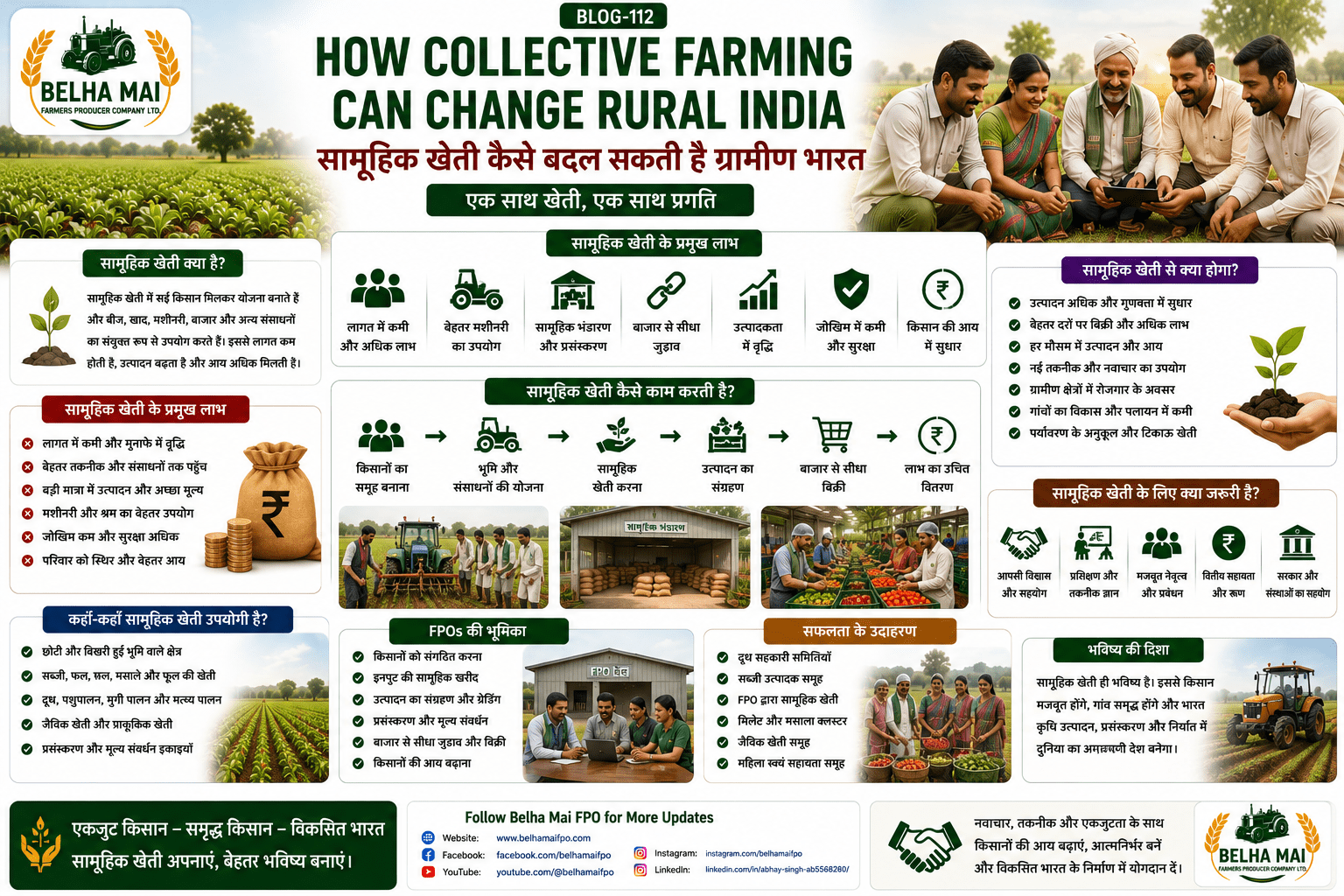
Collective farming means farmers working together for common agricultural goals. It does not always mean merging land ownership. In practical terms, collective farming can mean joint input purchase, shared machinery, group irrigation, collective crop planning, aggregation, shared storage, collective marketing, FPO-led value addition and direct buyer linkage.
सामूहिक खेती का अर्थ
Collective farming का मतलब है किसानों का common agricultural goals के लिए साथ काम करना। इसका मतलब हमेशा land ownership को merge करना नहीं है। Practical terms में collective farming का मतलब joint input purchase, shared machinery, group irrigation, collective crop planning, aggregation, shared storage, collective marketing, FPO-led value addition और direct buyer linkage हो सकता है।
Why collective farming is needed
How collective farming can change rural India becomes clear when we understand the weakness of individual small farmers. A small farmer alone cannot buy expensive machinery, build storage, negotiate with big buyers, process produce, create brands or enter export markets easily. But a group of farmers can do these things together.
सामूहिक खेती की जरूरत क्यों है
सामूहिक खेती कैसे ग्रामीण भारत को बदल सकती है, यह तब स्पष्ट होता है जब हम individual small farmers की कमजोरी समझते हैं। अकेला छोटा किसान expensive machinery नहीं खरीद सकता, storage नहीं बना सकता, big buyers से negotiate नहीं कर सकता, produce process नहीं कर सकता, brands नहीं बना सकता और export markets में आसानी से enter नहीं कर सकता। लेकिन farmers का group यह सब together कर सकता है।
Small landholding is a major challenge
Small landholding is one of the biggest challenges in rural India. When land is divided into small plots, farming becomes less profitable. Small farmers cannot easily use modern machines, irrigation systems, storage systems or advanced farming infrastructure. Collective farming can help small landholders work as a larger unit without losing individual ownership.
छोटी landholding बड़ी challenge है
Small landholding rural India की सबसे बड़ी challenges में से एक है। जब जमीन छोटे-छोटे plots में divided होती है, तो farming कम profitable हो जाती है। Small farmers modern machines, irrigation systems, storage systems या advanced farming infrastructure आसानी से use नहीं कर पाते। Collective farming छोटे landholders को individual ownership खोए बिना larger unit की तरह काम करने में मदद कर सकती है।
Collective input purchase reduces cost
Farmers need seeds, fertilizers, pesticides, bio-inputs, tools and other materials. When farmers buy individually, they may pay higher prices. Through collective farming and FPOs, farmers can purchase inputs in bulk. Bulk purchase can reduce cost, improve quality and reduce chances of fake or poor-quality inputs.
Collective input purchase cost घटाता है
Farmers को seeds, fertilizers, pesticides, bio-inputs, tools और other materials चाहिए। जब farmers individually खरीदते हैं, तो वे higher prices pay कर सकते हैं। Collective farming और FPOs के माध्यम से farmers bulk में inputs purchase कर सकते हैं। Bulk purchase cost घटा सकता है, quality सुधार सकता है और fake या poor-quality inputs की संभावना कम कर सकता है।
Shared machinery makes farming affordable
Modern farm machinery is expensive. Small farmers cannot individually buy tractors, seed drills, sprayers, harvesters, rotavators, super seeders or processing machines. Collective farming can make machinery affordable through shared use, custom hiring centres and FPO machinery banks.
Shared machinery खेती को affordable बनाती है
Modern farm machinery expensive है। Small farmers individually tractors, seed drills, sprayers, harvesters, rotavators, super seeders या processing machines नहीं खरीद सकते। Collective farming shared use, custom hiring centres और FPO machinery banks के माध्यम से machinery को affordable बना सकती है।
Collective irrigation can solve water problems
Many small farmers cannot afford individual borewell, pump, pipeline, drip irrigation or sprinkler system. Collective farming can support group irrigation models. Farmers can share water sources, pumps, pipelines, solar irrigation systems and water conservation structures. This can improve productivity and reduce irrigation risk.
Collective irrigation water problems solve कर सकती है
कई small farmers individual borewell, pump, pipeline, drip irrigation या sprinkler system afford नहीं कर सकते। Collective farming group irrigation models को support कर सकती है। Farmers water sources, pumps, pipelines, solar irrigation systems और water conservation structures share कर सकते हैं। इससे productivity improve हो सकती है और irrigation risk कम हो सकता है।
Better crop planning through collective action
When farmers plan together, they can understand market demand, input needs, harvesting schedule and buyer requirements. Collective crop planning helps avoid oversupply of one crop and shortage of another. How collective farming can change rural India depends strongly on better planning before sowing.
Collective action से better crop planning
जब farmers साथ plan करते हैं, तो वे market demand, input needs, harvesting schedule और buyer requirements समझ सकते हैं। Collective crop planning एक crop की oversupply और दूसरी की shortage से बचने में मदद करती है। सामूहिक खेती कैसे ग्रामीण भारत को बदल सकती है, यह sowing से पहले better planning पर बहुत निर्भर करता है।
Collective farming improves bargaining power
A single farmer with small quantity has weak bargaining power. But many farmers together can create marketable volume. Buyers take organized farmer groups more seriously. Collective farming improves negotiation power and helps farmers ask for better prices.
Collective farming bargaining power बढ़ाती है
Small quantity वाला single farmer weak bargaining power रखता है। लेकिन कई farmers together marketable volume बना सकते हैं। Buyers organized farmer groups को अधिक seriously लेते हैं। Collective farming negotiation power बढ़ाती है और farmers को better prices मांगने में मदद करती है।
Aggregation is the heart of collective farming
Aggregation means collecting produce from many farmers in one place. It is the heart of collective farming. Without aggregation, farmers remain scattered. With aggregation, FPOs can supply larger quantities to processors, exporters, retailers, institutional buyers and government procurement systems.
Aggregation collective farming का heart है
Aggregation का मतलब है कई farmers की produce को एक जगह collect करना। यह collective farming का heart है। Aggregation के बिना farmers scattered रहते हैं। Aggregation के साथ FPOs processors, exporters, retailers, institutional buyers और government procurement systems को larger quantities supply कर सकते हैं।
Collective storage reduces distress selling
Farmers often sell immediately after harvest because they lack storage. Collective farming can help create shared warehouses, cold rooms, packhouses and drying platforms. Shared storage gives farmers the power to wait, compare prices and sell at a better time.
Collective storage distress selling घटाता है
Farmers अक्सर harvest के तुरंत बाद sell करते हैं क्योंकि उनके पास storage नहीं होता। Collective farming shared warehouses, cold rooms, packhouses और drying platforms बनाने में मदद कर सकती है। Shared storage farmers को wait करने, prices compare करने और better time पर sell करने की power देता है।
Grading and sorting improve value
Collective farming can support shared grading and sorting facilities. When produce is graded properly, better-quality produce can receive better prices. FPOs can help farmers follow common quality standards, reduce rejection and improve buyer confidence.
Grading और sorting value सुधारते हैं
Collective farming shared grading और sorting facilities support कर सकती है। जब produce properly graded होती है, तो better-quality produce को better prices मिल सकते हैं। FPOs farmers को common quality standards follow करने, rejection reduce करने और buyer confidence improve करने में मदद कर सकते हैं।
Packaging becomes easier together
Good packaging is important for transport, retail, processing and export markets. Individual farmers may not invest in proper packaging. Collective farming can make packaging affordable through shared packaging units, common labels and FPO-led branding.
Packaging साथ मिलकर आसान होती है
Good packaging transport, retail, processing और export markets के लिए important है। Individual farmers proper packaging में invest नहीं कर पाते। Collective farming shared packaging units, common labels और FPO-led branding के माध्यम से packaging affordable बना सकती है।
Collective marketing improves farmer income
How collective farming can change rural India is strongly connected with collective marketing. When farmers sell together, they can reduce middlemen dependency, negotiate better, reach larger buyers and improve price realization. Collective marketing can convert small farmers into organized suppliers.
Collective marketing farmer income सुधारती है
सामूहिक खेती कैसे ग्रामीण भारत को बदल सकती है, यह collective marketing से strongly connected है। जब farmers साथ sell करते हैं, तो वे middlemen dependency reduce कर सकते हैं, better negotiate कर सकते हैं, larger buyers तक पहुंच सकते हैं और price realization improve कर सकते हैं। Collective marketing small farmers को organized suppliers में बदल सकती है।
Direct buyer linkage becomes possible
Large buyers usually prefer consistent quality and quantity. Individual small farmers cannot easily meet these requirements. Collective farming through FPOs can connect farmers with processors, wholesalers, retailers, hotels, exporters, e-commerce platforms and institutional buyers.
Direct buyer linkage possible होता है
Large buyers generally consistent quality और quantity prefer करते हैं। Individual small farmers ये requirements आसानी से meet नहीं कर पाते। FPOs के माध्यम से collective farming farmers को processors, wholesalers, retailers, hotels, exporters, e-commerce platforms और institutional buyers से connect कर सकती है।
Value addition can happen at village level
Collective farming can support value addition at village level. Farmers can process wheat into flour, paddy into rice, millets into flour, amla into powder, mango into pulp, honey into packaged honey and vegetables into processed products. This keeps more value in rural India.
Value addition गांव स्तर पर हो सकता है
Collective farming village level पर value addition support कर सकती है। Farmers wheat को flour, paddy को rice, millets को flour, amla को powder, mango को pulp, honey को packaged honey और vegetables को processed products में बदल सकते हैं। इससे rural India में more value रहती है।
Processing units become practical collectively
Processing units require machines, electricity, food safety standards, packaging, working capital and marketing. Individual small farmers may not afford this. But FPOs and collective farming groups can build processing units that serve many farmers and create rural employment.
Processing units collectively practical बनते हैं
Processing units को machines, electricity, food safety standards, packaging, working capital और marketing चाहिए। Individual small farmers इसे afford नहीं कर सकते। लेकिन FPOs और collective farming groups ऐसे processing units बना सकते हैं जो many farmers को serve करें और rural employment create करें।
Farmer-owned brands can emerge
Collective farming can help farmers create their own brands. Farmer-owned brands can sell grains, rice, flour, pulses, millets, honey, amla products, mango products and processed foods. Branding gives farmers identity and better market recognition.
Farmer-owned brands बन सकते हैं
Collective farming farmers को अपने brands बनाने में मदद कर सकती है। Farmer-owned brands grains, rice, flour, pulses, millets, honey, amla products, mango products और processed foods sell कर सकते हैं। Branding farmers को identity और better market recognition देती है।
Collective farming supports digital agriculture
Digital agriculture becomes more useful when farmers are organized. FPOs can maintain member records, crop data, input records, production estimates, sales records, payments and traceability. Collective farming creates the structure needed for digital systems.
Collective farming digital agriculture support करती है
Digital agriculture तब more useful होती है जब farmers organized होते हैं। FPOs member records, crop data, input records, production estimates, sales records, payments और traceability maintain कर सकते हैं। Collective farming digital systems के लिए required structure बनाती है।
Collective farming improves access to credit
Banks are more confident when farmers are organized and records are maintained. Collective farming can improve access to credit through FPOs, SHGs, cooperatives and farmer groups. Credit can then support machinery, storage, processing, irrigation and working capital.
Collective farming credit access सुधारती है
Banks तब अधिक confident होते हैं जब farmers organized होते हैं और records maintained होते हैं। Collective farming FPOs, SHGs, cooperatives और farmer groups के माध्यम से credit access improve कर सकती है। Credit फिर machinery, storage, processing, irrigation और working capital support कर सकता है।
Collective farming reduces risk
Farming is risky because of weather, pests, market prices and crop failure. Collective farming can reduce risk through crop diversification, shared knowledge, insurance awareness, storage, buyer linkage and better planning. Risk becomes easier to manage when farmers work together.
Collective farming risk घटाती है
Farming weather, pests, market prices और crop failure के कारण risky है। Collective farming crop diversification, shared knowledge, insurance awareness, storage, buyer linkage और better planning के माध्यम से risk reduce कर सकती है। Farmers साथ काम करें तो risk manage करना आसान होता है।
Knowledge sharing becomes stronger
Farmers learn from each other. Collective farming creates opportunities for training, exposure visits, demonstrations, field schools and local problem-solving. Farmers can share experiences about seed, pest control, irrigation, machinery, market rates and government schemes.
Knowledge sharing मजबूत होती है
Farmers एक-दूसरे से सीखते हैं। Collective farming training, exposure visits, demonstrations, field schools और local problem-solving के opportunities create करती है। Farmers seed, pest control, irrigation, machinery, market rates और government schemes पर experiences share कर सकते हैं।
Youth can lead collective farming
Rural youth can play an important role in collective farming. They can manage digital records, machinery booking, market communication, social media, e-commerce, logistics, packaging, quality control and FPO operations. Youth participation can make collective farming modern and professional.
Youth collective farming lead कर सकते हैं
Rural youth collective farming में important role निभा सकते हैं। वे digital records, machinery booking, market communication, social media, e-commerce, logistics, packaging, quality control और FPO operations manage कर सकते हैं। Youth participation collective farming को modern और professional बना सकता है।
Women can benefit from collective farming
Women can participate in seed production, nursery work, livestock, food processing, packaging, grading, value addition and SHG-FPO enterprises. Collective farming can create income opportunities for women near villages and improve household financial security.
Women collective farming से benefit ले सकती हैं
Women seed production, nursery work, livestock, food processing, packaging, grading, value addition और SHG-FPO enterprises में participate कर सकती हैं। Collective farming women के लिए गांव के पास income opportunities create कर सकती है और household financial security improve कर सकती है।
Sustainable agriculture becomes easier collectively
Sustainable practices such as composting, bio-input preparation, crop rotation, water conservation, agroforestry, soil testing and residue management can be promoted better through collective farming. FPOs can organize training and shared resources for sustainable agriculture.
Sustainable agriculture collectively आसान होती है
Composting, bio-input preparation, crop rotation, water conservation, agroforestry, soil testing और residue management जैसी sustainable practices collective farming के माध्यम से better promote की जा सकती हैं। FPOs sustainable agriculture के लिए training और shared resources organize कर सकते हैं।
Collective farming and climate resilience
Climate change is increasing farming risk. Collective farming can help farmers adapt through shared weather information, water conservation, crop diversification, climate-resilient varieties, insurance awareness and community-level planning. How collective farming can change rural India depends on its ability to help farmers face climate risk together.
Collective farming और climate resilience
Climate change farming risk बढ़ा रहा है। Collective farming shared weather information, water conservation, crop diversification, climate-resilient varieties, insurance awareness और community-level planning के माध्यम से farmers को adapt करने में मदद कर सकती है। सामूहिक खेती कैसे ग्रामीण भारत को बदल सकती है, यह climate risk का साथ मिलकर सामना करने की क्षमता पर depend करता है।
FPOs are the best platform for collective farming
Farmer Producer Organizations are one of the best platforms for collective farming. FPOs give farmers a legal and business structure. They can handle input supply, aggregation, storage, processing, marketing, branding, finance, training and buyer linkage.
FPOs collective farming का best platform हैं
Farmer Producer Organizations collective farming के best platforms में से एक हैं। FPOs farmers को legal और business structure देते हैं। वे input supply, aggregation, storage, processing, marketing, branding, finance, training और buyer linkage handle कर सकते हैं।
FPOs convert farmers into shareholders
In an FPO, farmers are not just beneficiaries. They are members and shareholders. This creates ownership. When farmers own the institution, they can participate in decisions, business planning and long-term growth.
FPOs farmers को shareholders बनाते हैं
FPO में farmers केवल beneficiaries नहीं होते। वे members और shareholders होते हैं। इससे ownership create होती है। जब farmers institution own करते हैं, तो वे decisions, business planning और long-term growth में participate कर सकते हैं।
Collective farming needs trust
Trust is the foundation of collective farming. Farmers must trust each other and the institution. Without trust, collective purchase, collective selling and shared infrastructure do not work. Transparent accounts, fair payment and regular communication build trust.
Collective farming को trust चाहिए
Trust collective farming की foundation है। Farmers को एक-दूसरे और institution पर trust होना चाहिए। Trust के बिना collective purchase, collective selling और shared infrastructure काम नहीं करते। Transparent accounts, fair payment और regular communication trust build करते हैं।
Governance is important
Collective farming needs good governance. Rules should be clear. Records should be transparent. Payments should be timely. Responsibilities should be defined. Leaders should be accountable. Good governance protects farmers and strengthens the institution.
Governance important है
Collective farming को good governance चाहिए। Rules clear होने चाहिए। Records transparent होने चाहिए। Payments timely होने चाहिए। Responsibilities defined होनी चाहिए। Leaders accountable होने चाहिए। Good governance farmers को protect करती है और institution को strengthen करती है।
Professional management is needed
Collective farming should not depend only on emotion. It needs professional management. Accounts, inventory, logistics, quality, buyer communication, compliance, branding and business planning must be handled properly. FPOs need trained teams for this work.
Professional management चाहिए
Collective farming केवल emotion पर depend नहीं करनी चाहिए। इसे professional management चाहिए। Accounts, inventory, logistics, quality, buyer communication, compliance, branding और business planning properly handle होने चाहिए। FPOs को इस work के लिए trained teams चाहिए।
Challenges in collective farming
Collective farming also has challenges. Farmers may have different opinions, different crop choices, different risk capacity and different expectations. There may be trust issues, leadership issues, payment concerns and management problems. These challenges can be solved through transparency, training and clear rules.
Collective farming की challenges
Collective farming में challenges भी हैं। Farmers के opinions, crop choices, risk capacity और expectations अलग हो सकते हैं। Trust issues, leadership issues, payment concerns और management problems हो सकती हैं। इन challenges को transparency, training और clear rules से solve किया जा सकता है।
Collective farming should be voluntary
Farmers should join collective farming with understanding and willingness. It should not be forced. Farmers should clearly understand the benefits, responsibilities, rules, costs and expected returns. Voluntary participation creates long-term success.
Collective farming voluntary होनी चाहिए
Farmers को understanding और willingness के साथ collective farming join करनी चाहिए। यह forced नहीं होनी चाहिए। Farmers को benefits, responsibilities, rules, costs और expected returns clearly समझने चाहिए। Voluntary participation long-term success create करता है।
Government schemes can support collective farming
Government schemes can support FPOs, storage, processing, machinery banks, irrigation, financial inclusion, crop insurance and value addition. Collective farming becomes stronger when farmers use schemes through proper institutions and documentation.
Government schemes collective farming support कर सकती हैं
Government schemes FPOs, storage, processing, machinery banks, irrigation, financial inclusion, crop insurance और value addition को support कर सकती हैं। Collective farming तब stronger होती है जब farmers schemes को proper institutions और documentation के माध्यम से use करते हैं।
Collective farming can reduce rural migration
If farming becomes profitable, organized and enterprise-based, rural youth will not be forced to migrate only for survival. Collective farming can create jobs in machinery services, processing, packaging, logistics, digital services, marketing and FPO management.
Collective farming rural migration घटा सकती है
यदि farming profitable, organized और enterprise-based बने, तो rural youth survival के लिए migration करने को मजबूर नहीं होंगे। Collective farming machinery services, processing, packaging, logistics, digital services, marketing और FPO management में jobs create कर सकती है।
How collective farming can change rural India through income growth
How collective farming can change rural India can be seen through income growth. When farmers reduce input cost, use shared machinery, improve productivity, store produce, sell collectively, process products and build brands, their income can improve. Collective strength converts scattered effort into organized business.
Income growth के माध्यम से collective farming rural India बदल सकती है
सामूहिक खेती कैसे ग्रामीण भारत को बदल सकती है, यह income growth के माध्यम से देखा जा सकता है। जब farmers input cost reduce करते हैं, shared machinery use करते हैं, productivity improve करते हैं, produce store करते हैं, collectively sell करते हैं, products process करते हैं और brands build करते हैं, तो income improve हो सकती है। Collective strength scattered effort को organized business में बदल देती है।
How collective farming can change rural India through social unity
Collective farming also builds social unity. Farmers meet, discuss, plan and solve problems together. This strengthens village-level cooperation. When farmers become organized, they can communicate better with government departments, banks, buyers, startups and institutions.
Social unity के माध्यम से collective farming rural India बदल सकती है
Collective farming social unity भी बनाती है। Farmers साथ बैठते हैं, discuss करते हैं, plan करते हैं और problems solve करते हैं। इससे village-level cooperation strengthen होती है। जब farmers organized होते हैं, तो वे government departments, banks, buyers, startups और institutions से better communicate कर सकते हैं।
How collective farming can change rural India through farmer dignity
How collective farming can change rural India is not only about income. It is also about dignity. A farmer who sells alone may feel weak in the market. A farmer who is part of an FPO, brand, processing unit or collective enterprise feels ownership and confidence.
Farmer dignity के माध्यम से collective farming rural India बदल सकती है
सामूहिक खेती कैसे ग्रामीण भारत को बदल सकती है, यह केवल income के बारे में नहीं है। यह dignity के बारे में भी है। अकेले market में sell करने वाला farmer weak महसूस कर सकता है। लेकिन FPO, brand, processing unit या collective enterprise का हिस्सा किसान ownership और confidence महसूस करता है।
Belha Mai FPO perspective
Belha Mai Farmers Producer Company Ltd. believes that how collective farming can change rural India must be understood from the small farmer’s point of view. Small farmers need collective strength for input supply, irrigation, machinery, storage, aggregation, processing, value addition, credit access and market linkage. FPOs can become the backbone of this transformation.
बेल्हा माई FPO का दृष्टिकोण
Belha Mai Farmers Producer Company Ltd. का मानना है कि सामूहिक खेती कैसे ग्रामीण भारत को बदल सकती है, इसे small farmer के point of view से समझना चाहिए। Small farmers को input supply, irrigation, machinery, storage, aggregation, processing, value addition, credit access और market linkage के लिए collective strength चाहिए। FPOs इस transformation की backbone बन सकते हैं।
Conclusion
How collective farming can change rural India is clear when we look at the real problems of small farmers. Individually, small farmers struggle with cost, machinery, irrigation, storage, market access, credit and bargaining power. Collectively, they can reduce cost, improve productivity, aggregate produce, build infrastructure, access buyers and create rural enterprises.
निष्कर्ष
सामूहिक खेती कैसे ग्रामीण भारत को बदल सकती है, यह small farmers की real problems को देखकर clear होता है। Individually small farmers cost, machinery, irrigation, storage, market access, credit और bargaining power से struggle करते हैं। Collectively वे cost reduce कर सकते हैं, productivity improve कर सकते हैं, produce aggregate कर सकते हैं, infrastructure build कर सकते हैं, buyers access कर सकते हैं और rural enterprises create कर सकते हैं।
The way forward
The way forward is farmer unity, strong FPOs, transparent governance, shared machinery, collective irrigation, storage, grading, processing, branding, digital records, credit access, women and youth participation and direct buyer linkage. How collective farming can change rural India depends on how successfully farmers move from isolated farming to organized farmer-owned enterprises.
आगे का रास्ता
आगे का रास्ता farmer unity, strong FPOs, transparent governance, shared machinery, collective irrigation, storage, grading, processing, branding, digital records, credit access, women and youth participation और direct buyer linkage है। सामूहिक खेती कैसे ग्रामीण भारत को बदल सकती है, यह इस पर depend करेगा कि farmers isolated farming से organized farmer-owned enterprises की ओर कितनी successfully move करते हैं।
FAQ in English
What is collective farming?
Collective farming means farmers working together for input purchase, machinery use, irrigation, crop planning, aggregation, storage, processing, marketing and better income.
How collective farming can change rural India?
How collective farming can change rural India can be understood through reduced input cost, better bargaining power, shared machinery, improved storage, direct market linkage, value addition and stronger FPOs.
Is collective farming useful for small farmers?
Yes, collective farming is very useful for small farmers because it helps them access resources and markets that are difficult to access individually.
Does collective farming mean farmers lose land ownership?
No, collective farming does not always mean losing land ownership. Farmers can keep individual land ownership while working together for inputs, machinery, irrigation, marketing and value addition.
How do FPOs support collective farming?
FPOs support collective farming through input supply, aggregation, storage, grading, processing, branding, credit linkage, training and direct buyer connection.
How does collective farming reduce cost?
Collective farming reduces cost through bulk input purchase, shared machinery, common infrastructure, group irrigation and collective transport.
Can collective farming improve farmer income?
Yes, collective farming can improve farmer income by reducing cost, improving productivity, increasing bargaining power, reducing losses and connecting farmers with better markets.
What are the challenges of collective farming?
Challenges include trust issues, weak governance, different farmer expectations, management problems and payment concerns. These can be reduced through transparency, training and clear rules.
FAQ in Hindi
सामूहिक खेती क्या है?
सामूहिक खेती का मतलब है किसानों का input purchase, machinery use, irrigation, crop planning, aggregation, storage, processing, marketing और better income के लिए साथ काम करना।
सामूहिक खेती कैसे ग्रामीण भारत को बदल सकती है?
सामूहिक खेती कैसे ग्रामीण भारत को बदल सकती है, यह reduced input cost, better bargaining power, shared machinery, improved storage, direct market linkage, value addition और strong FPOs के माध्यम से समझा जा सकता है।
क्या सामूहिक खेती छोटे किसानों के लिए उपयोगी है?
हाँ, collective farming small farmers के लिए बहुत useful है क्योंकि यह उन्हें ऐसे resources और markets access करने में मदद करती है जो individually difficult होते हैं।
क्या collective farming में किसान जमीन की ownership खो देता है?
नहीं, collective farming का मतलब हमेशा land ownership खोना नहीं है। Farmers individual land ownership रखते हुए inputs, machinery, irrigation, marketing और value addition के लिए साथ काम कर सकते हैं।
FPOs collective farming को कैसे support करते हैं?
FPOs input supply, aggregation, storage, grading, processing, branding, credit linkage, training और direct buyer connection के माध्यम से collective farming support करते हैं।
Collective farming cost कैसे घटाती है?
Collective farming bulk input purchase, shared machinery, common infrastructure, group irrigation और collective transport के माध्यम से cost घटाती है।
क्या collective farming farmer income बढ़ा सकती है?
हाँ, collective farming cost reduce करके, productivity improve करके, bargaining power बढ़ाकर, losses घटाकर और farmers को better markets से जोड़कर farmer income बढ़ा सकती है।
Collective farming की challenges क्या हैं?
Challenges में trust issues, weak governance, different farmer expectations, management problems और payment concerns शामिल हैं। इन्हें transparency, training और clear rules से reduce किया जा सकता है।
Internal Links Section
👉 Why small farmers struggle in India
https://belhamaifpo.com/agriculture/why-small-farmers-struggle-in-india/
👉 Role of cooperatives vs FPOs
https://belhamaifpo.com/agriculture/cooperatives-vs-fpos/
👉 How FPOs solve market linkage issues
https://belhamaifpo.com/agriculture/how-fpos-solve-market-linkage-issues/
👉 Access to credit for small farmers
https://belhamaifpo.com/agriculture/access-to-credit-for-small-farmers/
👉 Financial inclusion of farmers
https://belhamaifpo.com/agriculture/financial-inclusion-of-farmers/
👉 Future of Indian agriculture in next 10 years
https://belhamaifpo.com/agriculture/future-of-indian-agriculture/
👉 How farmers can get better market prices
https://belhamaifpo.com/agriculture/better-market-prices-for-farmers/
👉 Farmer Producer Organization
https://belhamaifpo.com/farmer-producer-organization/
👉 Agriculture
https://belhamaifpo.com/agriculture/
External Authority Links
👉 Small Farmers’ Agribusiness Consortium
https://sfacindia.com/
👉 Department of Agriculture & Farmers Welfare
https://agriwelfare.gov.in/
👉 Ministry of Cooperation
https://cooperation.gov.in/
👉 NABARD
https://www.nabard.org/
👉 e-NAM National Agriculture Market
https://www.enam.gov.in/
Follow Belha Mai FPO for More Updates
For more farmer awareness blogs, agriculture updates, FPO development content, product information and practical farming videos, please follow and connect with Belha Mai Farmers Producer Company Ltd.
👉 Website
https://belhamaifpo.com/
👉 Facebook Page
https://www.facebook.com/profile.php?id=61561043486818
👉 YouTube Channel
https://www.youtube.com/channel/UC9ZvojoTMCa7mU1-Q_Bh60A
👉 LinkedIn
https://www.linkedin.com/in/abhay-singh-ab5568280/
👉 Instagram
https://instagram.com/belhamaifpo
Belha Mai FPO is working to support farmers through better information, technology, market linkage, value addition, FPO awareness and rural development.