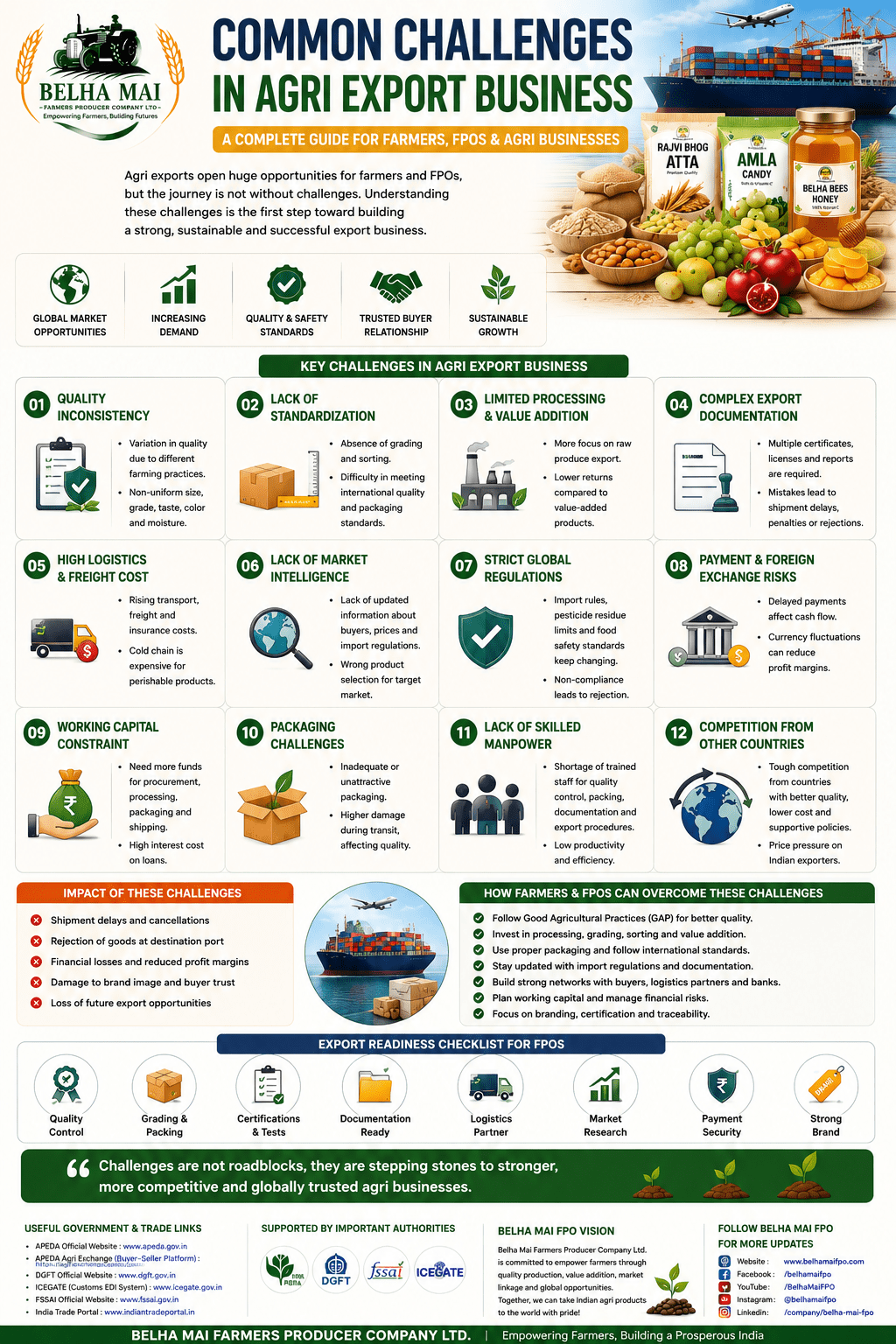
कृषि निर्यात व्यवसाय की सामान्य चुनौतियाँ
Introduction
Agri Export Business can create strong opportunities for farmers, Farmer Producer Organisations, food processors and rural entrepreneurs. Indian agricultural products such as rice, fruits, vegetables, honey, spices, millets, amla products, mango products, processed foods and dehydrated products have demand in many international markets.
कृषि निर्यात व्यवसाय किसानों, किसान उत्पादक संगठनों, खाद्य प्रसंस्करण इकाइयों और ग्रामीण उद्यमियों के लिए बड़े अवसर पैदा कर सकता है। भारत के कृषि उत्पाद जैसे चावल, फल, सब्जियाँ, शहद, मसाले, मिलेट्स, आँवला उत्पाद, आम उत्पाद, प्रसंस्कृत खाद्य पदार्थ और निर्जलित उत्पाद कई अंतरराष्ट्रीय बाजारों में मांग रखते हैं।
However, Agri Export Business is not simple. It requires quality control, proper documentation, strong packaging, buyer verification, logistics planning, compliance, payment security and professional communication.
लेकिन कृषि निर्यात व्यवसाय सरल नहीं है। इसके लिए गुणवत्ता नियंत्रण, सही दस्तावेज़ीकरण, मजबूत पैकेजिंग, खरीदार की जाँच, लॉजिस्टिक्स योजना, नियमों का पालन, भुगतान सुरक्षा और पेशेवर संवाद की आवश्यकता होती है।
Many farmers and FPOs have good products, but they struggle because they are not fully prepared for export requirements. Export success depends not only on production but also on systems, discipline and market understanding.
कई किसानों और FPOs के पास अच्छे उत्पाद होते हैं, लेकिन वे संघर्ष करते हैं क्योंकि वे निर्यात आवश्यकताओं के लिए पूरी तरह तैयार नहीं होते। निर्यात की सफलता केवल उत्पादन पर नहीं, बल्कि व्यवस्था, अनुशासन और बाजार की समझ पर भी निर्भर करती है।
Why Agri Export Business Is Challenging
Agri Export Business is challenging because it connects local farm production with international market expectations. A product that sells easily in a local mandi may not be accepted by an international buyer unless it meets quality, packaging, labelling, testing and documentation requirements.
कृषि निर्यात व्यवसाय चुनौतीपूर्ण इसलिए है क्योंकि यह स्थानीय कृषि उत्पादन को अंतरराष्ट्रीय बाजार की अपेक्षाओं से जोड़ता है। जो उत्पाद स्थानीय मंडी में आसानी से बिक जाता है, वह अंतरराष्ट्रीय खरीदार द्वारा तब तक स्वीकार नहीं किया जा सकता जब तक वह गुणवत्ता, पैकेजिंग, लेबलिंग, परीक्षण और दस्तावेज़ीकरण की आवश्यकताओं को पूरा न करे।
Export buyers compare suppliers from many countries. They look for consistent quality, competitive price, timely delivery, food safety, proper certificates and professional handling.
निर्यात खरीदार कई देशों के आपूर्तिकर्ताओं की तुलना करते हैं। वे समान गुणवत्ता, प्रतिस्पर्धी मूल्य, समय पर आपूर्ति, खाद्य सुरक्षा, सही प्रमाणपत्र और पेशेवर व्यवस्था देखते हैं।
Therefore, FPOs must understand export as a complete business system. Export is not only about sending products abroad; it is about meeting international expectations again and again.
इसलिए FPOs को निर्यात को एक पूर्ण व्यावसायिक प्रणाली के रूप में समझना चाहिए। निर्यात केवल उत्पादों को विदेश भेजने का काम नहीं है; यह बार-बार अंतरराष्ट्रीय अपेक्षाओं को पूरा करने की प्रक्रिया है।
Quality Inconsistency
Quality inconsistency is one of the biggest challenges in agri export business. Agricultural products often vary in size, colour, taste, moisture, maturity, grade and cleanliness because they come from different farms, different harvesting stages and different farming practices.
गुणवत्ता में असमानता कृषि निर्यात व्यवसाय की सबसे बड़ी चुनौतियों में से एक है। कृषि उत्पादों के आकार, रंग, स्वाद, नमी, परिपक्वता, ग्रेड और स्वच्छता में अक्सर अंतर होता है, क्योंकि ये उत्पाद अलग-अलग खेतों, अलग-अलग कटाई चरणों और अलग-अलग खेती पद्धतियों से आते हैं।
International buyers expect uniform quality in every shipment. If one shipment is good and the next shipment is poor, buyer trust is damaged.
अंतरराष्ट्रीय खरीदार हर shipment में समान गुणवत्ता की अपेक्षा करते हैं। यदि एक shipment अच्छी हो और अगली shipment खराब हो, तो खरीदार का भरोसा कमजोर हो जाता है।
FPOs must solve this challenge through grading, sorting, farmer training, standard operating procedures and quality inspection before packaging.
FPOs को इस चुनौती को grading, sorting, farmer training, standard operating procedures और packaging से पहले quality inspection के माध्यम से हल करना चाहिए।
Lack of Standardisation
Lack of standardisation makes export difficult. Many farmers produce good crops, but the produce may not be standardised according to export grade.
मानकीकरण की कमी निर्यात को कठिन बनाती है। कई किसान अच्छी फसल पैदा करते हैं, लेकिन वह उत्पाद निर्यात ग्रेड के अनुसार मानकीकृत नहीं होता।
Export buyers may ask for specific size, colour, moisture level, broken percentage, residue level, packaging type or shelf life. If the product does not match the agreed standard, the shipment may face rejection or price deduction.
निर्यात खरीदार विशेष आकार, रंग, नमी स्तर, टूटे हुए दानों का प्रतिशत, residue level, पैकेजिंग प्रकार या shelf life की मांग कर सकते हैं। यदि उत्पाद तय मानक से मेल नहीं खाता, तो shipment को rejection या price deduction का सामना करना पड़ सकता है।
FPOs should create product-wise standards before entering export. Rice, flour, honey, amla powder, mango pulp and dehydrated products should all have clear quality parameters.
FPOs को निर्यात में प्रवेश करने से पहले हर उत्पाद के लिए अलग-अलग मानक बनाने चाहिए। चावल, आटा, शहद, आँवला पाउडर, आम pulp और निर्जलित उत्पादों के लिए स्पष्ट गुणवत्ता मानक होने चाहिए।
Limited Processing and Value Addition
Many agri exporters depend only on raw produce. This limits profit and increases risk because raw products are often perishable, price-sensitive and difficult to differentiate.
कई कृषि निर्यातक केवल कच्चे उत्पादों पर निर्भर रहते हैं। इससे लाभ सीमित हो जाता है और जोखिम बढ़ जाता है, क्योंकि कच्चे उत्पाद अक्सर जल्दी खराब होने वाले, मूल्य-संवेदनशील और अलग पहचान बनाने में कठिन होते हैं।
Value addition helps improve shelf life, brand identity and market value. Processing can convert raw produce into more stable and higher-value products.
मूल्य संवर्धन shelf life, brand identity और market value को बेहतर बनाता है। प्रसंस्करण कच्चे उत्पादों को अधिक स्थिर और अधिक मूल्य वाले उत्पादों में बदल सकता है।
For FPOs, processing can include cleaning, grading, milling, dehydration, pulping, powder making, packaging, labelling and branding. Products such as Rajvi Bhog atta, dalia, suji, amla powder, dry amla, mango pulp, dehydrated mango and Belha Bees honey can create better export opportunities when properly processed and packed.
FPOs के लिए processing में cleaning, grading, milling, dehydration, pulping, powder making, packaging, labelling और branding शामिल हो सकते हैं। Rajvi Bhog atta, dalia, suji, amla powder, dry amla, mango pulp, dehydrated mango और Belha Bees honey जैसे उत्पाद सही processing और packaging के साथ बेहतर निर्यात अवसर बना सकते हैं।
Export Documentation Challenges
Export documentation is a major challenge in Agri Export Business. Food and agricultural exports may require commercial invoice, packing list, shipping bill, bill of lading or airway bill, certificate of origin, APEDA RCMC where applicable, FSSAI license, certificate of analysis, phytosanitary certificate where required and buyer-specific certificates.
कृषि निर्यात व्यवसाय में export documentation एक बड़ी चुनौती है। खाद्य और कृषि निर्यात के लिए commercial invoice, packing list, shipping bill, bill of lading या airway bill, certificate of origin, जहाँ लागू हो APEDA RCMC, FSSAI license, certificate of analysis, जहाँ आवश्यक हो phytosanitary certificate और खरीदार द्वारा मांगे गए विशेष प्रमाणपत्रों की आवश्यकता हो सकती है।
Even a small mistake in documents can delay shipment or payment. Product name, quantity, HS code, invoice value, buyer address, shipment details and certificate details must match across all documents.
दस्तावेज़ों में छोटी गलती भी shipment या payment में देरी कर सकती है। उत्पाद का नाम, मात्रा, HS code, invoice value, खरीदार का पता, shipment details और certificate details सभी दस्तावेज़ों में समान होने चाहिए।
FPOs should work with experienced customs brokers, freight forwarders and banks during initial export shipments. Later, the FPO team can build internal documentation capacity.
शुरुआती export shipments में FPOs को अनुभवी customs brokers, freight forwarders और banks के साथ काम करना चाहिए। बाद में FPO अपनी टीम के भीतर documentation क्षमता विकसित कर सकता है।
Food Safety and Compliance Requirements
Food safety requirements are strict in international markets. Buyers may ask for FSSAI details, lab test reports, pesticide residue reports, microbial reports, heavy metal reports, HACCP, ISO 22000 or organic certification depending on the product and market.
अंतरराष्ट्रीय बाजारों में खाद्य सुरक्षा की आवश्यकताएँ कड़ी होती हैं। खरीदार उत्पाद और बाजार के अनुसार FSSAI details, lab test reports, pesticide residue reports, microbial reports, heavy metal reports, HACCP, ISO 22000 या organic certification मांग सकते हैं।
For FPOs, compliance should not be treated as a burden. It is a tool for buyer trust and long-term market access.
FPOs को compliance को बोझ नहीं समझना चाहिए। यह खरीदार का भरोसा बनाने और लंबे समय तक बाजार तक पहुँच बनाए रखने का साधन है।
Strong food safety practices, hygiene, batch records, testing and traceability can help farmer-led brands enter better markets.
मजबूत food safety practices, hygiene, batch records, testing और traceability किसान-नेतृत्व वाले brands को बेहतर बाजारों में प्रवेश करने में मदद कर सकते हैं।
Packaging Challenges
Packaging is one of the most visible parts of export business. Poor packaging can cause leakage, breakage, moisture damage, insect attack, spoilage and rejection.
पैकेजिंग निर्यात व्यवसाय का सबसे दिखाई देने वाला हिस्सा है। खराब पैकेजिंग से leakage, breakage, moisture damage, insect attack, spoilage और rejection हो सकता है।
Export packaging must be strong enough to survive long-distance transport, handling, storage and climate variation. A good product can lose its value if the packaging fails during transit.
Export packaging इतनी मजबूत होनी चाहिए कि वह लंबी दूरी के transport, handling, storage और climate variation को सहन कर सके। यदि transit के दौरान packaging खराब हो जाए, तो अच्छा उत्पाद भी अपना मूल्य खो सकता है।
FPOs should choose packaging based on product type. Flour and powder products need moisture-proof packaging, honey needs food-grade and leakage-proof containers, dehydrated fruits need protection from air and moisture, and fresh fruits need strong cartons with proper ventilation.
FPOs को उत्पाद के प्रकार के अनुसार packaging चुननी चाहिए। आटा और powder products को moisture-proof packaging चाहिए, शहद को food-grade और leakage-proof containers चाहिए, dehydrated fruits को हवा और नमी से सुरक्षा चाहिए, और fresh fruits को सही ventilation वाले मजबूत cartons चाहिए।
Labelling Requirements
Labelling requirements can differ from country to country. Export labels may need product name, ingredients, net weight, batch number, manufacturing date, expiry or best-before date, country of origin, importer details, storage instructions, allergen information and certification details.
लेबलिंग की आवश्यकताएँ देश के अनुसार बदल सकती हैं। Export labels में product name, ingredients, net weight, batch number, manufacturing date, expiry या best-before date, country of origin, importer details, storage instructions, allergen information और certification details की आवश्यकता हो सकती है।
A wrong label can create customs issues, buyer complaints or product rejection. FPOs should confirm label requirements with the buyer before printing packaging material.
गलत label से customs issues, buyer complaints या product rejection हो सकता है। FPOs को packaging material print करने से पहले buyer से label requirements की पुष्टि करनी चाहिए।
Labelling should be treated as part of compliance, not only as part of design. A beautiful label is not useful if it does not meet legal and buyer requirements.
Labelling को केवल design का हिस्सा नहीं, बल्कि compliance का हिस्सा समझना चाहिए। सुंदर label उपयोगी नहीं है यदि वह कानूनी और खरीदार की आवश्यकताओं को पूरा नहीं करता।
Logistics and Freight Cost
Logistics cost is a major challenge in Agri Export Business. Goods must move from farm or processing unit to warehouse, port, airport or final buyer location.
कृषि निर्यात व्यवसाय में logistics cost एक बड़ी चुनौती है। माल को खेत या processing unit से warehouse, port, airport या final buyer location तक पहुँचाना होता है।
Costs may include loading, unloading, inland transport, container charges, port handling, freight, insurance and sometimes cold chain. If these costs are not calculated properly, export profit can disappear.
इन costs में loading, unloading, inland transport, container charges, port handling, freight, insurance और कभी-कभी cold chain शामिल हो सकते हैं। यदि इन costs की सही गणना नहीं की गई, तो export profit समाप्त हो सकता है।
For perishable products such as fresh fruits and vegetables, logistics is even more challenging. Delay can reduce quality and shelf life.
Fresh fruits और vegetables जैसे जल्दी खराब होने वाले उत्पादों के लिए logistics और भी चुनौतीपूर्ण होता है। देरी से गुणवत्ता और shelf life कम हो सकती है।
Cold Chain Challenge
Fresh fruits, vegetables, dairy, frozen foods and some processed products may need cold chain. Cold chain includes pre-cooling, refrigerated storage, refrigerated transport and temperature control during shipment.
Fresh fruits, vegetables, dairy, frozen foods और कुछ processed products को cold chain की आवश्यकता हो सकती है। Cold chain में pre-cooling, refrigerated storage, refrigerated transport और shipment के दौरान temperature control शामिल होता है।
Many FPOs do not have access to proper cold chain infrastructure. This limits their ability to export fresh produce to distant markets.
कई FPOs के पास उचित cold chain infrastructure की सुविधा नहीं होती। इससे दूर के बाजारों में fresh produce export करने की उनकी क्षमता सीमित हो जाती है।
To reduce risk, FPOs can first focus on processed, dehydrated or shelf-stable products where cold chain dependence is lower.
जोखिम कम करने के लिए FPOs पहले processed, dehydrated या shelf-stable products पर ध्यान दे सकते हैं, जिनमें cold chain पर निर्भरता कम होती है।
Buyer Verification
Finding international buyers is important, but verifying buyers is even more important. Not every buyer enquiry is genuine.
International buyers खोजना महत्वपूर्ण है, लेकिन buyers की जाँच करना उससे भी अधिक महत्वपूर्ण है। हर buyer enquiry वास्तविक नहीं होती।
Some buyers collect prices only, some act as middlemen without real demand, and some may create payment risk. FPOs should not rush into shipment without checking buyer credibility.
कुछ buyers केवल कीमतें इकट्ठी करते हैं, कुछ वास्तविक मांग के बिना middlemen के रूप में काम करते हैं, और कुछ payment risk पैदा कर सकते हैं। FPOs को buyer credibility जाँचे बिना shipment में जल्दबाजी नहीं करनी चाहिए।
FPOs should verify buyer website, company registration, import history, business address, references, communication behaviour and payment terms.
FPOs को buyer website, company registration, import history, business address, references, communication behaviour और payment terms की जाँच करनी चाहिए।
Payment Risk
Payment risk is one of the most serious challenges in Agri Export Business. Exporters may face delayed payment, partial payment, deduction disputes or non-payment.
कृषि निर्यात व्यवसाय में payment risk सबसे गंभीर चुनौतियों में से एक है। Exporters को delayed payment, partial payment, deduction disputes या non-payment का सामना करना पड़ सकता है।
This can create major cash flow problems, especially for FPOs with limited working capital. If payment is delayed, the FPO may struggle to pay farmers, workers and suppliers.
यह cash flow की बड़ी समस्या पैदा कर सकता है, विशेष रूप से उन FPOs के लिए जिनके पास सीमित working capital होता है। यदि payment में देरी होती है, तो FPO को farmers, workers और suppliers को भुगतान करने में कठिनाई हो सकती है।
For new buyers, FPOs should prefer safer payment terms such as advance payment, partial advance, Letter of Credit or secure documentary payment.
नए buyers के लिए FPOs को advance payment, partial advance, Letter of Credit या secure documentary payment जैसे सुरक्षित payment terms को प्राथमिकता देनी चाहिए।
Currency Fluctuation
Export payments are often made in foreign currency. Currency rates can change between quotation, shipment and payment realisation.
Export payments अक्सर foreign currency में किए जाते हैं। Quotation, shipment और payment realisation के बीच currency rates बदल सकते हैं।
If the currency moves against the exporter, profit margin can reduce. This risk should be considered while preparing export pricing.
यदि currency exporter के विरुद्ध चली जाती है, तो profit margin कम हो सकता है। Export pricing तैयार करते समय इस risk को ध्यान में रखना चाहिए।
FPOs should include a small buffer for currency risk and should understand bank charges, conversion rates and payment timelines before confirming orders.
FPOs को currency risk के लिए छोटा buffer रखना चाहिए और order confirm करने से पहले bank charges, conversion rates और payment timelines को समझना चाहिए।
Working Capital Constraint
Export requires working capital. FPOs may need money for procurement, processing, packaging, testing, certification, transport, documentation and freight before receiving payment from the buyer.
Export के लिए working capital की आवश्यकता होती है। Buyer से payment प्राप्त करने से पहले FPOs को procurement, processing, packaging, testing, certification, transport, documentation और freight के लिए धन की आवश्यकता हो सकती है।
If payment comes late, working capital remains blocked. This can affect the next procurement cycle and farmer payments.
यदि payment देर से आता है, तो working capital फँसा रहता है। इससे अगला procurement cycle और किसानों का भुगतान प्रभावित हो सकता है।
FPOs should plan export orders according to their financial capacity. They should avoid taking very large orders without clear funding and payment security.
FPOs को अपनी financial capacity के अनुसार export orders की योजना बनानी चाहिए। स्पष्ट funding और payment security के बिना बहुत बड़े orders लेने से बचना चाहिए।
High Certification and Testing Cost
Certification and testing can be expensive for small exporters. Lab testing, pesticide residue reports, microbial tests, heavy metal tests, organic certification, HACCP or ISO certification may increase cost.
छोटे exporters के लिए certification और testing महंगे हो सकते हैं। Lab testing, pesticide residue reports, microbial tests, heavy metal tests, organic certification, HACCP या ISO certification से cost बढ़ सकती है।
However, certification can also open better markets. Serious buyers often prefer tested, certified and well-documented products.
हालाँकि certification बेहतर बाजारों के द्वार भी खोल सकता है। गंभीर खरीदार अक्सर tested, certified और well-documented products को प्राथमिकता देते हैं।
FPOs should not take every certification blindly. They should choose certifications based on product type, buyer requirement and target market.
FPOs को हर certification बिना सोचे नहीं लेना चाहिए। उन्हें product type, buyer requirement और target market के आधार पर certifications चुनने चाहिए।
Market Intelligence Gap
Many FPOs do not have updated information about international demand, buyer preferences, price trends, importing country rules and competitor countries.
कई FPOs के पास international demand, buyer preferences, price trends, importing country rules और competitor countries के बारे में updated information नहीं होती।
Without market intelligence, export decisions become risky. A product may be available locally, but that does not automatically mean it has good export demand.
Market intelligence के बिना export decisions जोखिमपूर्ण हो जाते हैं। कोई product स्थानीय रूप से उपलब्ध हो सकता है, लेकिन इसका अर्थ यह नहीं कि उसकी export demand भी अच्छी होगी।
FPOs should regularly study APEDA updates, DGFT notifications, trade portals, buyer enquiries, export reports and market trends.
FPOs को APEDA updates, DGFT notifications, trade portals, buyer enquiries, export reports और market trends का नियमित अध्ययन करना चाहिए।
Competition from Other Countries
Indian exporters compete with suppliers from many countries. For fruits, vegetables, grains, spices and processed foods, buyers compare quality, price, packaging, supply reliability and certifications.
Indian exporters कई देशों के suppliers के साथ प्रतिस्पर्धा करते हैं। Fruits, vegetables, grains, spices और processed foods में buyers quality, price, packaging, supply reliability और certifications की तुलना करते हैं।
Some countries may have lower logistics cost, better infrastructure or stronger market access. Therefore, Indian FPOs must improve their systems to compete effectively.
कुछ देशों की logistics cost कम, infrastructure बेहतर या market access अधिक मजबूत हो सकता है। इसलिए Indian FPOs को प्रभावी प्रतिस्पर्धा के लिए अपनी व्यवस्था सुधारनी होगी।
FPOs should not compete only on price. They should compete through quality, traceability, farmer-led story, better packaging, food safety, reliability and value addition.
FPOs को केवल price पर प्रतिस्पर्धा नहीं करनी चाहिए। उन्हें quality, traceability, farmer-led story, better packaging, food safety, reliability और value addition के माध्यम से प्रतिस्पर्धा करनी चाहिए।
Policy and Regulation Changes
Export rules can change due to government policy, food security needs, international restrictions, quality alerts or destination country regulations.
Export rules government policy, food security needs, international restrictions, quality alerts या destination country regulations के कारण बदल सकते हैं।
Sudden changes can affect shipment plans, pricing and buyer commitments. Therefore, exporters must stay updated before confirming orders.
अचानक बदलाव shipment plans, pricing और buyer commitments को प्रभावित कर सकते हैं। इसलिए exporters को orders confirm करने से पहले updated रहना चाहिए।
FPOs should stay updated with DGFT, APEDA, FSSAI, customs and destination country rules. Before confirming any order, exporters should check whether the product is freely exportable and whether any special condition applies.
FPOs को DGFT, APEDA, FSSAI, customs और destination country rules से updated रहना चाहिए। कोई भी order confirm करने से पहले exporters को यह जाँचना चाहिए कि product freely exportable है या उस पर कोई special condition लागू है।
Rejection at Destination Port
Rejection at destination port can cause major financial loss. Rejection may happen due to quality failure, wrong documents, pest detection, residue issues, labelling mistakes, damaged packaging or non-compliance with buyer country rules.
Destination port पर rejection से बड़ा financial loss हो सकता है। Rejection quality failure, wrong documents, pest detection, residue issues, labelling mistakes, damaged packaging या buyer country rules के non-compliance के कारण हो सकता है।
To reduce rejection risk, FPOs should check product quality, lab reports, documents, packaging, certificates and buyer requirements before shipment.
Rejection risk कम करने के लिए FPOs को shipment से पहले product quality, lab reports, documents, packaging, certificates और buyer requirements की जाँच करनी चाहिए।
Export should not be done in a hurry. A delayed but correct shipment is better than a rushed shipment that gets rejected.
Export जल्दबाजी में नहीं करना चाहिए। थोड़ी देर से भेजी गई सही shipment उस जल्दबाजी में भेजी गई shipment से बेहतर है जो reject हो जाए।
Lack of Skilled Manpower
Export requires trained people. The team must understand documentation, quality control, packaging, buyer communication, logistics, finance and compliance.
Export के लिए प्रशिक्षित लोगों की आवश्यकता होती है। Team को documentation, quality control, packaging, buyer communication, logistics, finance और compliance की समझ होनी चाहिए।
Many FPOs struggle because their team is not trained for export operations. Even a good product can fail if the team cannot handle export systems properly.
कई FPOs इसलिए संघर्ष करते हैं क्योंकि उनकी team export operations के लिए प्रशिक्षित नहीं होती। यदि team export systems को सही तरीके से नहीं संभाल सकती, तो अच्छा product भी असफल हो सकता है।
FPOs should invest in training. A small trained team can manage export better than a large untrained team.
FPOs को training में निवेश करना चाहिए। एक छोटी प्रशिक्षित team बड़ी अप्रशिक्षित team से बेहतर export manage कर सकती है।
Poor Communication with Buyers
Poor communication can damage export relationships. International buyers expect timely replies, clear product information, proper documents, professional emails and honest updates.
खराब communication export relationships को नुकसान पहुँचा सकता है। International buyers timely replies, clear product information, proper documents, professional emails और honest updates की अपेक्षा करते हैं।
Delayed or unclear communication reduces trust. If the buyer does not get clear answers, they may move to another supplier.
देरी से या अस्पष्ट communication भरोसा कम करता है। यदि buyer को स्पष्ट जवाब नहीं मिलते, तो वह दूसरे supplier के पास जा सकता है।
FPOs should prepare standard product catalogues, price sheets, company profiles, email formats and response formats. This improves professionalism and saves time.
FPOs को standard product catalogues, price sheets, company profiles, email formats और response formats तैयार करने चाहिए। इससे professionalism बढ़ता है और समय बचता है।
Common Mistakes in Agri Export Business
One common mistake is starting export without preparation. Some exporters find a buyer first and then start arranging documents, packaging and testing.
एक सामान्य गलती बिना तैयारी के export शुरू करना है। कुछ exporters पहले buyer खोजते हैं और फिर documents, packaging और testing की व्यवस्था शुरू करते हैं।
This creates delay, confusion and risk. Export readiness should begin before buyer negotiation, not after order confirmation.
इससे delay, confusion और risk पैदा होता है। Export readiness buyer negotiation से पहले शुरू होनी चाहिए, order confirmation के बाद नहीं।
Another mistake is quoting price without full cost calculation. Export pricing must include processing, packaging, testing, documentation, logistics, freight, insurance, bank charges, currency risk and profit margin.
दूसरी गलती पूरी cost calculation के बिना price quote करना है। Export pricing में processing, packaging, testing, documentation, logistics, freight, insurance, bank charges, currency risk और profit margin शामिल होना चाहिए।
How FPOs Can Overcome Export Challenges
FPOs can overcome export challenges step by step. The first step is product readiness. The product should be cleaned, graded, tested, packed and labelled properly.
FPOs export challenges को चरणबद्ध तरीके से दूर कर सकते हैं। पहला कदम product readiness है। Product को properly cleaned, graded, tested, packed और labelled होना चाहिए।
The second step is compliance readiness. IEC, APEDA RCMC where applicable, FSSAI, test reports and documentation should be ready before export discussion becomes serious.
दूसरा कदम compliance readiness है। Export discussion गंभीर होने से पहले IEC, जहाँ लागू हो APEDA RCMC, FSSAI, test reports और documentation तैयार होना चाहिए।
The third step is market readiness. FPOs should identify target countries, buyer types, price range, product demand and competitor products.
तीसरा कदम market readiness है। FPOs को target countries, buyer types, price range, product demand और competitor products की पहचान करनी चाहिए।
The fourth step is financial readiness. Working capital, payment terms, risk buffer and export pricing should be planned carefully.
चौथा कदम financial readiness है। Working capital, payment terms, risk buffer और export pricing की सावधानीपूर्वक योजना बनानी चाहिए।
Export Readiness Checklist for FPOs
Before entering Agri Export Business, an FPO should check product quality, quantity availability, packaging, shelf life, testing, certifications, export documents, buyer verification, pricing, logistics partner, payment security and internal team capacity.
Agri Export Business में प्रवेश करने से पहले FPO को product quality, quantity availability, packaging, shelf life, testing, certifications, export documents, buyer verification, pricing, logistics partner, payment security और internal team capacity की जाँच करनी चाहिए।
A clear checklist reduces mistakes. Export should be treated as a planned business process, not an urgent shipment activity.
एक स्पष्ट checklist गलतियों को कम करती है। Export को जल्दबाजी वाली shipment activity नहीं, बल्कि planned business process के रूप में देखना चाहिए।
When an FPO follows a system, it can reduce risk, improve buyer trust and build long-term export relationships.
जब कोई FPO एक व्यवस्थित प्रक्रिया का पालन करता है, तो वह risk कम कर सकता है, buyer trust बढ़ा सकता है और long-term export relationships बना सकता है।
Belha Mai FPO Vision for Agri Export Business
Belha Mai Farmers Producer Company Ltd. understands that Agri Export Business can create new opportunities for farmers, but only when the business is built on quality, trust and professionalism.
Belha Mai Farmers Producer Company Ltd. समझता है कि कृषि निर्यात व्यवसाय किसानों के लिए नए अवसर पैदा कर सकता है, लेकिन यह तभी संभव है जब व्यापार गुणवत्ता, भरोसे और पेशेवर व्यवस्था पर आधारित हो।
Products under Rajvi Bhog, Belha Bees, mango value addition and amla value addition can gradually move toward export readiness with proper systems.
Rajvi Bhog, Belha Bees, mango value addition और amla value addition के अंतर्गत आने वाले उत्पाद सही व्यवस्था के साथ धीरे-धीरे export readiness की ओर बढ़ सकते हैं।
For Belha Mai FPO, the goal is not only to export products but to create farmer-led brands that can compete with quality in global markets.
Belha Mai FPO का लक्ष्य केवल products export करना नहीं है, बल्कि ऐसे farmer-led brands बनाना है जो global markets में गुणवत्ता के आधार पर प्रतिस्पर्धा कर सकें।
Export challenges are not roadblocks; they are steps that help build a stronger and more disciplined organisation.
Export challenges बाधाएँ नहीं हैं; वे ऐसे कदम हैं जो एक मजबूत और अधिक अनुशासित संगठन बनाने में मदद करते हैं।
Conclusion
Agri Export Business offers strong opportunities, but it also brings serious challenges. Quality inconsistency, documentation errors, packaging issues, logistics cost, buyer verification, payment risk, certification cost, compliance rules and working capital pressure can affect export success.
Agri Export Business मजबूत अवसर देता है, लेकिन इसके साथ गंभीर चुनौतियाँ भी आती हैं। Quality inconsistency, documentation errors, packaging issues, logistics cost, buyer verification, payment risk, certification cost, compliance rules और working capital pressure export success को प्रभावित कर सकते हैं।
For farmers, FPOs and agri businesses, the solution is preparation. With quality control, documentation discipline, packaging improvement, buyer verification, export pricing, trained manpower and strong branding, FPOs can reduce risk and build a sustainable export business.
Farmers, FPOs और agri businesses के लिए समाधान तैयारी है। Quality control, documentation discipline, packaging improvement, buyer verification, export pricing, trained manpower और strong branding के माध्यम से FPOs risk कम करके sustainable export business बना सकते हैं।
In the future of the Food Processing Industry in India, FPOs that understand export challenges and prepare properly will have better chances in global markets.
Food Processing Industry in India के भविष्य में वे FPOs global markets में बेहतर अवसर प्राप्त करेंगे जो export challenges को समझकर सही तैयारी करेंगे।
FAQ
What are the common challenges in Agri Export Business?
Common challenges in Agri Export Business include quality inconsistency, documentation errors, packaging issues, logistics cost, buyer verification, payment risk, certification cost, working capital pressure and global compliance.
Agri Export Business की सामान्य चुनौतियों में quality inconsistency, documentation errors, packaging issues, logistics cost, buyer verification, payment risk, certification cost, working capital pressure और global compliance शामिल हैं।
Why do agri export shipments get rejected?
Agri export shipments may get rejected due to poor quality, wrong documents, pest detection, residue issues, damaged packaging, wrong labelling or non-compliance with importing country rules.
Agri export shipments poor quality, wrong documents, pest detection, residue issues, damaged packaging, wrong labelling या importing country rules के non-compliance के कारण reject हो सकती हैं।
How can FPOs reduce export risk?
FPOs can reduce export risk through quality control, proper documentation, buyer verification, safe payment terms, good packaging, lab testing, traceability and trained manpower.
FPOs quality control, proper documentation, buyer verification, safe payment terms, good packaging, lab testing, traceability और trained manpower के माध्यम से export risk कम कर सकते हैं।
Why is buyer verification important in export?
Buyer verification is important because unknown or fake buyers can create payment risk, price misuse, sample misuse or shipment disputes.
Buyer verification महत्वपूर्ण है क्योंकि unknown या fake buyers payment risk, price misuse, sample misuse या shipment disputes पैदा कर सकते हैं।
What should FPOs do before entering export business?
FPOs should prepare product quality, documents, certifications, packaging, pricing, buyer list, payment safety, logistics partner and internal export team before entering export business.
FPOs को export business में प्रवेश करने से पहले product quality, documents, certifications, packaging, pricing, buyer list, payment safety, logistics partner और internal export team तैयार करनी चाहिए।
Internal Links Section
👉 Food Processing Industry in India: Complete Guide
👉 Export Pricing Strategy for Agri Products
👉 Top Countries Importing Indian Fruits and Grains
👉 Global Demand for Indian Agricultural Products
👉 Export Documentation for Food Products
👉 How to Find International Buyers for Agri Products
External Authority Links
👉 ICEGATE – Indian Customs EDI Gateway
Follow Belha Mai FPO for More Updates
Stay connected with Belha Mai Farmers Producer Company Ltd. for more updates on agriculture, food processing, farmer development, FPO awareness, market linkage, value addition, rural entrepreneurship and sustainable farming.
कृषि, food processing, farmer development, FPO awareness, market linkage, value addition, rural entrepreneurship और sustainable farming से जुड़ी जानकारी के लिए Belha Mai Farmers Producer Company Ltd. से जुड़े रहें।
👉 Website
👉 YouTube
Belha Mai FPO is committed to supporting farmers through better information, technology, market linkage, value addition, FPO awareness and rural development.
Belha Mai FPO बेहतर जानकारी, technology, market linkage, value addition, FPO awareness और rural development के माध्यम से किसानों को सहयोग देने के लिए प्रतिबद्ध है।