Introduction
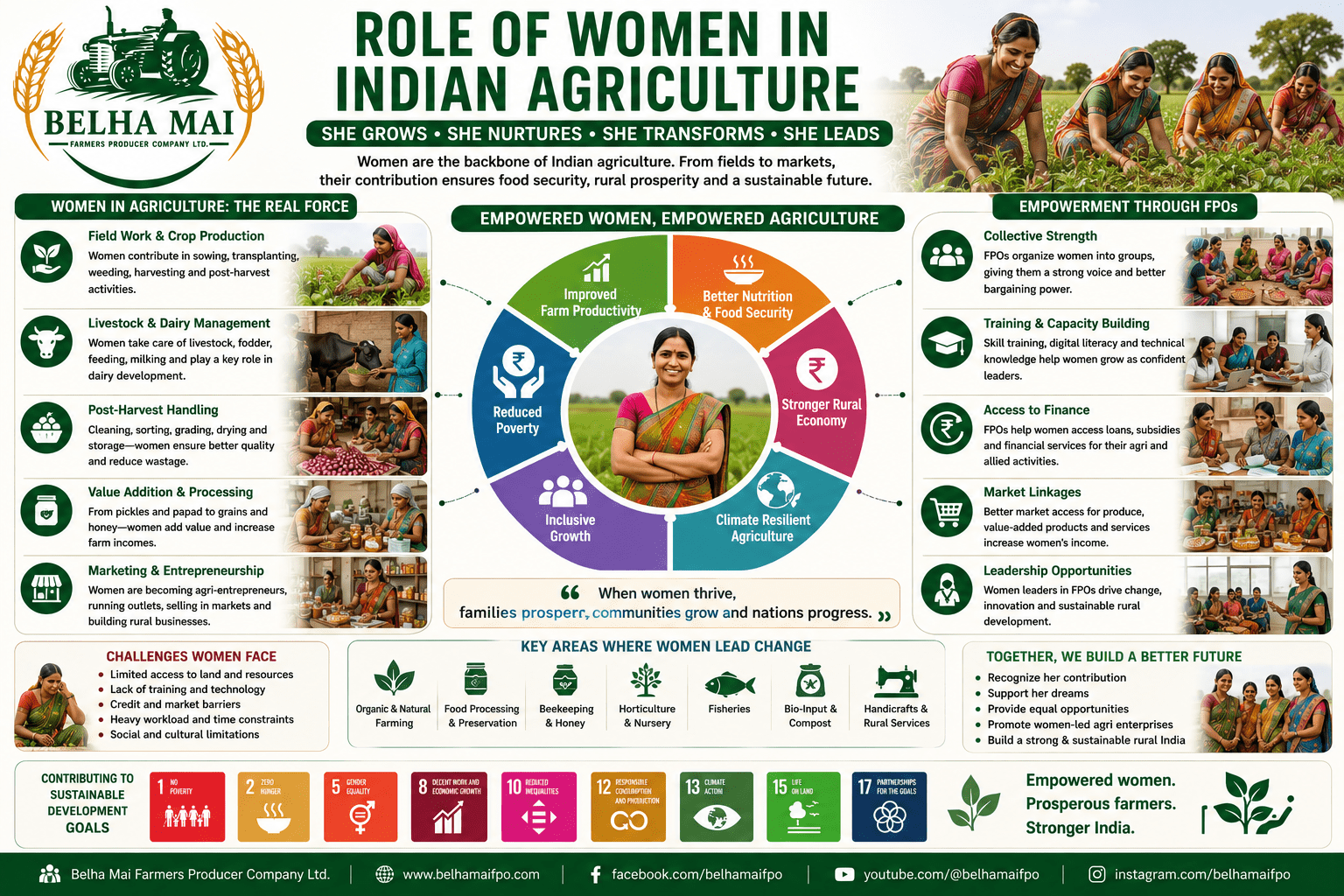
Role of Women in Indian Agriculture is one of the most important subjects in rural development, food security, women empowerment, and sustainable agriculture. Women are deeply involved in farming activities across India, yet their contribution is often under-recognized. From sowing seeds to harvesting crops, from livestock care to post-harvest handling, from family nutrition to value addition, women form the backbone of rural agriculture.
In many villages, women work in the field, manage household food systems, care for animals, preserve seeds, process farm produce, support marketing, and participate in informal decision-making. However, they often face limited access to land ownership, finance, training, technology, machinery, markets, and formal leadership opportunities.
Farmer Producer Organizations, Self-Help Groups, cooperatives, rural enterprises, CSR initiatives, and government programs can play a major role in strengthening women’s participation in agriculture. When women are recognized, trained, included, and empowered, Indian agriculture becomes more productive, inclusive, and sustainable.
Role of Women in Indian Agriculture Through Field Work
Role of Women in Indian Agriculture begins with field work. Women participate in many crop production activities such as seed selection, sowing, transplanting, weeding, irrigation support, harvesting, threshing, cleaning, grading, and storage.
In several farming households, women work side by side with men during the entire crop cycle. Their labour is essential for timely farming operations and crop management. Without women’s contribution, agricultural productivity and household food security would be seriously affected.
Field work by women is not only physical labour. It also includes knowledge of crops, seasons, seeds, soil, water, pests, and local farming practices. This knowledge must be respected and strengthened through training, technology, and institutional support.
Role of Women in Indian Agriculture Through Seed Preservation
Women have traditionally played an important role in seed preservation. In many rural families, women select, clean, dry, store, and protect seeds for the next season. This work helps preserve local varieties and supports food security.
Seed preservation requires experience and careful handling. Women often understand which seeds are healthy, which varieties perform better locally, and how seeds should be stored safely.
FPOs and rural institutions can strengthen this role by training women in seed quality, seed treatment, storage methods, local seed banks, and seed enterprise development. This can turn traditional knowledge into a stronger income opportunity.
Role of Women in Indian Agriculture Through Livestock Management
Livestock is a major part of rural livelihoods, and women play a central role in its management. They often care for cows, buffaloes, goats, poultry, and other animals. Their work includes feeding, cleaning, fodder collection, milking, animal care, and household-level dairy management.
Livestock provides regular income, nutrition, manure, and financial security for rural families. Women’s daily work in livestock management supports both agriculture and household welfare.
With better training, veterinary support, fodder management, dairy linkage, goatery development, poultry support, and market access, women can become stronger contributors to rural income generation.
Role of Women in Indian Agriculture Through Post-Harvest Handling
Post-harvest handling is one of the most important areas where women contribute significantly. Women are involved in cleaning, drying, grading, sorting, threshing, storage, packaging, and preparing produce for sale or household use.
These activities affect the quality and value of farm produce. Poor post-harvest handling can reduce prices and increase wastage. Women’s careful work often helps protect produce quality.
FPOs can create better post-harvest opportunities for women through training, grading centers, packaging units, storage systems, processing units, and quality control roles. This can convert unpaid or low-paid work into recognized employment.
Role of Women in Indian Agriculture Through Value Addition
Value addition is a powerful area for women’s participation. Women can contribute to food processing, flour production, spice grinding, pickle making, honey packaging, fruit processing, amla products, mango products, millet products, pulses, snacks, and local food brands.
Value addition helps increase the value of farm produce and creates income beyond raw agricultural sale. Women-led processing units can become strong rural livelihood models.
When women participate in value addition, they gain income, skills, confidence, and visibility. This also helps rural families retain more value within the village economy.
Role of Women in Indian Agriculture Through Food Processing
Food processing offers strong employment opportunities for rural women. Processing activities such as cleaning, cutting, drying, grinding, cooking, bottling, packaging, labeling, and quality checking can create regular income.
Women are often highly skilled in food preparation and preservation. With proper training, hygiene standards, packaging support, branding, and market linkage, these skills can become formal business opportunities.
FPOs can support women in food processing by creating common facilities, providing raw material, training workers, maintaining quality standards, and connecting products with markets.
Role of Women in Indian Agriculture Through Family Nutrition
Women play an important role in family nutrition. They often decide how food is stored, cooked, distributed, and consumed within the household. Their knowledge affects the health and nutrition of children, elderly people, and working family members.
Agriculture and nutrition are closely connected. When women are involved in kitchen gardens, pulses, millets, vegetables, fruits, dairy, poultry, and diversified farming, household nutrition improves.
Women-centered agriculture can support food security and better health outcomes. This makes women’s role important not only for income but also for community well-being.
Role of Women in Indian Agriculture Through Natural Farming
Women can play a strong role in natural farming and sustainable agriculture. Many natural farming practices involve composting, seed treatment, bio-input preparation, mulching, mixed cropping, kitchen gardens, and livestock-based inputs.
Women are often closely connected with household biomass, livestock, kitchen waste, and local resources. This makes them important participants in low-cost sustainable farming practices.
FPOs can support women in natural farming through training, demonstration plots, bio-input preparation units, and market linkage for naturally grown produce.
Role of Women in Indian Agriculture Through Soil Health
Women can contribute to soil health through compost preparation, organic matter management, crop residue use, kitchen waste composting, vermicompost, farmyard manure handling, and natural input preparation.
Soil health is the foundation of sustainable agriculture. When women are trained in soil testing, balanced fertilizer use, composting, and organic input management, their role becomes even stronger.
Women’s participation in soil health programs can help reduce input costs, improve productivity, and protect long-term farming resources.
Role of Women in Indian Agriculture Through Water Management
Women often understand the importance of water because they manage household water use and observe field-level water needs. In agriculture, they can support irrigation management, mulching, kitchen gardens, water-saving practices, and crop planning.
Water conservation is essential for climate-resilient agriculture. Women’s participation in water management programs can improve adoption at the household and community level.
FPOs and development partners can include women in water conservation training, micro-irrigation awareness, farm pond planning, and climate-smart farming discussions.
Role of Women in Indian Agriculture Through Climate Resilience
Climate change affects women farmers deeply. Irregular rainfall, heat stress, crop failure, water scarcity, fodder shortage, and rising costs increase the burden on rural women.
Women can also be important agents of climate resilience. They can participate in crop diversification, seed preservation, kitchen gardens, livestock care, natural farming, water conservation, and local adaptation strategies.
When women are included in climate action programs, rural communities become more resilient. Their knowledge and participation are essential for sustainable agriculture.
Role of Women in Indian Agriculture Through FPO Participation
FPOs can create a formal platform for women’s participation in agriculture. Women can become shareholders, board members, group leaders, workers, entrepreneurs, trainers, and decision-makers.
FPO participation gives women access to training, market information, input services, value addition, finance, processing opportunities, and leadership roles. This helps women move from invisible labour to recognized economic participation.
A women-inclusive FPO can improve both farmer income and social development. It can create a stronger and more balanced rural economy.
Role of Women in Indian Agriculture Through Self-Help Groups
Self-Help Groups have played an important role in rural women’s empowerment. SHGs help women save money, access credit, build confidence, and start small income activities.
When SHGs connect with agriculture and FPOs, they can support processing, packaging, livestock, kitchen gardens, seed banks, bio-inputs, local marketing, and rural enterprises.
This connection between SHGs and FPOs can create strong women-led livelihood models. It can also improve financial inclusion and community-level development.
Role of Women in Indian Agriculture Through Rural Entrepreneurship
Women can become rural entrepreneurs through agriculture-based businesses. These may include food processing, dairy, poultry, goatery, beekeeping, mushroom cultivation, nursery raising, bio-input production, composting, packaging, and local retail.
Rural entrepreneurship gives women income and independence. It also creates jobs for other women and strengthens the village economy.
FPOs, CSR organizations, NGOs, banks, and government schemes can support women entrepreneurs through training, finance, infrastructure, branding, and market linkage.
Role of Women in Indian Agriculture Through Market Linkages
Women often contribute to production and processing, but they may have limited access to markets. Better market linkage can help women earn more from their work.
FPOs can help women connect with local markets, retail buyers, institutions, exhibitions, online platforms, food companies, and direct consumers. Market linkage is essential for turning women’s work into income.
When women understand pricing, packaging, quality, branding, and buyer requirements, they become stronger participants in the agricultural value chain.
Role of Women in Indian Agriculture Through Digital Tools
Digital tools can help women access information, training, market prices, government schemes, weather updates, payment systems, and customer networks. However, many rural women still face digital literacy gaps.
FPOs and development partners can train women in mobile use, WhatsApp groups, digital payments, online marketing, digital records, and farmer apps.
Digital inclusion can increase women’s confidence and participation. It can also help them connect with markets and institutions more directly.
Role of Women in Indian Agriculture Through Financial Inclusion
Women often have limited access to formal finance. Lack of land ownership, collateral, documentation, mobility, and financial literacy can restrict their ability to invest in farming or enterprise.
Financial inclusion is essential for women’s empowerment in agriculture. Women need access to savings, credit, insurance, working capital, government schemes, and enterprise finance.
FPOs, SHGs, banks, NABARD, government departments, CSR organizations, and NGOs can work together to improve women’s financial access and business confidence.
Role of Women in Indian Agriculture Through Leadership
Women’s leadership is essential for inclusive rural development. Women should not only work in agriculture but also take part in planning, management, decision-making, and institution building.
Leadership roles in FPOs, SHGs, cooperatives, processing units, village committees, and farmer groups can strengthen women’s voice. Women leaders can identify problems that may otherwise remain ignored.
When women lead, development becomes more balanced, practical, and community-focused. Leadership also inspires other women to participate.
Role of Women in Indian Agriculture Through Skill Development
Skill development is necessary to improve women’s income and confidence. Women need training in farming practices, livestock care, food processing, packaging, quality control, digital tools, bookkeeping, marketing, machinery use, and enterprise management.
Skill development helps women move from low-paid labour to higher-value roles. It also prepares them for entrepreneurship and leadership.
CSR organizations, NGOs, government agencies, FPOs, and training institutions can create strong skill programs for rural women in agriculture.
Role of Women in Indian Agriculture Through Farm Mechanisation
Farm mechanisation can reduce the physical burden on women. Many traditional farm activities require heavy manual effort, and women often spend long hours in difficult conditions.
Women-friendly tools and machines can reduce drudgery in weeding, harvesting, threshing, carrying, processing, and post-harvest work. Training women to use machines can also create new employment opportunities.
FPO-led machinery access can help women farmers benefit from technology without needing to purchase expensive equipment individually.
Role of Women in Indian Agriculture Through Beekeeping
Beekeeping can be a strong livelihood activity for women. It supports honey production, pollination, biodiversity, and additional income. Women can participate in honey extraction, filtering, bottling, labeling, packaging, and marketing.
FPOs can help women access beekeeping training, equipment, processing support, quality control, branding, and market linkage.
Women-led honey enterprises can create regular income and support sustainable rural development.
Role of Women in Indian Agriculture Through Horticulture and Nursery Activities
Horticulture and nursery activities can create strong opportunities for women. Women can participate in plant propagation, nursery management, grafting support, pot filling, watering, plant care, grading, and sales.
Fruit crops, vegetables, medicinal plants, flowers, and nursery plants can provide income across seasons. These activities can also be connected with FPO-led market and enterprise models.
Women-led nursery activities can support climate action, income generation, and rural entrepreneurship.
Role of Women in Indian Agriculture Through Agro-Processing
Agro-processing is one of the strongest opportunities for women in agriculture. It creates work in cleaning, grading, sorting, cutting, drying, processing, packaging, quality control, and product preparation.
Women can participate in processing units for grains, fruits, honey, amla, mango, millets, spices, pulses, and other rural products.
Agro-processing helps women earn locally and supports year-round income. It also strengthens farmer income by adding value to farm produce.
Role of Women in Indian Agriculture Through Sustainable Development Goals
Women’s role in agriculture is directly connected with Sustainable Development Goals. It supports SDG 1 No Poverty, SDG 2 Zero Hunger, SDG 5 Gender Equality, SDG 8 Decent Work, SDG 12 Responsible Production, SDG 13 Climate Action, SDG 15 Life on Land, and SDG 17 Partnerships.
When women are empowered in agriculture, rural development becomes stronger. Women’s participation improves income, nutrition, sustainability, family welfare, and community resilience.
This makes women central to both agriculture and sustainable development.
Challenges Faced by Women in Indian Agriculture
Women in agriculture face many challenges. These include limited land ownership, low recognition, lack of formal identity as farmers, limited access to finance, low access to training, technology gaps, market barriers, mobility restrictions, unpaid labour, and heavy workload.
Many women work in agriculture but are not officially recognized as farmers. This affects their access to schemes, credit, insurance, training, and institutional support.
Solving these challenges requires policy support, institutional inclusion, FPO participation, financial access, skill development, and social recognition.
Belha Mai FPO and Women in Agriculture
Belha Mai Farmers Producer Company Ltd. recognizes the importance of women in agriculture and rural development. Women’s participation is essential for stronger farming systems, value addition, household stability, and sustainable rural livelihoods.
Through FPO-led activities such as farmer services, value addition, processing, digital outreach, market linkage, and sustainable agriculture, women can play a stronger role in the rural economy.
For Belha Mai FPO, empowering women in agriculture means strengthening families, farmers, villages, and the future of rural India.
Why Women’s Role in Agriculture Matters for India’s Future
India’s agricultural future cannot be strong without women. Women already contribute deeply to farming, livestock, post-harvest work, nutrition, processing, and rural livelihoods. The next step is to recognize, train, include, and empower them.
When women receive equal opportunities, agriculture becomes more productive and inclusive. Families become more stable, children benefit, and rural communities become stronger.
Women are not only helping agriculture survive. They are helping agriculture transform.
Conclusion
Role of Women in Indian Agriculture can be understood through one clear truth: women are central to farming, food security, family welfare, and rural development. Their contribution begins in the field and continues through livestock, post-harvest work, processing, value addition, nutrition, enterprise, and leadership.
Recognizing women as farmers, entrepreneurs, workers, leaders, and decision-makers is essential for sustainable agriculture. FPOs can play a major role by giving women access to training, finance, markets, processing, technology, and leadership opportunities.
For Belha Mai Farmers Producer Company Ltd., women’s empowerment in agriculture is not only a social responsibility. It is a practical pathway toward stronger farmers, stronger families, stronger villages, and sustainable rural prosperity.
FAQ
What is the Role of Women in Indian Agriculture?
The role of women in Indian agriculture includes field work, seed preservation, livestock care, post-harvest handling, food processing, value addition, family nutrition, natural farming, market support, and rural enterprise development.
Why are women important in Indian agriculture?
Women are important in Indian agriculture because they contribute to crop production, livestock management, food security, post-harvest work, household nutrition, value addition, and rural livelihoods.
How can FPOs support women farmers?
FPOs can support women farmers by giving them membership, training, leadership roles, market access, finance linkage, processing opportunities, digital support, and participation in value-added rural enterprises.
What challenges do women face in agriculture?
Women face challenges such as limited land ownership, low recognition as farmers, lack of finance, limited training, technology gaps, market barriers, unpaid labour, mobility restrictions, and heavy workload.
How does women empowerment improve agriculture?
Women empowerment improves agriculture by increasing productivity, improving household nutrition, creating income, strengthening decision-making, supporting sustainable practices, and building stronger rural communities.
Why should CSR organizations support women in agriculture?
CSR organizations should support women in agriculture because it creates impact in poverty reduction, gender equality, rural employment, food security, sustainable agriculture, and community development.
Internal Links Section
👉 SDG Goals — https://belhamaifpo.com/sdg-goals/
👉 Farmer Producer Organizations Complete Guide — https://belhamaifpo.com/farmer-producer-organisation/farmer-producer-organizations-fpos/
👉 How FPOs Create Year-Round Income for Farmers — https://belhamaifpo.com/sdg-goals/how-fpos-create-year-round-income-for-farmers/
👉 How Agro-Processing Creates Rural Employment — https://belhamaifpo.com/sdg-goals/how-agro-processing-creates-rural-employment/
👉 Role of Collective Farming in Increasing Farmer Income — https://belhamaifpo.com/sdg-goals/role-of-collective-farming-in-increasing-farmer-income/
👉 How Agriculture Can Reduce Rural Poverty in India — https://belhamaifpo.com/sdg-goals/how-agriculture-can-reduce-rural-poverty-in-india/
👉 Why FPOs are Key to Sustainable Agriculture — https://belhamaifpo.com/sdg-goals/why-fpos-are-key-to-sustainable-agriculture/
👉 Honey Processing in India: Complete Guide — https://belhamaifpo.com/agriculture/honey-processing-in-india-complete-guide/
👉 Rajvi Bhog Food Products: Complete Guide — https://belhamaifpo.com/agriculture/rajvi-bhog-food-products-quality-export-guide/
👉 Belha Mai FPO — https://belhamaifpo.com/
External Authority Links
👉 United Nations Sustainable Development Goals — https://sdgs.un.org/goals
👉 Ministry of Agriculture and Farmers Welfare — https://agriwelfare.gov.in/
👉 Ministry of Women and Child Development — https://wcd.nic.in/
👉 National Rural Livelihood Mission — https://nrlm.gov.in/
👉 Small Farmers’ Agribusiness Consortium — https://sfacindia.com/
👉 National Bank for Agriculture and Rural Development — https://www.nabard.org/
👉 NITI Aayog SDG India Index — https://www.niti.gov.in/sdg-india-index
Follow Belha Mai FPO for More Updates
Website: https://belhamaifpo.com/
Facebook: https://www.facebook.com/profile.php?id=61561043486818
YouTube: https://www.youtube.com/channel/UC9ZvojoTMCa7mU1-Q_Bh60A
LinkedIn: https://www.linkedin.com/in/abhay-singh-ab5568280/
Instagram:https://instagram.com/belhamaifpo
Belha Mai Farmers Producer Company Ltd. supports farmers through better information, technology, market linkage, value addition, FPO awareness, rural development, women empowerment, and sustainable agriculture.