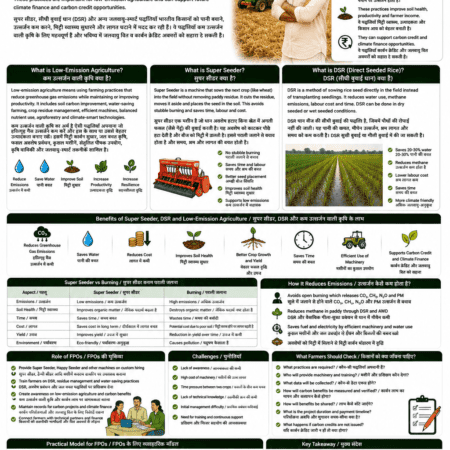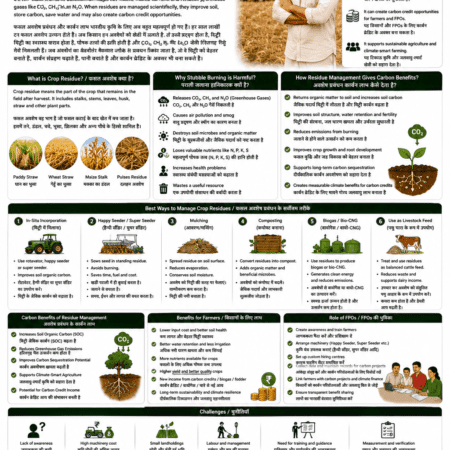
Introduction
How FPOs Reduce Poverty in Rural India is an important question for anyone working in agriculture, rural development, CSR, livelihood creation, and sustainable development. Rural poverty in India is closely connected with small landholdings, low farm income, high input costs, weak bargaining power, poor market access, lack of processing, and limited local employment. Farmer Producer Organizations, also known as FPOs, can help address many of these problems through collective action.
Most small and marginal farmers cannot individually negotiate better prices, access large buyers, create storage infrastructure, invest in processing units, or build branded products. They often sell raw produce in local markets at low prices and buy agricultural inputs at higher rates. This keeps farmer income uncertain and rural households vulnerable.
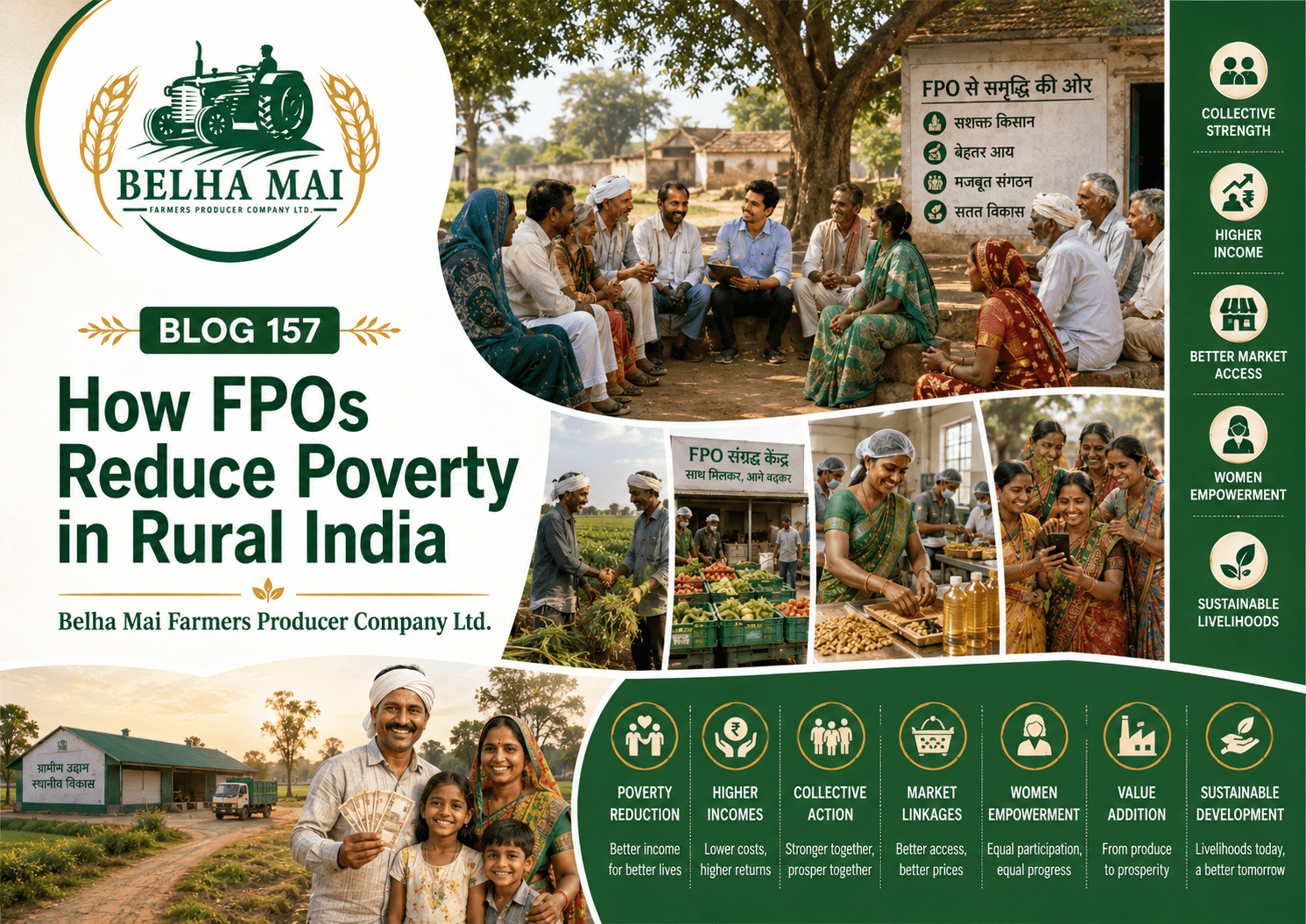
FPOs reduce poverty in rural India by organizing farmers into a stronger economic institution. Through collective purchase, collective sale, market linkage, value addition, farm services, women participation, and institutional partnerships, FPOs can help farming families move from survival-based agriculture toward income-based rural enterprise.
How FPOs Reduce Poverty in Rural India Through Collective Strength
How FPOs Reduce Poverty in Rural India begins with collective strength. A single farmer with a small quantity of produce may not have bargaining power, but hundreds or thousands of farmers working together through an FPO can create a stronger market position.
Collective strength helps farmers purchase inputs in bulk, access services more easily, aggregate produce, negotiate with buyers, and participate in larger value chains. It also gives farmers confidence because they are no longer working alone. They become part of a formal institution that represents their economic interests.
This collective model is especially important for small and marginal farmers. Poverty reduction becomes possible when farmers can reduce costs, improve productivity, and sell produce at better prices. FPOs create the structure needed for this transformation.
How FPOs Reduce Poverty in Rural India by Lowering Input Costs
One major reason for rural poverty is the high cost of agricultural inputs. Farmers need seeds, fertilizers, pesticides, organic inputs, irrigation support, machinery services, and technical advice. When they buy individually, they may pay higher prices or receive poor-quality inputs.
FPOs can reduce this burden by arranging quality inputs at better rates. Bulk procurement can improve price negotiation. Proper input supply can also reduce the risk of fake or low-quality products reaching farmers.
Lower input cost directly improves net income. Even if the selling price remains the same, reduced production cost can increase the farmer’s profit. This is one of the practical ways FPOs reduce poverty in rural India.
How FPOs Reduce Poverty in Rural India Through Better Market Linkage
Market linkage is one of the strongest tools for poverty reduction. Many farmers are forced to sell produce to local traders immediately after harvest because they lack storage, transport, buyer connections, or price information. This often leads to distress selling.
FPOs can aggregate produce from farmers and connect it with better buyers such as wholesalers, processors, retailers, institutional buyers, food companies, exporters, and government procurement channels. Better market access can improve price realization and reduce dependence on middlemen.
When farmers receive better prices for their produce, rural income improves. Better market linkage also creates trust and stability. Farmers begin to see agriculture as a planned business activity rather than an uncertain seasonal struggle.
How FPOs Reduce Poverty in Rural India by Reducing Distress Selling
Distress selling happens when farmers sell produce immediately at low prices because they need cash, lack storage, or do not have access to better buyers. This is one of the biggest reasons farmers remain poor despite working hard.
FPOs can reduce distress selling by helping farmers aggregate produce, store produce temporarily, negotiate with buyers, and plan market timing. Even basic collection centers, storage support, and buyer coordination can make a difference.
When farmers are not forced to sell immediately at low prices, they have a better chance of receiving fair value. This improves household income and reduces vulnerability. That is why FPOs are important for poverty reduction in rural India.
How FPOs Reduce Poverty in Rural India Through Value Addition
Selling raw produce gives farmers limited income. Value addition allows farmers to earn from processing, grading, packaging, branding, and marketing. This can significantly improve rural income opportunities.
FPOs can support value addition through activities such as cleaning, grading, sorting, milling, dehydration, pulping, packaging, food processing, honey processing, flour production, fruit-based products, and branded rural products. These activities create more value from the same agricultural produce.
Value addition also creates local employment. It requires people for processing, packaging, machine operation, quality checking, storage, transportation, sales, accounting, and digital marketing. This means poverty reduction happens not only for farmers but also for rural youth, women, and workers.
How FPOs Reduce Poverty in Rural India by Creating Rural Employment
Agriculture is seasonal. Many rural families do not get regular income throughout the year. This increases poverty, migration, debt, and household insecurity. FPOs can create year-round livelihood opportunities through different rural services and enterprises.
FPOs can generate employment through input supply centers, farm machinery banks, aggregation centers, storage units, processing units, packaging units, digital services, transport, marketing, and field coordination. These services create local jobs around agriculture.
When employment is created within villages, rural families become more stable. Youth do not need to migrate only because there are no local opportunities. Women can also participate in local processing, packaging, grading, and value-added product activities. This helps reduce poverty at the household level.
How FPOs Reduce Poverty in Rural India by Empowering Women
Women are central to rural agriculture, but their economic contribution is often not formally recognized. They work in sowing, weeding, harvesting, grading, cleaning, livestock care, seed preservation, and post-harvest handling. However, they often have limited access to ownership, training, income, leadership, and finance.
FPOs can improve women’s participation by including women as shareholders, board members, group leaders, workers, entrepreneurs, and participants in processing activities. Women-led value addition can create strong livelihood opportunities in villages.
When women earn income, the impact often reaches the entire family. It supports children’s education, nutrition, health, savings, and household stability. Therefore, women empowerment through FPOs is a direct pathway for reducing rural poverty.
How FPOs Reduce Poverty in Rural India Through Farm Machinery Access
Small farmers often cannot afford tractors, seed drills, Super Seeders, harvesters, sprayers, and other machinery. High machinery costs reduce productivity and increase dependence on costly private services.
FPOs can create shared farm machinery services where farmers rent machines at affordable rates. This improves access to technology without requiring each farmer to purchase expensive equipment.
Farm machinery can save time, reduce labour burden, improve sowing and harvesting efficiency, and support climate-friendly practices. When machinery services reduce cost and improve productivity, farmers earn better net income. This is another way FPOs reduce poverty in rural India.
How FPOs Reduce Poverty in Rural India by Improving Access to Knowledge
Poverty is not only linked with money. It is also linked with lack of information. Many farmers lose income because they do not receive timely guidance on seeds, soil health, pest management, weather, irrigation, crop selection, government schemes, or market prices.
FPOs can provide farmer training, crop advisory, technical awareness, government scheme information, soil testing support, and market updates. This helps farmers make better decisions.
Better knowledge reduces crop risk and improves productivity. When farmers know what to grow, how to grow, when to sell, and where to sell, their income improves. Knowledge-based farming is an important part of poverty reduction.
How FPOs Reduce Poverty in Rural India Through Government Scheme Linkage
India has several schemes for agriculture, horticulture, food processing, farm machinery, irrigation, credit, training, storage, and rural enterprise development. However, many farmers do not access these schemes because of lack of awareness, documentation challenges, or weak institutional support.
FPOs can act as a bridge between farmers and government departments. They can spread awareness, support documentation, coordinate applications, organize training, and help farmers access relevant schemes.
When government schemes reach actual farmers, rural development becomes stronger. FPOs help improve last-mile delivery. This makes them valuable institutions for poverty reduction and rural transformation.
How FPOs Reduce Poverty in Rural India by Supporting Financial Inclusion
Many small farmers depend on informal credit or traders for money. This can create a cycle of dependency and low income. Formal finance is often difficult because farmers may lack documentation, collateral, credit history, or proper guidance.
FPOs can support financial inclusion by connecting farmers with banks, credit institutions, insurance services, government credit schemes, and financial literacy programs. A well-governed FPO can also access institutional finance for business activities.
Financial inclusion gives farmers more control. They can invest in better inputs, irrigation, machinery, livestock, processing, and value-added activities. This reduces dependence on exploitative systems and supports long-term poverty reduction.
How FPOs Reduce Poverty in Rural India by Building Rural Enterprises
A strong FPO can help farmers move beyond traditional farming into rural enterprise. This is very important because rural poverty cannot be solved only by crop production. Villages need enterprises that create income throughout the year.
FPOs can support enterprises around food processing, honey processing, amla products, mango products, flour milling, seed production, nursery development, organic inputs, agroforestry, farm services, packaging, and local brands.
Rural enterprises keep more value within the village economy. They create income for farmers, employment for workers, opportunities for women, and business roles for youth. This makes FPOs a strong tool for poverty reduction.
How FPOs Reduce Poverty in Rural India Through Sustainable Livelihoods
Short-term income is not enough. Rural families need sustainable livelihoods that protect soil, water, biodiversity, and future farm productivity. FPOs can promote sustainable agriculture practices that reduce risk and improve long-term resilience.
These practices may include soil testing, balanced fertilizer use, organic inputs, natural farming, crop diversification, water conservation, agroforestry, residue management, and climate-resilient agriculture.
Sustainable agriculture helps reduce future poverty because it protects the natural resources that farming families depend on. When land remains productive and farming becomes more resilient, rural households become more secure.
How FPOs Reduce Poverty in Rural India by Reducing Migration Pressure
Many rural youth migrate to cities because villages do not provide enough income opportunities. Migration can be useful in some cases, but distress migration often happens because families cannot survive on local income.
FPOs can reduce migration pressure by creating local employment and enterprise opportunities. Processing units, packaging centers, storage facilities, machinery services, marketing teams, field operations, and digital work can create livelihoods within the rural economy.
When youth see agriculture as a business opportunity, they become more willing to stay connected with villages. FPOs can help turn rural youth into agri-entrepreneurs, service providers, managers, and technology users.
How FPOs Reduce Poverty in Rural India Through Partnerships
FPOs need partnerships to grow. Government departments, banks, NABARD, SFAC, CSR organizations, NGOs, research institutions, incubators, universities, processors, exporters, and buyers can all support FPO development.
Partnerships can bring finance, infrastructure, training, technology, market access, quality systems, and business mentorship. A strong partnership can help an FPO create long-term impact for farmers.
For CSR and development organizations, FPOs provide a ready grassroots platform. They work directly with farmers and understand village-level challenges. This makes FPOs suitable partners for poverty reduction projects.
How FPOs Reduce Poverty in Rural India Through Better Governance
Good governance is essential for FPO success. If an FPO has proper records, transparent systems, regular meetings, responsible leadership, clear business planning, and farmer trust, it can become a strong rural institution.
Governance helps build credibility with banks, buyers, government departments, CSR agencies, and development partners. It also ensures that benefits reach farmers and the organization does not become inactive.
Poverty reduction requires long-term institutional strength. A well-managed FPO can continue serving farmers year after year. This makes governance an important part of rural development.
Belha Mai FPO and Poverty Reduction
Belha Mai Farmers Producer Company Ltd. is working as a farmer-led institution to support rural development, farmer services, input access, farm machinery, market linkage, value addition, digital outreach, women participation, and sustainable agriculture.
The organization’s work aligns with the idea of reducing rural poverty by strengthening farmers at the grassroots level. Through collective action, better services, enterprise development, and institutional partnerships, an FPO can help farmers access better opportunities.
For Belha Mai FPO, poverty reduction is not only about income. It is about building stronger farmers, stronger women, stronger youth, stronger markets, and stronger rural institutions.
Why Poverty Reduction Through FPOs Matters for India
India’s rural development depends on the prosperity of small and marginal farmers. If farmers remain poor, rural markets, food systems, local employment, and village economies remain weak. Poverty reduction must therefore be connected with agriculture and farmer institutions.
FPOs offer a practical model because they organize farmers into a formal economic platform. They help farmers reduce costs, improve productivity, access markets, create value addition, build enterprises, and connect with partners.
This is why How FPOs Reduce Poverty in Rural India is not only a blog topic. It is a development strategy for building a stronger and more inclusive rural economy.
Conclusion
How FPOs Reduce Poverty in Rural India can be understood through one simple idea: farmers become stronger when they work together. FPOs reduce poverty by lowering input costs, improving market access, creating value addition, supporting women, generating rural employment, providing farm services, building enterprises, and promoting sustainable livelihoods.
Farmer Producer Organizations are not only agricultural institutions. They are poverty reduction platforms, rural enterprise builders, and grassroots development partners.
For India, strong FPOs can become one of the most practical tools for reducing rural poverty and creating long-term rural prosperity.
FAQ
How FPOs Reduce Poverty in Rural India?
FPOs reduce poverty in rural India by organizing small farmers, lowering input costs, improving market access, creating value addition, supporting women, generating employment, and building sustainable rural livelihoods.
Why are FPOs important for poverty reduction?
FPOs are important for poverty reduction because small farmers often lack bargaining power, finance, storage, processing, and buyer access. FPOs provide collective strength and connect farmers with better opportunities.
Can FPOs improve farmer income?
Yes. FPOs can improve farmer income by reducing production costs, improving productivity, aggregating produce, negotiating better prices, reducing distress selling, and creating value-added products.
How do FPOs help women in rural poverty reduction?
FPOs help women by giving them opportunities in membership, training, leadership, processing, packaging, value-added products, and rural enterprise activities. Women’s income supports household stability and family welfare.
How do FPOs create rural employment?
FPOs create rural employment through input supply, farm machinery services, aggregation centers, storage, processing, packaging, logistics, marketing, accounting, field work, and digital operations.
Why should CSR organizations support FPOs?
CSR organizations should support FPOs because FPOs work directly with farmers and rural communities. They can implement poverty reduction, livelihood, women empowerment, sustainable agriculture, and rural enterprise projects at the grassroots level.
Internal Links Section
👉 SDG Goals — https://belhamaifpo.com/sdg-goals/
👉 Farmer Producer Organizations Complete Guide —https://belhamaifpo.com/farmer-producer-organisation/farmer-producer-organizations-fpos/
👉 Role of FPOs in Achieving Rural Development in India — https://belhamaifpo.com/sdg-goals/role-of-fpos-in-achieving-rural-development-in-india/
👉 Why small farmers struggle in India — https://belhamaifpo.com/agriculture/why-small-farmers-struggle-in-india/
👉 Belha Mai FPO — https://belhamaifpo.com/
External Authority Links
👉 United Nations Sustainable Development Goals — https://sdgs.un.org/goals
👉 NITI Aayog SDG India Index — https://www.niti.gov.in/sdg-india-index
👉 Ministry of Agriculture and Farmers Welfare — https://agriwelfare.gov.in/
👉 Small Farmers’ Agribusiness Consortium — https://sfacindia.com/
👉 National Bank for Agriculture and Rural Development — https://www.nabard.org/
Follow Belha Mai FPO for More Updates
Website: https://belhamaifpo.com/
Facebook:https://www.facebook.com/profile.php?id=61561043486818
YouTube: https://www.youtube.com/channel/UC9ZvojoTMCa7mU1-Q_Bh60A
LinkedIn: https://www.linkedin.com/in/abhay-singh-ab5568280/
Instagram:https://instagram.com/belhamaifpo
Belha Mai Farmers Producer Company Ltd. supports farmers through better information, technology, market linkage, value addition, FPO awareness, rural development, and sustainable agriculture.