Introduction
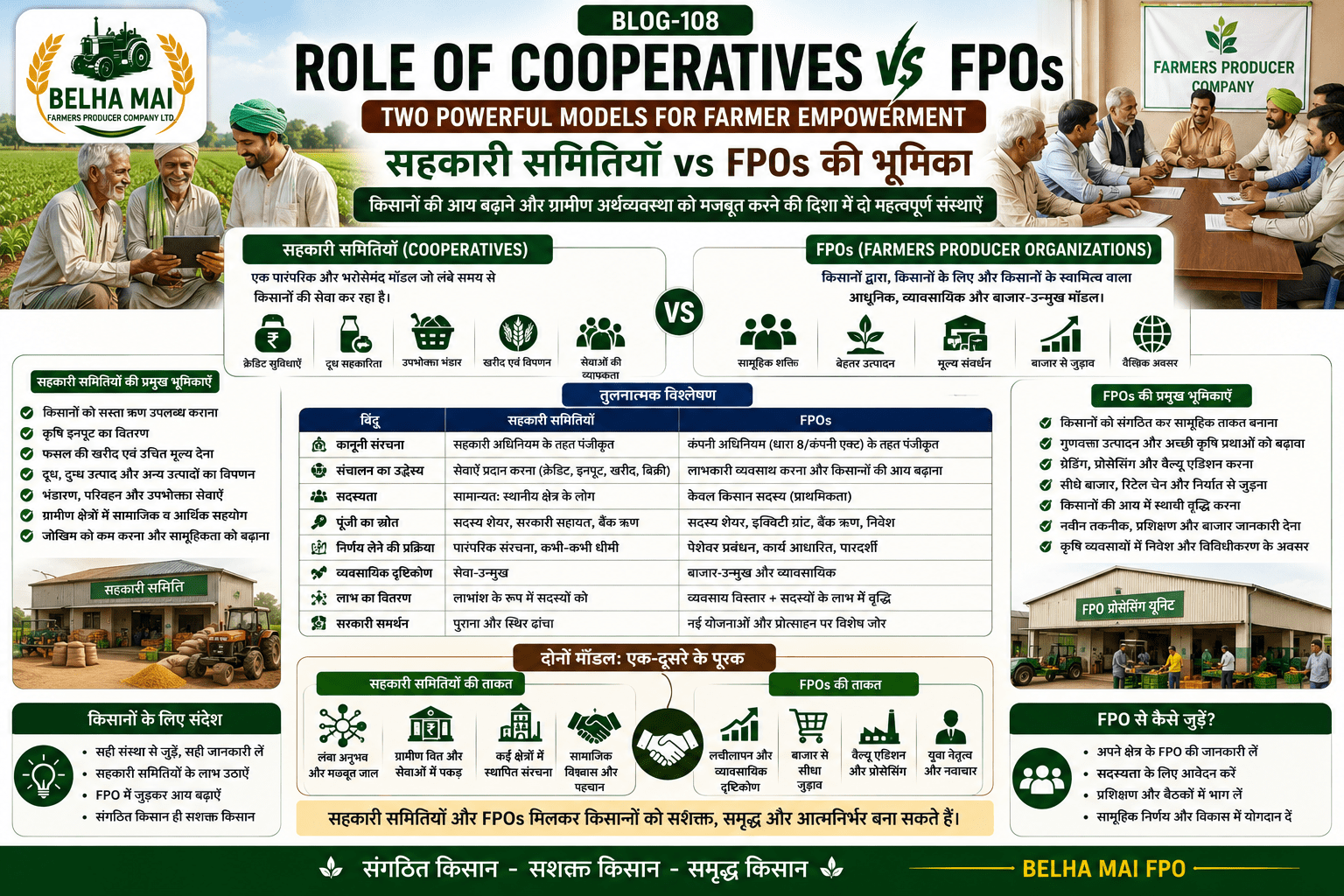
Role of cooperatives vs FPOs is an important topic for farmers, policymakers, rural entrepreneurs and agriculture institutions. In India, farmers need collective strength because most farmers are small and marginal. Individually, a farmer may not have enough land, production quantity, bargaining power, storage, machinery, processing capacity or market access. Farmer institutions like cooperatives and FPOs can help solve this problem.
परिचय
सहकारी समितियों बनाम FPOs की भूमिका किसानों, नीति निर्माताओं, ग्रामीण उद्यमियों और कृषि संस्थाओं के लिए महत्वपूर्ण विषय है। भारत में किसानों को सामूहिक शक्ति की जरूरत है क्योंकि अधिकतर किसान छोटे और सीमांत हैं। अकेले किसान के पास पर्याप्त जमीन, उत्पादन मात्रा, सौदेबाजी शक्ति, भंडारण, मशीनरी, processing capacity या market access नहीं होता। Cooperatives और FPOs जैसी किसान संस्थाएं इस समस्या को हल करने में मदद कर सकती हैं।
Why farmer institutions are needed
Role of cooperatives vs FPOs becomes clear when we look at the challenges of small farmers. Small farmers struggle with high input cost, low selling price, dependence on middlemen, lack of storage, weak transport, limited credit access and low bargaining power. Collective institutions can reduce these weaknesses by organizing farmers.
किसान संस्थाओं की जरूरत क्यों है
सहकारी समितियों बनाम FPOs की भूमिका तब स्पष्ट होती है जब हम छोटे किसानों की चुनौतियों को देखते हैं। छोटे किसान high input cost, low selling price, middlemen dependency, storage की कमी, weak transport, limited credit access और low bargaining power से जूझते हैं। Collective institutions किसानों को संगठित करके इन कमजोरियों को कम कर सकती हैं।
What cooperatives mean
Cooperatives are member-owned institutions formed to provide services to members. In agriculture, cooperatives have played an important role in credit, dairy, input supply, sugarcane, marketing, storage and rural services. Their main principle is mutual help and service to members.
सहकारी समितियों का अर्थ
Cooperatives member-owned institutions होती हैं जो members को services देने के लिए बनाई जाती हैं। Agriculture में cooperatives ने credit, dairy, input supply, sugarcane, marketing, storage और rural services में महत्वपूर्ण भूमिका निभाई है। उनका मुख्य सिद्धांत mutual help और member service है।
What FPOs mean
FPOs, or Farmer Producer Organizations, are farmer-owned business institutions created to improve farmer income through aggregation, input supply, market linkage, processing, value addition, branding and business development. Many FPOs are registered as Farmer Producer Companies under the Companies Act.
FPOs का अर्थ
FPOs, यानी Farmer Producer Organizations, farmer-owned business institutions हैं जो aggregation, input supply, market linkage, processing, value addition, branding और business development के माध्यम से farmer income बढ़ाने के लिए बनाए जाते हैं। कई FPOs Companies Act के तहत Farmer Producer Companies के रूप में registered होते हैं।
Cooperatives and FPOs both support collective strength
Role of cooperatives vs FPOs should not be seen only as competition. Both models support collective strength. Cooperatives have deep roots in rural India, while FPOs are designed to make farmers more market-oriented and business-ready. Both can help farmers when they are managed well.
Cooperatives और FPOs दोनों collective strength देते हैं
सहकारी समितियों बनाम FPOs की भूमिका को केवल competition के रूप में नहीं देखना चाहिए। दोनों models collective strength देते हैं। Cooperatives की rural India में deep roots हैं, जबकि FPOs किसानों को market-oriented और business-ready बनाने के लिए design किए गए हैं। दोनों farmers की मदद कर सकते हैं यदि उनका management अच्छा हो।
Main difference in purpose
Cooperatives are generally service-oriented institutions. Their purpose is to provide services such as credit, inputs, dairy collection, marketing or welfare support to members. FPOs are more business-oriented. Their purpose is to increase farmer income by building farmer-owned enterprises and connecting farmers with better markets.
उद्देश्य में मुख्य अंतर
Cooperatives सामान्य रूप से service-oriented institutions होती हैं। उनका उद्देश्य members को credit, inputs, dairy collection, marketing या welfare support जैसी services देना होता है। FPOs अधिक business-oriented होती हैं। उनका उद्देश्य farmer-owned enterprises बनाकर और farmers को better markets से जोड़कर farmer income बढ़ाना है।
Governance difference
In cooperatives, governance follows cooperative laws and member-based democratic structure. In FPOs, governance follows company law when registered as a producer company, with directors, shareholders and business accountability. Both need transparent governance to succeed.
Governance में अंतर
Cooperatives में governance cooperative laws और member-based democratic structure के अनुसार होती है। FPOs में, यदि producer company के रूप में registered हों, तो governance company law, directors, shareholders और business accountability के अनुसार होती है। दोनों को सफल होने के लिए transparent governance चाहिए।
Membership structure
Cooperatives are usually formed by members who come together for a common service or purpose. FPOs are formed by farmers as producer-members who are also shareholders. In both cases, member participation is very important.
Membership structure
Cooperatives आमतौर पर members द्वारा common service या purpose के लिए बनाई जाती हैं। FPOs farmers द्वारा producer-members और shareholders के रूप में बनाई जाती हैं। दोनों cases में member participation बहुत जरूरी है।
Business orientation of FPOs
Role of cooperatives vs FPOs becomes especially important when we talk about business. FPOs are expected to work like farmer-owned businesses. They can aggregate produce, process products, create brands, negotiate with buyers, participate in e-commerce and supply to institutional markets.
FPOs का business orientation
सहकारी समितियों बनाम FPOs की भूमिका business के संदर्भ में विशेष रूप से महत्वपूर्ण है। FPOs से अपेक्षा होती है कि वे farmer-owned businesses की तरह काम करें। वे produce aggregate कर सकते हैं, products process कर सकते हैं, brands बना सकते हैं, buyers से negotiate कर सकते हैं, e-commerce में participate कर सकते हैं और institutional markets को supply कर सकते हैं।
Cooperatives and credit support
Cooperatives have historically played a strong role in rural credit and financial services. Many farmers have accessed agricultural loans, savings and rural finance through cooperative systems. This role remains important because farmers need timely and affordable credit.
Cooperatives और credit support
Cooperatives ने historical रूप से rural credit और financial services में मजबूत भूमिका निभाई है। कई farmers ने cooperative systems के माध्यम से agricultural loans, savings और rural finance access किया है। यह role आज भी important है क्योंकि farmers को timely और affordable credit चाहिए।
FPOs and market linkage
FPOs are especially important for market linkage. They can connect farmers with processors, retailers, exporters, hotels, institutional buyers, online buyers and government procurement systems. FPOs help farmers move from scattered selling to organized selling.
FPOs और market linkage
FPOs market linkage के लिए विशेष रूप से important हैं। वे farmers को processors, retailers, exporters, hotels, institutional buyers, online buyers और government procurement systems से connect कर सकते हैं। FPOs farmers को scattered selling से organized selling की ओर ले जाते हैं।
Input supply role
Both cooperatives and FPOs can provide input supply services. They can help farmers access seeds, fertilizers, pesticides, bio-inputs, farm tools and machinery services. When inputs are purchased collectively, farmers may get better quality and better rates.
Input supply की भूमिका
Cooperatives और FPOs दोनों input supply services दे सकते हैं। वे farmers को seeds, fertilizers, pesticides, bio-inputs, farm tools और machinery services तक पहुंचाने में मदद कर सकते हैं। जब inputs collectively purchase होते हैं, तो farmers को better quality और better rates मिल सकते हैं।
Aggregation role
Aggregation means collecting produce from many farmers and creating marketable volume. FPOs are usually stronger in aggregation for market linkage because they are designed for business and marketing. Cooperatives can also aggregate produce where they are active and well-managed.
Aggregation की भूमिका
Aggregation का मतलब है कई farmers की produce collect करके marketable volume बनाना। FPOs market linkage के लिए aggregation में usually stronger होती हैं क्योंकि वे business और marketing के लिए designed हैं। Cooperatives भी produce aggregate कर सकती हैं जहां वे active और well-managed हों।
Dairy cooperatives as a strong example
Dairy cooperatives are one of the best-known examples of cooperative success in India. They have helped farmers collect milk, process it, build brands and reach consumers. This shows that cooperative models can be powerful when systems are transparent and market-connected.
Dairy cooperatives एक मजबूत example
Dairy cooperatives भारत में cooperative success के सबसे प्रसिद्ध examples में से एक हैं। उन्होंने farmers को milk collect करने, process करने, brands बनाने और consumers तक पहुंचने में मदद की है। यह दिखाता है कि cooperative models तब powerful हो सकते हैं जब systems transparent और market-connected हों।
FPOs as new-generation farmer businesses
FPOs are often seen as new-generation farmer institutions. They focus on agriculture value chains, farmer-owned brands, aggregation, processing, storage, input supply, digital tools and buyer linkage. Role of cooperatives vs FPOs must consider this difference in business approach.
FPOs new-generation farmer businesses हैं
FPOs को अक्सर new-generation farmer institutions माना जाता है। वे agriculture value chains, farmer-owned brands, aggregation, processing, storage, input supply, digital tools और buyer linkage पर focus करते हैं। सहकारी समितियों बनाम FPOs की भूमिका में इस business approach के अंतर को समझना जरूरी है।
Value addition and processing
FPOs can play a major role in value addition. They can convert raw produce into flour, rice, pulses, spices, honey, amla products, mango pulp, millet products and packaged foods. Cooperatives can also do processing where they have infrastructure and strong management.
Value addition और processing
FPOs value addition में major role निभा सकते हैं। वे raw produce को flour, rice, pulses, spices, honey, amla products, mango pulp, millet products और packaged foods में बदल सकते हैं। Cooperatives भी processing कर सकती हैं जहां उनके पास infrastructure और strong management हो।
Branding and marketing
FPOs are encouraged to build farmer-owned brands and sell products in modern markets. Branding helps farmers receive better value and build identity. Cooperatives have also created strong brands in some sectors, especially dairy and sugar, but many traditional cooperatives remain service-focused.
Branding और marketing
FPOs को farmer-owned brands बनाने और products को modern markets में बेचने के लिए encourage किया जाता है। Branding farmers को better value और identity देती है। Cooperatives ने भी कुछ sectors, खासकर dairy और sugar में strong brands बनाए हैं, लेकिन कई traditional cooperatives service-focused रहती हैं।
Market competition
FPOs often operate in competitive markets. They must understand pricing, quality, packaging, logistics, buyer negotiation and business planning. Cooperatives also face competition, but many have historically operated in regulated or service-based environments.
Market competition
FPOs अक्सर competitive markets में operate करती हैं। उन्हें pricing, quality, packaging, logistics, buyer negotiation और business planning समझना पड़ता है। Cooperatives भी competition face करती हैं, लेकिन कई historically regulated या service-based environments में operate करती रही हैं।
Member participation matters in both
Role of cooperatives vs FPOs depends heavily on member participation. If members do not participate, supply produce, attend meetings, use services or trust the institution, both cooperatives and FPOs become weak. Member ownership must be real, not only on paper.
दोनों में member participation जरूरी है
सहकारी समितियों बनाम FPOs की भूमिका member participation पर बहुत निर्भर करती है। यदि members participate नहीं करते, produce supply नहीं करते, meetings attend नहीं करते, services use नहीं करते या institution पर trust नहीं करते, तो cooperatives और FPOs दोनों weak हो जाते हैं। Member ownership वास्तविक होनी चाहिए, केवल paper पर नहीं।
Professional management is necessary
Both cooperatives and FPOs need professional management. Accounts, records, stock, payments, buyer communication, legal compliance, taxation and business planning must be handled properly. Poor management can damage farmer trust.
Professional management जरूरी है
Cooperatives और FPOs दोनों को professional management चाहिए। Accounts, records, stock, payments, buyer communication, legal compliance, taxation और business planning properly handle होने चाहिए। Poor management farmer trust को damage कर सकता है।
Transparency builds trust
Transparency is essential in both models. Farmers should know purchase price, sale price, expenses, profit, payment status and business decisions. Transparent systems create trust and long-term member loyalty.
Transparency trust बनाती है
दोनों models में transparency essential है। Farmers को purchase price, sale price, expenses, profit, payment status और business decisions की जानकारी होनी चाहिए। Transparent systems trust और long-term member loyalty बनाते हैं।
Challenges of cooperatives
Some cooperatives face challenges such as political interference, slow decision-making, weak professional management, limited business innovation and low member participation. However, well-managed cooperatives can still be very powerful farmer institutions.
Cooperatives की चुनौतियां
कुछ cooperatives political interference, slow decision-making, weak professional management, limited business innovation और low member participation जैसी challenges face करती हैं। फिर भी well-managed cooperatives बहुत powerful farmer institutions हो सकती हैं।
Challenges of FPOs
Many FPOs face challenges such as low working capital, weak business planning, limited staff, poor market linkage, lack of storage, lack of processing infrastructure and limited member participation. FPOs need handholding, training and business support.
FPOs की चुनौतियां
कई FPOs low working capital, weak business planning, limited staff, poor market linkage, storage की कमी, processing infrastructure की कमी और limited member participation जैसी challenges face करती हैं। FPOs को handholding, training और business support चाहिए।
Working capital problem
FPOs often struggle with working capital. To buy produce from farmers, they need money. Without working capital, they cannot aggregate produce properly. Cooperatives also face finance problems, but many older cooperatives have stronger institutional banking linkages.
Working capital problem
FPOs अक्सर working capital से struggle करती हैं। Farmers से produce खरीदने के लिए उन्हें money चाहिए। Working capital के बिना वे produce properly aggregate नहीं कर पातीं। Cooperatives भी finance problems face करती हैं, लेकिन कई older cooperatives के institutional banking linkages stronger होते हैं।
Governance quality decides success
The success of cooperatives and FPOs depends on governance quality. Honest leadership, transparent accounts, member participation, professional staff, clear business plan and regular communication are essential. Weak governance can destroy even a good institution.
Governance quality success तय करती है
Cooperatives और FPOs की success governance quality पर depend करती है। Honest leadership, transparent accounts, member participation, professional staff, clear business plan और regular communication essential हैं। Weak governance अच्छी institution को भी destroy कर सकती है।
FPOs need business discipline
FPOs cannot survive only as scheme-based institutions. They must build real business. They need revenue, margins, buyer relationships, product quality, member supply and market discipline. Role of cooperatives vs FPOs becomes important here because FPOs are expected to operate with strong business focus.
FPOs को business discipline चाहिए
FPOs केवल scheme-based institutions के रूप में survive नहीं कर सकतीं। उन्हें real business build करना होगा। उन्हें revenue, margins, buyer relationships, product quality, member supply और market discipline चाहिए। यहां सहकारी समितियों बनाम FPOs की भूमिका important होती है क्योंकि FPOs से strong business focus expected है।
Cooperatives need modernization
Many cooperatives need modernization through digital records, better governance, professional management, market linkage, value addition and technology. Traditional strength must be combined with modern systems to stay relevant.
Cooperatives को modernization चाहिए
कई cooperatives को digital records, better governance, professional management, market linkage, value addition और technology के माध्यम से modernization चाहिए। Traditional strength को modern systems के साथ combine करना होगा ताकि cooperatives relevant बनी रहें।
FPOs and digital tools
FPOs can use digital tools for member records, crop planning, inventory, payments, buyer communication, e-commerce, traceability and market price information. Digital systems can make FPOs more transparent and efficient.
FPOs और digital tools
FPOs digital tools का उपयोग member records, crop planning, inventory, payments, buyer communication, e-commerce, traceability और market price information के लिए कर सकते हैं। Digital systems FPOs को अधिक transparent और efficient बना सकते हैं।
Cooperatives and local trust
Cooperatives often have strong local trust because they have existed for many years in villages. This trust is valuable. If cooperatives become more professional and market-linked, they can continue to support farmers strongly.
Cooperatives और local trust
Cooperatives में अक्सर strong local trust होता है क्योंकि वे villages में कई वर्षों से exist करती हैं। यह trust valuable है। यदि cooperatives अधिक professional और market-linked बनें, तो वे farmers को strong support दे सकती हैं।
FPOs and entrepreneurship
FPOs are useful for promoting rural entrepreneurship. They can create jobs in aggregation, processing, packaging, logistics, digital services, marketing and value addition. Young people and women can also participate through FPO-led enterprises.
FPOs और entrepreneurship
FPOs rural entrepreneurship promote करने के लिए useful हैं। वे aggregation, processing, packaging, logistics, digital services, marketing और value addition में jobs create कर सकती हैं। Youth और women भी FPO-led enterprises के माध्यम से participate कर सकते हैं।
Can cooperatives and FPOs work together
Role of cooperatives vs FPOs should also include cooperation between both models. Cooperatives and FPOs do not always need to compete. They can work together in input supply, credit, aggregation, training, storage, processing and market linkage.
क्या cooperatives और FPOs साथ काम कर सकते हैं
सहकारी समितियों बनाम FPOs की भूमिका में दोनों models के cooperation को भी शामिल करना चाहिए। Cooperatives और FPOs को हमेशा compete करने की जरूरत नहीं है। वे input supply, credit, aggregation, training, storage, processing और market linkage में साथ काम कर सकते हैं।
Which model is better for farmers
There is no single answer. A well-managed cooperative can be better than a weak FPO, and a strong FPO can be more effective than a weak cooperative. The real question is not only the legal structure. The real question is governance, transparency, business strength and farmer benefit.
किसानों के लिए कौन सा model बेहतर है
इसका एक single answer नहीं है। Well-managed cooperative weak FPO से बेहतर हो सकती है, और strong FPO weak cooperative से अधिक effective हो सकती है। असली question केवल legal structure नहीं है। असली question governance, transparency, business strength और farmer benefit है।
Small farmers need both service and business support
Small farmers need credit, inputs, training, machinery, storage, market linkage, processing and fair price. Cooperatives can support service and credit needs. FPOs can support business and market needs. Together, they can create a stronger rural economy.
छोटे किसानों को service और business दोनों support चाहिए
Small farmers को credit, inputs, training, machinery, storage, market linkage, processing और fair price चाहिए। Cooperatives service और credit needs support कर सकती हैं। FPOs business और market needs support कर सकती हैं। दोनों मिलकर stronger rural economy बना सकते हैं।
Belha Mai FPO perspective
Belha Mai Farmers Producer Company Ltd. believes that Role of cooperatives vs FPOs should be understood with a farmer-first approach. Cooperatives and FPOs are both important, but farmers need institutions that are transparent, professionally managed, market-linked and focused on income improvement. FPOs can become strong business platforms for farmers when supported with capital, training and market access.
बेल्हा माई FPO का दृष्टिकोण
Belha Mai Farmers Producer Company Ltd. का मानना है कि सहकारी समितियों बनाम FPOs की भूमिका को farmer-first approach से समझना चाहिए। Cooperatives और FPOs दोनों important हैं, लेकिन farmers को ऐसी institutions चाहिए जो transparent, professionally managed, market-linked और income improvement पर focused हों। FPOs capital, training और market access मिलने पर farmers के लिए strong business platforms बन सकती हैं।
Conclusion
Role of cooperatives vs FPOs shows that both models have important roles in Indian agriculture. Cooperatives have long experience in member services, credit, dairy, inputs and rural support. FPOs bring business orientation, market linkage, aggregation, value addition, branding and farmer-owned enterprise development.
निष्कर्ष
सहकारी समितियों बनाम FPOs की भूमिका दिखाती है कि दोनों models Indian agriculture में important roles रखते हैं। Cooperatives के पास member services, credit, dairy, inputs और rural support का long experience है। FPOs business orientation, market linkage, aggregation, value addition, branding और farmer-owned enterprise development लाते हैं।
The way forward
The way forward is not cooperatives against FPOs, but stronger farmer institutions. India needs transparent cooperatives, professionally managed FPOs, better governance, digital records, working capital, market linkage, value addition and farmer participation. Role of cooperatives vs FPOs should finally lead to one goal: stronger farmers and stronger rural India.
आगे का रास्ता
आगे का रास्ता cooperatives against FPOs नहीं, बल्कि stronger farmer institutions है। India को transparent cooperatives, professionally managed FPOs, better governance, digital records, working capital, market linkage, value addition और farmer participation चाहिए। सहकारी समितियों बनाम FPOs की भूमिका अंत में एक ही लक्ष्य की ओर ले जानी चाहिए: मजबूत किसान और मजबूत ग्रामीण भारत।
FAQ in English
What is the role of cooperatives vs FPOs?
Role of cooperatives vs FPOs means understanding how cooperatives and Farmer Producer Organizations support farmers through services, credit, input supply, aggregation, market linkage and business development.
What is the main difference between cooperatives and FPOs?
Cooperatives are generally service-oriented member institutions, while FPOs are more business-oriented farmer-owned enterprises focused on market linkage, aggregation and income improvement.
Are FPOs better than cooperatives?
Not always. A strong cooperative can perform better than a weak FPO, and a strong FPO can perform better than a weak cooperative. Governance and management decide success.
How do FPOs help farmers?
FPOs help farmers through input supply, aggregation, storage, grading, market linkage, value addition, branding, buyer negotiation and collective selling.
How do cooperatives help farmers?
Cooperatives help farmers through credit, input distribution, dairy collection, marketing support, rural services and member-based collective strength.
Can cooperatives and FPOs work together?
Yes, cooperatives and FPOs can work together in credit, input supply, training, aggregation, storage, processing and market linkage.
Why do small farmers need collective institutions?
Small farmers need collective institutions because individually they have low bargaining power, small quantity, limited storage, weak market access and high transaction cost.
What is the future of cooperatives and FPOs in India?
The future depends on transparent governance, professional management, digital systems, market linkage, working capital, value addition and active farmer participation.
FAQ in Hindi
सहकारी समितियों बनाम FPOs की भूमिका क्या है?
सहकारी समितियों बनाम FPOs की भूमिका का मतलब है यह समझना कि cooperatives और Farmer Producer Organizations किसानों को services, credit, input supply, aggregation, market linkage और business development के माध्यम से कैसे support करते हैं।
Cooperatives और FPOs में मुख्य अंतर क्या है?
Cooperatives सामान्य रूप से service-oriented member institutions होती हैं, जबकि FPOs अधिक business-oriented farmer-owned enterprises होती हैं जो market linkage, aggregation और income improvement पर focus करती हैं।
क्या FPOs cooperatives से बेहतर हैं?
हमेशा नहीं। Strong cooperative weak FPO से बेहतर perform कर सकती है और strong FPO weak cooperative से बेहतर हो सकती है। Success governance और management पर depend करती है।
FPOs किसानों की कैसे मदद करते हैं?
FPOs input supply, aggregation, storage, grading, market linkage, value addition, branding, buyer negotiation और collective selling के माध्यम से किसानों की मदद करते हैं।
Cooperatives किसानों की कैसे मदद करती हैं?
Cooperatives credit, input distribution, dairy collection, marketing support, rural services और member-based collective strength के माध्यम से किसानों की मदद करती हैं।
क्या cooperatives और FPOs साथ काम कर सकते हैं?
हाँ, cooperatives और FPOs credit, input supply, training, aggregation, storage, processing और market linkage में साथ काम कर सकते हैं।
छोटे किसानों को collective institutions की जरूरत क्यों है?
छोटे किसानों को collective institutions की जरूरत है क्योंकि individually उनके पास low bargaining power, small quantity, limited storage, weak market access और high transaction cost होती है।
भारत में cooperatives और FPOs का भविष्य क्या है?
भविष्य transparent governance, professional management, digital systems, market linkage, working capital, value addition और active farmer participation पर depend करता है।
Internal Links Section
👉 Why small farmers struggle in India
https://belhamaifpo.com/agriculture/why-small-farmers-struggle-in-india/
👉 How FPOs solve market linkage issues
https://belhamaifpo.com/agriculture/how-fpos-solve-market-linkage-issues/
👉 How collective farming can change rural India
https://belhamaifpo.com/agriculture/collective-farming-rural-india/
👉 Financial inclusion of farmers
https://belhamaifpo.com/agriculture/financial-inclusion-of-farmers/
👉 Access to credit for small farmers
https://belhamaifpo.com/agriculture/access-to-credit-for-small-farmers/
👉 How farmers can get better market prices
https://belhamaifpo.com/agriculture/better-market-prices-for-farmers/
👉 Farmer Producer Organization
https://belhamaifpo.com/farmer-producer-organization/
👉 Agriculture
https://belhamaifpo.com/agriculture/
External Authority Links
👉 Ministry of Cooperation
https://cooperation.gov.in/
👉 Small Farmers’ Agribusiness Consortium
https://sfacindia.com/
👉 Department of Agriculture & Farmers Welfare
https://agriwelfare.gov.in/
👉 NABARD
https://www.nabard.org/
👉 National Cooperative Development Corporation
https://www.ncdc.in/
Follow Belha Mai FPO for More Updates
For more farmer awareness blogs, agriculture updates, FPO development content, product information and practical farming videos, please follow and connect with Belha Mai Farmers Producer Company Ltd.
👉 Website
https://belhamaifpo.com/
👉 Facebook Page
https://www.facebook.com/profile.php?id=61561043486818
👉 YouTube Channel
https://www.youtube.com/channel/UC9ZvojoTMCa7mU1-Q_Bh60A
👉 LinkedIn
https://www.linkedin.com/in/abhay-singh-ab5568280/
👉 Instagram
https://instagram.com/belhamaifpo
Belha Mai FPO is working to support farmers through better information, technology, market linkage, value addition, FPO awareness and rural development.