Introduction
Indian agriculture is one of the most important pillars of the Indian economy and rural society. It provides food to the nation, employment to millions of rural families, raw material to many industries and stability to village life. But despite its importance, Indian agriculture continues to face many deep-rooted problems.
The biggest issue is that agriculture in India is not only a production activity. It is also a livelihood system for millions of small and marginal farmers. For many families, farming is not a large commercial business; it is the only source of survival, income, food security and social identity.
This is why the major problems in Indian agriculture directly affect rural income, farmer confidence, food supply, youth participation, women’s livelihood, village employment and the future of farming.
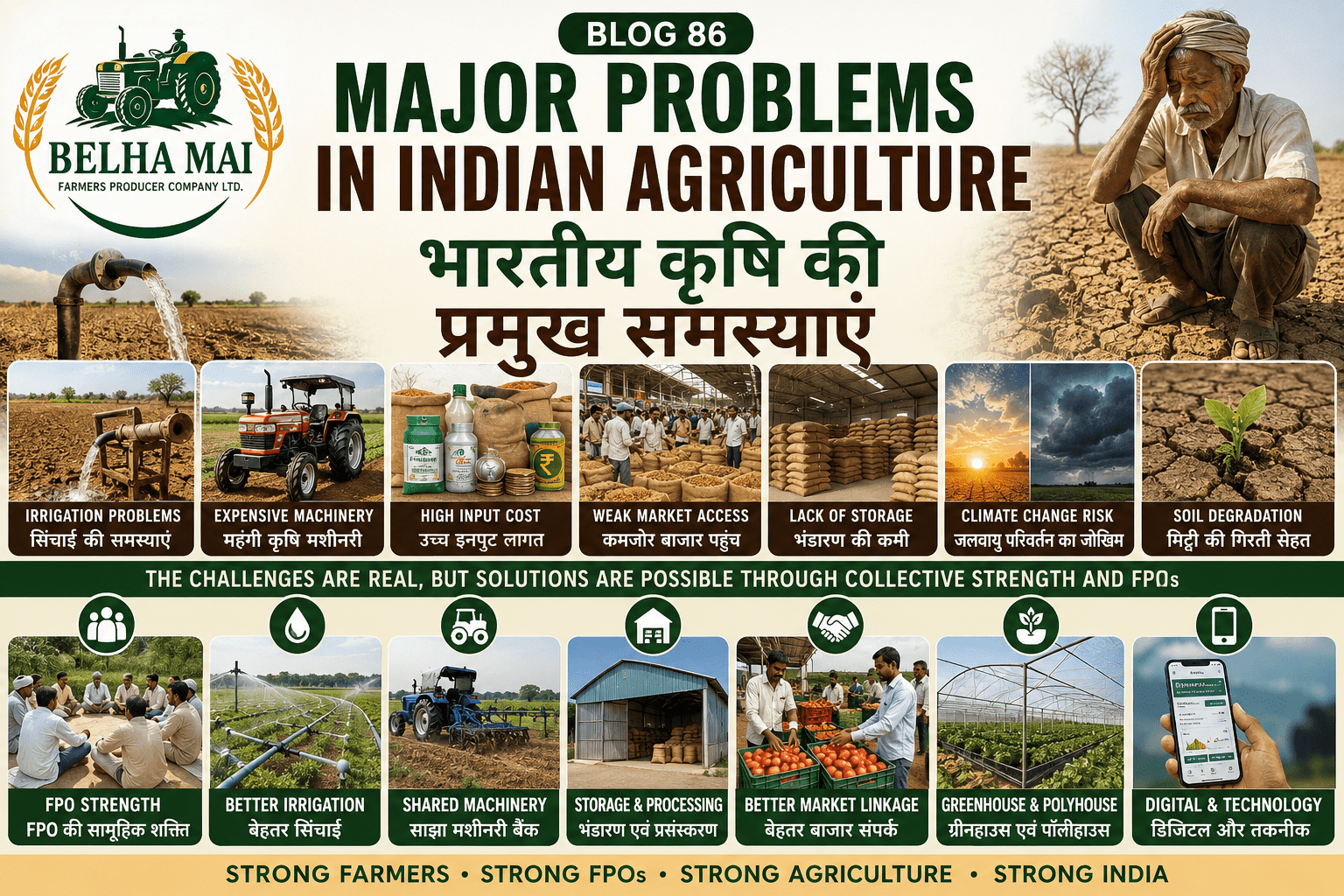
When we talk about the major problems in Indian agriculture, we must understand that these problems are connected with each other. Small landholding leads to low production. Low production creates weak market access. Weak market access reduces farmer income. Low income prevents investment in irrigation, machinery, storage, greenhouse, polyhouse, better seeds and technology. Lack of investment keeps productivity low. This cycle continues from one season to another.
The solution to Indian agriculture problems cannot come from only one intervention. Farmers need a complete ecosystem: better irrigation, genuine inputs, shared machinery, soil health support, credit, crop insurance, storage, processing, digital agriculture, market linkage, value addition and strong Farmer Producer Organizations.
Small landholding is a root problem in Indian agriculture
One of the biggest problems in Indian agriculture is small and fragmented landholding. Many farmers cultivate very small pieces of land. In many families, land has been divided from one generation to another, making farm size smaller over time.
A small farmer has to bear almost the same types of costs as a large farmer, but the income comes from a much smaller area. The farmer needs seeds, fertilizer, pesticides, labour, irrigation, machinery, transport and storage. But because land is small, production remains limited.
This creates a difficult situation. The farmer works hard but earns less. The cost of cultivation keeps increasing, but the scale of production remains small.
Small landholding also makes investment difficult. A large farmer may install a borewell, buy a tractor or build storage because the cost can be spread across more land. But a small farmer cannot easily justify such investment. The farmer may need irrigation, machinery and better infrastructure, but the income from a small farm is not enough to afford these assets.
This is why small landholding is not just a land problem. It becomes an irrigation problem, machinery problem, income problem, market problem and investment problem.
Irrigation remains a major challenge for farmers
Water is the lifeline of agriculture. A crop may have good seed, good soil and proper fertilizer, but without water at the right time, yield can fall badly.
Many farmers in India still face irrigation uncertainty. Some depend on rainfall. Some depend on canals. Some depend on ponds. Some depend on neighbouring farmers. Some rent pumps when water is available. This uncertainty makes farming risky.
For small farmers, the irrigation problem is even more serious. A personal borewell or boring is often not viable for a small landholding. The cost of boring, pump set, pipeline, electric connection or diesel pump can be too high compared to the earning potential from one or two acres.
This is one of the real ground-level problems that needs more attention. Small farmers are not avoiding irrigation because they do not understand its importance. They often cannot afford their own irrigation infrastructure.
Without assured irrigation, farmers cannot confidently grow high-value crops. They cannot easily move into vegetable farming, nursery production, horticulture, greenhouse, polyhouse or multilayer farming. Water uncertainty keeps them dependent on low-risk, low-income cropping patterns.
Community irrigation, shared borewell models, micro-irrigation, drip irrigation, sprinkler systems, water harvesting, farm ponds and FPO-led irrigation planning can help reduce this challenge.
High input cost reduces farmer profit
The cost of farming inputs has increased over time. Farmers need quality seeds, fertilizer, bio-inputs, pesticides, herbicides, growth promoters, labour, diesel, electricity, irrigation and crop protection materials.
A large farmer may be able to buy in bulk and negotiate better prices. But small farmers usually buy inputs in small quantities. Because of this, they often pay more per unit and have less bargaining power.
Another problem is input quality. Farmers sometimes face duplicate, low-quality or unsuitable products. If seed quality is poor, germination suffers. If fertilizer is not available on time, crop growth suffers. If pesticide is not genuine or not used correctly, pest attack may continue and cost may increase.
High input cost directly reduces profit. Even if the farmer gets a reasonable yield, the final income may remain low because cultivation cost is high.
FPOs can help by purchasing inputs in bulk and distributing genuine products to members. They can collaborate with reliable companies, agri-startups and technical experts. This can reduce cost, improve quality and provide farmers with better guidance.
Expensive agricultural machinery is out of reach
Modern farming needs machinery. Farmers need tractors, rotavators, seed drills, sprayers, threshers, harvesters, reapers, trailers, super seeders, irrigation pumps and other equipment.
But most of these machines are expensive. For a small farmer, buying a tractor or modern implement is usually not practical. The machine may be used only for a few days in the year, but the investment, maintenance, diesel, repairs and operator cost continue.
This creates dependency on rented machinery. During peak sowing or harvesting season, machinery demand is very high. If the machine is not available on time, sowing gets delayed, harvesting gets delayed and crop losses increase.
Timely access to machinery is very important. A delay of a few days can reduce productivity, increase labour cost or damage the crop.
FPO-led farm machinery banks are a practical solution. Instead of every farmer buying expensive equipment, the FPO can maintain machinery and provide it on rent. This reduces the burden on individual farmers and improves access to modern agriculture technology.
Shared machinery is one of the strongest solutions for small and marginal farmers.
Low production volume creates market access problems
Small farmers produce limited quantities. Even if the crop is good, the quantity may be too small to sell directly in a distant mandi, MSP centre, processing unit or institutional market.
This is a major problem in Indian agriculture. A farmer with a small quantity of produce may not find it economical to arrange transport, loading, unloading, mandi charges and waiting time. The extra cost may reduce the benefit of selling in a better market.
Because of this, many small farmers sell produce locally to village traders or middlemen. This saves time and transport cost, but the price is often lower.
The farmer may know that a better price is available outside the village, but the farmer cannot reach that market economically because the quantity is too small.
This is where aggregation becomes important. When an FPO collects produce from many farmers, the total quantity becomes large. Then it becomes possible to negotiate with mandis, processors, wholesalers, exporters, government procurement centres and institutional buyers.
One small farmer may not have enough produce to bargain, but a group of farmers together can create business volume.
Middlemen dependency weakens farmer income
Middlemen are part of the agriculture marketing system. They provide collection, transport, credit and quick payment in many places. But the problem arises when farmers have no alternative.
When farmers are dependent on one or two local traders, price discovery becomes weak. The farmer may not get the true market value of the crop. Small farmers are more vulnerable because they need immediate cash and cannot hold produce for long.
Distress selling happens when a farmer is forced to sell quickly due to debt, lack of storage, household expenses or fear of spoilage.
The solution is to create farmer-owned marketing systems. FPOs can aggregate produce, create direct buyer connections, build local collection centres, introduce grading and sorting, and help farmers sell collectively.
When farmers have more selling options, their bargaining power improves.
Lack of storage facilities causes losses
Storage is a serious problem in Indian agriculture. Many farmers do not have proper godowns, cold storage, packhouses or scientific storage facilities.
After harvest, farmers need safe storage to protect produce from moisture, pests, rodents, theft and quality loss. But small farmers often store produce at home or in temporary spaces. This increases risk.
For perishable crops like fruits and vegetables, lack of storage is even more damaging. Without cold chain, farmers have to sell quickly, often at low prices. Even a good crop may fail to give good income if post-harvest handling is poor.
Storage also gives bargaining power. A farmer who can store produce can wait for a better price. A farmer who cannot store must sell immediately.
FPOs can create common storage, warehouses, packhouses, cold rooms and grading facilities. This can reduce losses and improve market value.
Post-harvest losses reduce farmer income
Agriculture does not end at harvest. After harvest, produce must be cleaned, dried, sorted, graded, packed, stored and transported properly.
Many farmers lose income because of poor post-harvest management. Produce may get damaged during handling, transport or storage. Fruits may bruise. Vegetables may spoil. Grains may absorb moisture. Quality may decline before sale.
Post-harvest loss is not only a food loss issue. It is an income loss issue.
Farmers spend months growing a crop, but if the crop loses quality after harvest, the farmer loses money. Better post-harvest infrastructure can improve farmer income without even increasing production.
FPOs can play a strong role by creating common facilities for cleaning, grading, sorting, packing, primary processing and transport.
Soil degradation affects productivity
Healthy soil is the foundation of farming. But many farmers face declining soil health due to low organic matter, unbalanced fertilizer use, erosion, poor water management and repeated cropping without proper nutrient planning.
When soil health declines, crop productivity falls. Farmers then apply more fertilizer, but the result may not improve if the soil structure and biological health are weak.
Soil testing is very important. Without soil testing, farmers may not know what the soil actually needs. They may spend money on unnecessary inputs while the real deficiency remains untreated.
Small farmers need affordable soil testing, balanced nutrient management, organic matter improvement, composting, bio-fertilizers, crop rotation and sustainable farming guidance.
FPOs can organize soil testing camps and provide scientific advisory to farmers. Soil health improvement is a long-term investment in farmer income.
Climate change is increasing farming risk
Climate change has made farming more uncertain. Farmers are facing irregular rainfall, long dry spells, heat stress, unseasonal rain, hailstorms, floods, new pest attacks and disease pressure.
Small farmers suffer the most because they have limited savings and limited risk-bearing capacity. A single crop failure can disturb the financial condition of the entire family.
Climate risk affects sowing, irrigation, flowering, fruiting, harvesting and storage. It also increases pest and disease management costs.
Farmers need climate-resilient agriculture. This includes water conservation, drought-tolerant varieties, diversified crops, agroforestry, protected cultivation, weather advisory, crop insurance, soil health improvement and better risk planning.
FPOs can support farmers through awareness, weather updates, crop planning, input supply and collective response.
Credit access remains difficult for many farmers
Credit is needed before every crop season. Farmers need money for seed, fertilizer, labour, irrigation, pesticide and other expenses. But access to timely and affordable credit is still a challenge for many small farmers.
Some farmers do not have proper documents. Some do not have sufficient collateral. Some face delays in bank processes. Some depend on informal lenders.
When credit is expensive, farming becomes more risky. High interest reduces profit. Debt pressure forces farmers to sell produce quickly after harvest.
Kisan Credit Card, bank linkage, self-help groups, cooperatives and FPOs can improve credit access. FPOs can help farmers with documentation, awareness, financial discipline and institutional linkage.
Credit should not trap farmers in debt. It should help farmers invest in productive agriculture.
Crop insurance awareness and claim issues
Crop insurance is important because farming is risky. Weather, pests, diseases and natural calamities can damage crops.
But many farmers do not fully understand insurance terms, coverage, premium, claim process or eligibility. Some may not know how to report damage. Some may face delays in claim settlement. Some may not receive enough compensation to cover actual loss.
Small farmers need simple guidance on crop insurance. FPOs can help farmers understand schemes, maintain records, report crop damage and follow claim processes.
Insurance works better when farmers are informed and organized.
Weak extension and technical guidance
Agriculture is becoming knowledge-intensive. Farmers need guidance on seed selection, fertilizer management, pest control, irrigation scheduling, crop diversification, post-harvest handling, market demand and value addition.
But many farmers do not receive timely and practical technical support. Sometimes advice reaches late. Sometimes it is too general. Sometimes farmers receive product-based advice instead of crop-based advice.
Small farmers need local, practical, simple and trustworthy guidance. They need field demonstrations, training, advisory videos, expert visits and crop-specific support.
FPOs can become knowledge centres for farmers by connecting them with experts, institutions, government departments and agri-startups.
Market price volatility creates uncertainty
Agricultural prices often fluctuate. A crop may have a good price during sowing but a low price during harvest. When many farmers grow the same crop, prices may fall. When storage is not available, farmers are forced to sell at the current price.
Price uncertainty makes farming risky. Farmers cannot easily plan income. They cannot know whether the crop will be profitable until the time of sale.
Better market intelligence, crop planning, contract farming, storage, processing and direct buyer linkages can reduce price uncertainty.
FPOs can help farmers understand demand trends and avoid blind crop planning.
Lack of value addition keeps farmers at raw commodity level
Many farmers sell raw produce. Raw commodities usually have low margins. The higher value is often captured by traders, processors, brands, wholesalers and retailers.
For example, wheat becomes flour, fruits become processed products, amla becomes powder or juice, mango becomes pulp or dried mango, and honey becomes packaged branded honey. The farmer often sells at the first stage and others earn from value addition.
Farmers need to move up the value chain. This does not mean every farmer must become a processor individually. FPOs can create common processing units, packaging systems, branding and market linkages.
Value addition can create better income and rural employment.
Digital gap limits farmer opportunity
Digital agriculture is growing. Farmers can benefit from weather updates, mandi prices, online training, digital payments, e-commerce, government scheme portals, crop advisory and buyer connections.
But many farmers face digital barriers. They may not be comfortable with apps, online forms, English content, digital documentation or online marketplaces.
The solution is not only technology. The solution is assisted technology.
FPOs can help farmers use digital platforms by providing support, training and local-language communication.
Digital tools become powerful when they are connected with local farmer institutions.
Women farmers need better recognition and support
Women play a major role in agriculture. They participate in sowing, weeding, harvesting, livestock care, processing, storage and household-level farm management.
But women farmers often do not get equal recognition, training, ownership access, credit access or decision-making power. Many schemes and services are linked to land ownership, and land is often in the name of male family members.
Women’s participation can strengthen agriculture if they receive training, market linkage, processing opportunities, self-help group support, FPO participation and equal income opportunities.
Women empowerment is not separate from agriculture development. It is central to rural growth.
Youth are moving away from agriculture
Many rural youth do not see farming as a profitable or modern profession. They migrate to cities for jobs because agriculture appears uncertain, labour-intensive and low-income.
This is a serious challenge for the future of Indian agriculture. If youth lose interest in farming, rural innovation and farm entrepreneurship will suffer.
To bring youth back, farming must become profitable, technology-driven and enterprise-oriented. Agri-startups, drones, digital platforms, protected cultivation, food processing, branding, e-commerce, FPO management and agri-logistics can create new opportunities.
Young people will join agriculture when they see dignity, income and growth potential.
Greenhouse and polyhouse can increase income from small land
Small farmers cannot easily increase land area. Therefore, they need to increase income from the same land.
Greenhouse, polyhouse, shade net, drip irrigation, mulching and protected cultivation can help farmers grow high-value crops in controlled conditions. These systems can support vegetables, flowers, nursery plants and other high-value crops.
However, the investment is high. Small farmers need subsidy, bank support, technical guidance and market linkage before entering protected cultivation.
A practical path can begin with better crop planning, then drip irrigation, then mulching, then multilayer farming, then small protected cultivation, and later greenhouse or polyhouse.
This gradual model allows farmers to increase income and reinvest in better infrastructure.
Multilayer farming can improve land-use efficiency
Multilayer farming is useful for small farmers because it helps generate more income from limited land. In this system, different crops are grown in different layers on the same field.
A farmer can combine fruit trees, vegetables, spices, creepers and shade-loving crops according to local climate and soil.
This reduces dependency on one crop and creates multiple income streams. It also improves land use and can support sustainable farming.
FPOs can promote multilayer farming through demonstrations, training, input support and market linkage.
FPOs can become a solution platform for Indian agriculture
Many major problems in Indian agriculture are difficult for individual farmers to solve alone. But collective institutions can solve them better.
A Farmer Producer Organization can help farmers with input supply, machinery access, produce aggregation, storage, grading, processing, branding, market linkage, credit support, government scheme awareness and digital agriculture.
FPOs create scale without taking land away from farmers. Each farmer continues farming independently, but business activities are done collectively.
This is why FPOs are one of the most practical models for solving small farmer problems in India.
The way forward for Indian agriculture
Indian agriculture needs a shift from survival farming to enterprise farming.
Farmers need lower input cost, better irrigation, shared machinery, soil health improvement, climate resilience, crop diversification, storage, post-harvest infrastructure, processing, branding, direct market access and digital support.
Small farmers need collective strength because individual investment is often not viable.
The future of Indian agriculture will depend on how effectively small farmers are organized, trained, financed and connected to markets.
FPOs, cooperatives, agri-startups, government schemes, banks, research institutions and private buyers must work together.
The real goal is not only higher production. The real goal is better farmer income, stronger rural enterprises, sustainable agriculture and dignity for farming families.
Conclusion
The major problems in Indian agriculture are deeply connected. Small landholding, irrigation gaps, high input cost, expensive machinery, weak market access, storage shortage, post-harvest losses, soil degradation, climate risk, credit difficulty and low value addition all reduce farmer income.
Small farmers are affected the most because they have limited resources and limited investment capacity.
But the solution is possible.
Through FPOs, shared irrigation, machinery banks, bulk input purchase, aggregation, storage, processing, greenhouse, polyhouse, multilayer farming, digital agriculture and better market linkages, Indian agriculture can become more profitable and sustainable.
Farmers do not need sympathy. They need systems that work.
When farmers become organized, agriculture becomes stronger.
When agriculture becomes stronger, rural India becomes stronger.
Hindi Content
भारतीय कृषि की प्रमुख समस्याएं
भारतीय कृषि देश की अर्थव्यवस्था, खाद्य सुरक्षा और ग्रामीण जीवन की सबसे महत्वपूर्ण आधारशिला है। भारत के गांवों में करोड़ों परिवार सीधे या परोक्ष रूप से कृषि पर निर्भर हैं। किसान खेत में मेहनत करता है, अन्न पैदा करता है और समाज को भोजन उपलब्ध कराता है। लेकिन इसके बाद भी भारतीय कृषि कई बड़ी समस्याओं से जूझ रही है।
भारतीय कृषि की समस्याएं अलग-अलग नहीं हैं। ये एक-दूसरे से जुड़ी हुई हैं। छोटी जमीन के कारण उत्पादन कम होता है। कम उत्पादन के कारण बाजार तक पहुंच कमजोर होती है। बाजार कमजोर होने से किसान को कम दाम मिलता है। कम आय के कारण किसान सिंचाई, मशीनरी, स्टोरेज, ग्रीनहाउस, पॉलीहाउस और आधुनिक तकनीक में निवेश नहीं कर पाता।
यही चक्र किसान को संघर्ष में रखता है।
छोटी जोत भारतीय कृषि की बड़ी समस्या है
भारत में बहुत से किसान छोटी और बंटी हुई जमीन पर खेती करते हैं। पीढ़ी दर पीढ़ी जमीन बंटने से खेत छोटे होते जाते हैं। छोटी जमीन पर खेती करने वाले किसान को खर्च तो लगभग पूरा करना पड़ता है, लेकिन आय कम जमीन से ही आती है।
छोटे किसान को बीज, खाद, मजदूरी, सिंचाई, कीटनाशक, मशीनरी, कटाई और ढुलाई पर खर्च करना पड़ता है। लेकिन उत्पादन सीमित होता है। इसलिए खेती से बचत कम होती है।
छोटी जोत के कारण किसान बड़ा निवेश नहीं कर पाता। वह अपना बोरवेल, ट्रैक्टर, गोदाम या आधुनिक उपकरण आसानी से नहीं खरीद सकता। इसीलिए छोटी जोत केवल जमीन की समस्या नहीं है, बल्कि आय, सिंचाई, मशीनरी और बाजार की समस्या भी बन जाती है।
सिंचाई की कमी खेती को असुरक्षित बनाती है
सिंचाई खेती की सबसे जरूरी आवश्यकता है। पानी समय पर मिले तो उत्पादन अच्छा होता है। पानी न मिले तो अच्छी फसल भी कमजोर हो जाती है।
छोटे किसानों के लिए अपनी सिंचाई व्यवस्था बनाना कठिन होता है। बोरिंग, बोरवेल, पंप, पाइपलाइन, ड्रिप या स्प्रिंकलर का खर्च छोटी जमीन पर आर्थिक रूप से व्यवहारिक नहीं होता।
किसान जानता है कि सिंचाई जरूरी है, लेकिन वह इतना बड़ा निवेश नहीं कर पाता। इसलिए वह बारिश, नहर, तालाब, किराए के पंप या पड़ोसी की सिंचाई पर निर्भर रहता है।
FPO के माध्यम से सामूहिक सिंचाई, साझा बोरवेल, ड्रिप सिंचाई, सोलर पंप और जल संरक्षण के मॉडल विकसित किए जा सकते हैं।
कृषि इनपुट की बढ़ती लागत
खेती में बीज, खाद, कीटनाशक, मजदूरी, डीजल, बिजली और सिंचाई का खर्च लगातार बढ़ रहा है। छोटे किसान कम मात्रा में इनपुट खरीदते हैं, इसलिए उन्हें थोक दर का लाभ नहीं मिलता।
कई बार किसानों को नकली या कम गुणवत्ता वाले उत्पाद भी मिल जाते हैं। खराब बीज, गलत कीटनाशक या देर से उपलब्ध खाद फसल को नुकसान पहुंचा सकती है।
FPO किसानों के लिए थोक खरीद कर सकता है और गुणवत्तापूर्ण इनपुट उपलब्ध करा सकता है। इससे लागत घटती है और फसल की गुणवत्ता बढ़ती है।
महंगी कृषि मशीनरी छोटे किसान की पहुंच से बाहर है
आज खेती में ट्रैक्टर, रोटावेटर, सीड ड्रिल, स्प्रेयर, हार्वेस्टर, थ्रेशर और सुपर सीडर जैसी मशीनों की जरूरत बढ़ गई है। लेकिन ये मशीनें महंगी होती हैं।
छोटे किसान के लिए मशीन खरीदना व्यवहारिक नहीं है क्योंकि मशीन साल में कुछ ही दिन काम आती है। मशीन खरीदने के बाद रखरखाव, डीजल, मरम्मत और ऑपरेटर का खर्च भी जुड़ जाता है।
सीजन में किराए की मशीन समय पर न मिले तो बुवाई और कटाई में देरी होती है। इससे उत्पादन और आय दोनों प्रभावित होते हैं।
FPO मशीनरी बैंक बनाकर किसानों को किराए पर मशीन उपलब्ध करा सकता है। इससे किसान बिना मशीन खरीदे आधुनिक उपकरणों का लाभ ले सकता है।
कम उत्पादन के कारण बाजार तक पहुंच कमजोर होती है
छोटे किसान का उत्पादन कम होता है। यदि किसान के पास कुछ क्विंटल ही उपज है, तो उसे मंडी या MSP केंद्र तक ले जाना महंगा पड़ सकता है।
ढुलाई, मजदूरी, लोडिंग, अनलोडिंग और समय का खर्च किसान की आय कम कर देता है। इसलिए किसान गांव में ही व्यापारी या बिचौलिये को उपज बेच देता है।
FPO कई किसानों की उपज को इकट्ठा करके बड़ी मात्रा बना सकता है। जब मात्रा बढ़ती है, तो मंडी, प्रोसेसर, थोक खरीदार, निर्यातक और संस्थागत बाजार से जुड़ना आसान होता है।
बिचौलियों पर निर्भरता किसान की आय घटाती है
बिचौलिये कृषि बाजार का हिस्सा हैं। कई जगह वे किसान से माल उठाते हैं और तुरंत भुगतान करते हैं। लेकिन समस्या तब होती है जब किसान के पास कोई दूसरा विकल्प नहीं होता।
यदि किसान के पास स्टोरेज नहीं है, बाजार की जानकारी नहीं है और खरीदार से सीधा संपर्क नहीं है, तो उसे स्थानीय व्यापारी के भाव पर बेचना पड़ता है।
FPO किसानों को सामूहिक बिक्री, सीधा बाजार और बेहतर सौदेबाजी शक्ति देता है।
स्टोरेज की कमी से किसान मजबूर होता है
कटाई के बाद उपज को सुरक्षित रखना बहुत जरूरी है। लेकिन छोटे किसानों के पास गोदाम, कोल्ड स्टोरेज, पैकहाउस या वैज्ञानिक भंडारण की सुविधा नहीं होती।
भंडारण न होने के कारण किसान जल्दी बेचने को मजबूर होता है। फल और सब्जियों में यह समस्या और गंभीर है क्योंकि वे जल्दी खराब हो जाते हैं।
FPO सामूहिक गोदाम, कोल्ड रूम, पैकहाउस, ग्रेडिंग और सॉर्टिंग सुविधा बनाकर किसानों की मदद कर सकता है।
कटाई के बाद होने वाला नुकसान
फसल काटने के बाद सफाई, सुखाई, ग्रेडिंग, पैकिंग, स्टोरेज और ट्रांसपोर्ट जरूरी होता है। यदि यह सही तरीके से न हो तो किसान की आय घट जाती है।
फल दब जाते हैं, सब्जियां खराब हो जाती हैं, अनाज में नमी आ जाती है और गुणवत्ता कम हो जाती है।
पोस्ट-हार्वेस्ट नुकसान केवल खाद्य नुकसान नहीं है, यह किसान की आय का नुकसान है।
FPO पोस्ट-हार्वेस्ट इंफ्रास्ट्रक्चर बनाकर इस नुकसान को कम कर सकता है।
मिट्टी की सेहत कमजोर होना
मिट्टी खेती की नींव है। यदि मिट्टी कमजोर होगी तो उत्पादन कम होगा। कई किसानों को मिट्टी की वास्तविक स्थिति का पता नहीं होता क्योंकि वे नियमित मिट्टी परीक्षण नहीं कराते।
बिना मिट्टी परीक्षण के किसान अनुमान से खाद डालते हैं। इससे खर्च बढ़ता है और परिणाम हमेशा अच्छा नहीं मिलता।
मिट्टी परीक्षण, जैविक खाद, कंपोस्ट, फसल चक्र, संतुलित पोषण और जैव उर्वरक मिट्टी की सेहत सुधार सकते हैं।
FPO किसानों के लिए मिट्टी परीक्षण और सलाह की व्यवस्था कर सकता है।
जलवायु परिवर्तन खेती को जोखिमपूर्ण बना रहा है
आज किसान अनियमित बारिश, गर्मी, सूखा, ओलावृष्टि, बाढ़, कीट और रोग जैसी समस्याओं से जूझ रहे हैं। जलवायु परिवर्तन ने खेती की अनिश्चितता बढ़ा दी है।
छोटे किसान के लिए एक फसल खराब होना पूरे परिवार की आर्थिक स्थिति को प्रभावित कर सकता है।
जलवायु-सहनीय खेती, जल संरक्षण, फसल विविधीकरण, कृषि वानिकी, मौसम सलाह, बीमा और protected cultivation छोटे किसानों को मदद दे सकते हैं।
ऋण और वित्तीय पहुंच की समस्या
किसान को हर सीजन में पैसे की जरूरत होती है। बीज, खाद, मजदूरी, सिंचाई और कीटनाशक के लिए पूंजी चाहिए। लेकिन छोटे किसानों को समय पर और सस्ता ऋण मिलना आसान नहीं होता।
दस्तावेज, गारंटी, बैंक प्रक्रिया और पुराने कर्ज के कारण कई किसान औपचारिक ऋण से दूर रह जाते हैं। फिर वे महंगे कर्ज पर निर्भर होते हैं।
FPO किसानों को बैंक, KCC और संस्थागत वित्त से जोड़ने में मदद कर सकता है।
तकनीकी जानकारी की कमी
खेती अब केवल परंपरा से नहीं चल सकती। किसान को बीज, खाद, सिंचाई, रोग प्रबंधन, बाजार मांग, मौसम, प्रोसेसिंग और पैकिंग की जानकारी चाहिए।
लेकिन कई किसानों तक सही समय पर सही सलाह नहीं पहुंचती।
FPO किसान प्रशिक्षण, फील्ड डेमो, विशेषज्ञ सलाह, डिजिटल वीडियो और स्थानीय भाषा में जानकारी देकर इस समस्या को कम कर सकता है।
ग्रीनहाउस और पॉलीहाउस से आय बढ़ाने की संभावना
छोटे किसान के पास जमीन कम है, इसलिए उसे उसी जमीन से अधिक आय लेने की जरूरत है। ग्रीनहाउस, पॉलीहाउस, शेडनेट, ड्रिप, मल्चिंग और protected cultivation इसमें मदद कर सकते हैं।
इनसे किसान उच्च मूल्य वाली सब्जियां, फूल, नर्सरी पौधे और विशेष फसलें उगा सकता है।
लेकिन यह निवेश महंगा है। इसलिए किसान को सब्सिडी, बैंक सहायता, प्रशिक्षण और बाजार लिंक की जरूरत होती है।
किसान पहले ड्रिप और मल्चिंग अपनाकर, फिर मल्टीलेयर फार्मिंग करके, और बाद में ग्रीनहाउस या पॉलीहाउस की ओर बढ़ सकता है।
मल्टीलेयर फार्मिंग छोटे किसानों के लिए उपयोगी है
मल्टीलेयर फार्मिंग में एक ही जमीन पर कई फसलें अलग-अलग स्तर पर उगाई जाती हैं। इससे जमीन का बेहतर उपयोग होता है और किसान को कई स्रोतों से आय मिलती है।
फलदार पेड़, सब्जियां, मसाले, बेल वाली फसलें और छाया पसंद फसलें स्थानीय परिस्थिति के अनुसार साथ में उगाई जा सकती हैं।
यह मॉडल छोटे किसानों के लिए उपयोगी है क्योंकि इसमें अधिक जमीन की जरूरत नहीं होती।
FPO भारतीय कृषि की समस्याओं का व्यावहारिक समाधान है
FPO किसानों की अपनी संस्था है। यह किसानों को संगठित करके व्यापारिक ताकत देता है।
FPO गुणवत्तापूर्ण इनपुट, साझा मशीनरी, उपज एकत्रीकरण, स्टोरेज, ग्रेडिंग, प्रोसेसिंग, ब्रांडिंग, बाजार लिंक, क्रेडिट सहायता, सरकारी योजना जानकारी और डिजिटल कृषि में मदद कर सकता है।
एक किसान अकेला कमजोर हो सकता है, लेकिन संगठित किसान मजबूत बाजार शक्ति बन सकता है।
निष्कर्ष
भारतीय कृषि की प्रमुख समस्याएं आपस में जुड़ी हुई हैं। छोटी जोत, सिंचाई की कमी, महंगे इनपुट, महंगी मशीनरी, कमजोर बाजार पहुंच, स्टोरेज की कमी, पोस्ट-हार्वेस्ट नुकसान, मिट्टी की खराब सेहत, जलवायु जोखिम और वित्तीय कठिनाई किसान की आय को प्रभावित करते हैं।
इन समस्याओं का समाधान केवल उत्पादन बढ़ाना नहीं है। समाधान है बेहतर व्यवस्था बनाना।
FPO, साझा सिंचाई, मशीनरी बैंक, सामूहिक बिक्री, स्टोरेज, प्रोसेसिंग, ग्रीनहाउस, पॉलीहाउस, मल्टीलेयर फार्मिंग, डिजिटल कृषि और मजबूत बाजार लिंक भारतीय कृषि को अधिक लाभदायक बना सकते हैं।
किसान को सहानुभूति नहीं, मजबूत प्रणाली चाहिए।
जब किसान संगठित होगा, तब कृषि मजबूत होगी।
जब कृषि मजबूत होगी, तब ग्रामीण भारत मजबूत होगा।
FAQ in English
What are the major problems in Indian agriculture?
The major problems in Indian agriculture include small landholding, irrigation shortage, high input cost, expensive machinery, weak market access, middlemen dependency, storage shortage, post-harvest losses, soil degradation, climate risk, credit issues and low value addition.
Why do small farmers face more problems in agriculture?
Small farmers face more problems because they have limited land, low production volume and low investment capacity. They cannot easily afford irrigation, machinery, storage, transport or modern infrastructure.
Why is irrigation a major problem in Indian agriculture?
Irrigation is a major problem because many farmers do not have assured water access. For small farmers, installing a personal borewell, pump or drip system is often too costly and not viable for small landholdings.
How does machinery cost affect farmers?
Machinery cost affects farmers because tractors, harvesters, seed drills and other equipment are expensive. Small farmers cannot buy them individually and often depend on rented machinery.
How do FPOs help solve agriculture problems?
FPOs help farmers through collective input purchase, shared machinery, produce aggregation, storage, grading, processing, credit linkage, market access, technology support and better bargaining power.
Can greenhouse and polyhouse farming help small farmers?
Yes, greenhouse and polyhouse farming can help small farmers increase income from limited land by growing high-value crops, but they need subsidy, credit, training and market support.
Why is market access difficult for small farmers?
Market access is difficult because small farmers produce limited quantities. Transporting small produce to a mandi or MSP centre may not be economical.
What is the future solution for Indian agriculture?
The future solution is collective farming support through FPOs, shared infrastructure, irrigation access, machinery banks, digital agriculture, value addition, protected cultivation and direct market linkage.
FAQ in Hindi
भारतीय कृषि की प्रमुख समस्याएं क्या हैं?
भारतीय कृषि की प्रमुख समस्याएं छोटी जोत, सिंचाई की कमी, महंगे इनपुट, महंगी मशीनरी, कमजोर बाजार पहुंच, बिचौलियों पर निर्भरता, स्टोरेज की कमी, कटाई के बाद नुकसान, मिट्टी की खराब सेहत, जलवायु जोखिम, ऋण समस्या और कम मूल्य संवर्धन हैं।
छोटे किसान अधिक समस्या क्यों झेलते हैं?
छोटे किसान के पास जमीन कम होती है, उत्पादन कम होता है और निवेश क्षमता सीमित होती है। इसलिए वे सिंचाई, मशीनरी, स्टोरेज, ट्रांसपोर्ट और आधुनिक तकनीक में आसानी से निवेश नहीं कर पाते।
सिंचाई भारतीय कृषि की बड़ी समस्या क्यों है?
कई किसानों के पास भरोसेमंद सिंचाई व्यवस्था नहीं है। छोटे किसान के लिए अपना बोरवेल, पंप या ड्रिप सिस्टम लगाना महंगा और आर्थिक रूप से कठिन होता है।
मशीनरी की लागत किसान को कैसे प्रभावित करती है?
ट्रैक्टर, हार्वेस्टर, सीड ड्रिल और अन्य मशीनें महंगी होती हैं। छोटे किसान इन्हें खरीद नहीं पाते और किराए की मशीन पर निर्भर रहते हैं।
FPO कृषि समस्याओं को कैसे हल करता है?
FPO किसानों को सामूहिक खरीद, साझा मशीनरी, उपज एकत्रीकरण, स्टोरेज, ग्रेडिंग, प्रोसेसिंग, क्रेडिट लिंक, बाजार पहुंच और बेहतर सौदेबाजी शक्ति देता है।
क्या ग्रीनहाउस और पॉलीहाउस छोटे किसानों की आय बढ़ा सकते हैं?
हाँ, ग्रीनहाउस और पॉलीहाउस कम जमीन में उच्च मूल्य वाली फसलें उगाने में मदद कर सकते हैं, लेकिन इसके लिए सब्सिडी, ऋण, प्रशिक्षण और बाजार समर्थन जरूरी है।
छोटे किसानों के लिए बाजार पहुंच कठिन क्यों है?
छोटे किसानों की उपज कम होती है। कम मात्रा को मंडी या MSP केंद्र तक ले जाना महंगा पड़ सकता है, इसलिए वे स्थानीय स्तर पर बेचने को मजबूर होते हैं।
भारतीय कृषि का भविष्य समाधान क्या है?
भारतीय कृषि का भविष्य समाधान FPO, साझा सिंचाई, मशीनरी बैंक, डिजिटल कृषि, मूल्य संवर्धन, protected cultivation और सीधे बाजार लिंक में है।
Internal Links Section
👉 Why small farmers struggle in India
https://belhamaifpo.com/agriculture/why-small-farmers-struggle-in-india/
👉 Farmer Producer Company in India: Complete Guide
https://belhamaifpo.com/farmer-producer-company-in-india/
👉 Farmer Producer Organization
https://belhamaifpo.com/farmer-producer-organization/
👉 Government Agriculture Schemes for Farmers
https://belhamaifpo.com/government-agriculture-schemes-for-farmers/
👉 Farm Machinery Bank
https://belhamaifpo.com/farm-machinery-bank/
👉 Soil Testing
https://belhamaifpo.com/soil-testing/
👉 Agriculture
https://belhamaifpo.com/agriculture/
External Authority Links
👉 Department of Agriculture & Farmers Welfare
https://agriwelfare.gov.in/
👉 Agriculture Census, Government of India
https://agcensus.gov.in/
👉 Pradhan Mantri Krishi Sinchayee Yojana
https://pmksy.gov.in/
👉 Formation and Promotion of 10,000 FPOs
https://10kfpomis.dac.gov.in/
👉 Small Farmers’ Agribusiness Consortium
https://sfacindia.com/