

Introduction
Understanding challenges in amla farming and solutions is becoming increasingly important as farmers face climate, market, and post-harvest problems. Challenges in amla farming and solutions have become an important topic as amla cultivation continues to expand across India. Amla (Indian Gooseberry) is one of the country’s most valuable horticultural and medicinal crops because of its:
- high nutritional value,
- medicinal importance,
- processing potential,
- and growing demand in wellness industries.
Despite its huge potential, amla farmers continue to face multiple challenges related to:
- climate change,
- pest and disease management,
- irrigation,
- market linkage,
- post-harvest losses,
- trader domination,
- and weak infrastructure.
Many orchard owners invest for years in:
- plantation development,
- irrigation,
- labor,
- and orchard maintenance,
yet still struggle to receive fair prices due to poor market systems and weak value-chain integration.
At the same time, scientific farming methods, modern infrastructure, FPO-led aggregation, and value addition are creating new opportunities to solve these problems.
In this blog, we will understand:
- major challenges in amla farming,
- practical solutions,
- infrastructure needs,
- market problems,
- post-harvest issues,
- and the role of FPOs in transforming the amla sector.
👉 Learn more on Government subsidies for amla farming : https://belhamaifpo.com/uncategorized/government-subsidies-for-amla-farming/
Why Challenges in Amla Farming and Solutions Matter for Farmers
One of the biggest reasons for studying challenges in amla farming and solutions is that many farmers focus only on production while ignoring:
- post-harvest management,
- processing,
- branding,
- and market linkage.
As a result:
- farmer income remains unstable,
- middlemen dominate the value chain,
- and large profit margins move away from producers.
Understanding both problems and solutions helps farmers:
- improve productivity,
- reduce losses,
- and strengthen long-term profitability.
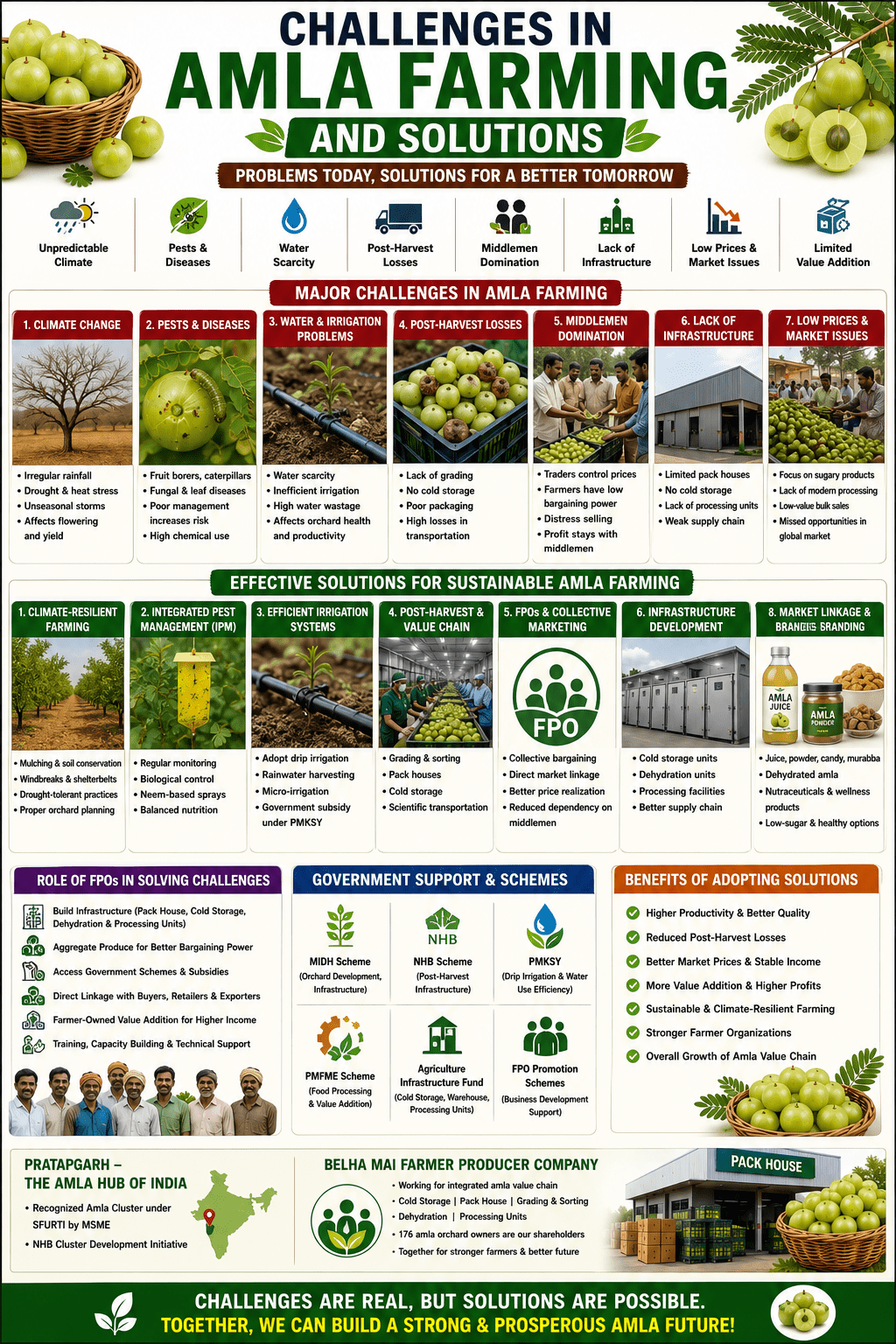
Major Challenges in Amla Farming
1. Climate Change and Unpredictable Weather
One of the biggest modern challenges in amla farming is climate variability.
Farmers increasingly face:
- irregular rainfall,
- extreme heat,
- unseasonal storms,
- and drought conditions.
These problems affect:
- flowering,
- fruit setting,
- yield quality,
- and productivity.
Solution
Scientific orchard management can help reduce climate risks through:
- drip irrigation,
- mulching,
- water conservation,
- organic matter management,
- and climate-resilient farming practices.
2. Water Scarcity and Irrigation Problems
Many amla-growing regions face:
- declining groundwater levels,
- irregular irrigation,
- and poor water management systems.
Young orchards especially require proper irrigation during establishment stages.
👉 Learn more on Water & Irrigation Challenges https://belhamaifpo.com/agriculture/irrigation-challenges-in-indian-agriculture/
Solution
Drip irrigation systems are one of the best solutions because they:
- save water,
- improve fertilizer efficiency,
- reduce labor costs,
- and improve orchard health.
Government subsidies under PMKSY and horticulture schemes can help farmers adopt modern irrigation systems.
3. Pest and Disease Problems
Amla orchards may face:
- bark-eating caterpillars,
- fruit borers,
- fungal infections,
- and leaf diseases.
Poor orchard management increases disease risk.
Solution
Integrated Pest Management (IPM) helps reduce:
- chemical dependency,
- environmental damage,
- and pest outbreaks.
Farmers should focus on:
- orchard sanitation,
- pruning,
- biological control,
- and scientific spraying schedules.
4. Poor Quality Planting Material
Many farmers unknowingly purchase:
- low-quality saplings,
- mixed varieties,
- or non-certified planting material.
This affects:
- productivity,
- fruit quality,
- and orchard profitability.
Solution
Farmers should use:
- certified nurseries,
- scientifically developed varieties,
- and disease-free planting material.
High-quality varieties improve:
- yield,
- shelf life,
- and market acceptance.
5. Lack of Scientific Orchard Management
Many orchards still lack:
- pruning,
- canopy management,
- nutrient balancing,
- and soil health management.
This reduces long-term productivity.
Solution
Scientific orchard management should include:
- soil testing,
- integrated nutrient management,
- pruning,
- mulching,
- and proper spacing.
Training and extension services are highly important.
6. Post-Harvest Losses
One of the biggest challenges in amla farming and solutions is poor post-harvest management.
Most regions still lack:
- grading systems,
- pack houses,
- cold storage,
- dehydration units,
- and scientific transportation systems.
As a result:
- large quantities of amla are wasted,
- prices collapse during harvest season,
- and farmer profitability declines.
👉 Learn more on Post-harvest management of amla : https://belhamaifpo.com/farmer-producer-organisation/post-harvest-management-of-amla/
Solution
Modern infrastructure development is essential:
- cold storage,
- pack houses,
- grading lines,
- sorting systems,
- and dehydration facilities
can significantly reduce post-harvest losses.
7. Trader and Middlemen Domination
In many regions:
- traders lease orchards,
- middlemen dominate mandi systems,
- and processors procure through intermediaries.
Meanwhile:
- orchard owners bear yearly cultivation expenses,
- but major profits are captured by traders within a short seasonal window.
Solution
FPO-led aggregation and direct market linkage can help farmers:
- negotiate better prices,
- reduce dependency on middlemen,
- and improve bargaining power.
Farmer-owned processing is also extremely important.
👉 Learn more on Government subsidies for amla farming : https://belhamaifpo.com/uncategorized/government-subsidies-for-amla-farming/
8. Lack of Processing Infrastructure
Modern infrastructure can solve many challenges in amla farming and solutions related to storage, transportation, and processing. Despite India’s huge amla production, many clusters still lack:
- scientific processing units,
- dehydration systems,
- modern packaging,
- and export-oriented infrastructure.
Solution
Investment in:
- juice processing,
- powder manufacturing,
- dehydration,
- nutraceutical products,
- and wellness industries
can significantly increase farmer income.
9. Weak Branding and Marketing
Most amla products are sold:
- unbranded,
- in bulk,
- or through intermediaries.
This reduces value realization.
Solution
Branding, packaging, and direct marketing are becoming increasingly important.
Modern consumers prefer:
- traceability,
- branded products,
- hygienic packaging,
- and authentic wellness products.
10. Excessive Focus on Sugary Products
India has one of the world’s largest diabetic populations, yet many processors still mainly focus on:
- sugary murabba,
- sugar-coated candy,
- and sweet products.
This limits global positioning of amla as a modern superfood.
👉 Learn more on Value-added products from amla : https://belhamaifpo.com/agriculture/value-added-products-from-amla/
Solution
The future lies in:
- low-sugar wellness products,
- nutraceuticals,
- probiotics,
- kombucha,
- herbal beverages,
- and functional foods.
This aligns better with global wellness trends.
Importance of Modern Infrastructure
Scientific infrastructure is critical for solving:
- market instability,
- post-harvest losses,
- and value-chain inefficiencies.
Important infrastructure includes:
- cold storage,
- grading systems,
- pack houses,
- dehydration units,
- and processing facilities.
Role of FPOs in Solving Challenges in Amla Farming
FPO-led aggregation and direct market linkage are emerging as powerful approaches for addressing challenges in amla farming and solutions across India. Farmer Producer Organizations (FPOs) can play a transformational role in solving major challenges in the amla sector.
Infrastructure Development
FPOs can establish:
- pack houses,
- grading lines,
- cold storage,
- dehydration units,
- and processing systems.
Collective Marketing
FPOs help farmers:
- aggregate produce,
- improve bargaining power,
- and directly access buyers.
Farmer-Owned Value Addition
FPOs can move farmers into:
- juice manufacturing,
- powder processing,
- dehydration,
- nutraceuticals,
- and export-oriented wellness products.
This allows farmers to capture a larger share of value addition profits.
👉 Learn more on Amla farming in India: complete guide for Farmers, Processing & Business Opportunities : https://belhamaifpo.com/farmer-producer-organisation/amla-farming-in-india/
Government Support and Subsidies
Government schemes supporting:
- horticulture,
- irrigation,
- infrastructure,
- food processing,
- and FPO development
can significantly help solve sectoral challenges.
Programs under:
- MIDH,
- NHB,
- PMFME,
- PMKSY,
- and Agricultural Infrastructure Fund
are highly important.
👉 Learn more on Government subsidies for amla farming : https://belhamaifpo.com/uncategorized/government-subsidies-for-amla-farming/
Pratapgarh’s Emerging Role in Amla Value Chain Development
Pratapgarh is widely recognized as one of India’s most important amla-growing regions and is often called the traditional Amla Capital of India.
The district is recognized:
- under SFURTI Yojana by MSME as an Amla Cluster,
- and under NHB cluster development initiatives.
This creates huge opportunities for:
- scientific infrastructure,
- processing,
- dehydration,
- and export-oriented value addition.
Belha Mai Farmer Producer Company’s Initiative
Understanding challenges in amla farming and solutions is essential for building a sustainable and profitable amla value chain in India. Belha Mai Farmer Producer Company is actively working toward:
- cold storage,
- pack houses,
- grading and sorting systems,
- dehydration units,
- and integrated post-harvest infrastructure.
The organization currently has:
- 176 amla orchard owners as shareholders.
This initiative has the potential to significantly improve:
- farmer income,
- value-chain efficiency,
- and direct market access.
👉 Visit Us on : https://belhamaifpo.com/
Conclusion
Challenges in amla farming and solutions are deeply connected with:
- infrastructure,
- market systems,
- post-harvest management,
- and farmer organization.
While amla farming has huge potential in:
- wellness industries,
- nutraceuticals,
- exports,
- and value addition,
farmers still face major structural problems related to:
- weak infrastructure,
- trader domination,
- post-harvest losses,
- and limited processing systems.
Scientific farming methods are helping reduce several challenges in amla farming and solutions related to irrigation, pests, and orchard productivity.
The work being undertaken in Pratapgarh by Belha Mai Farmer Producer Company represents an important step toward building a modern and farmer-led amla ecosystem in India.
Some Useful Links:
👉 https://www.nabard.org/EngDefault.aspx