Export Potential of Amla from India
Introduction
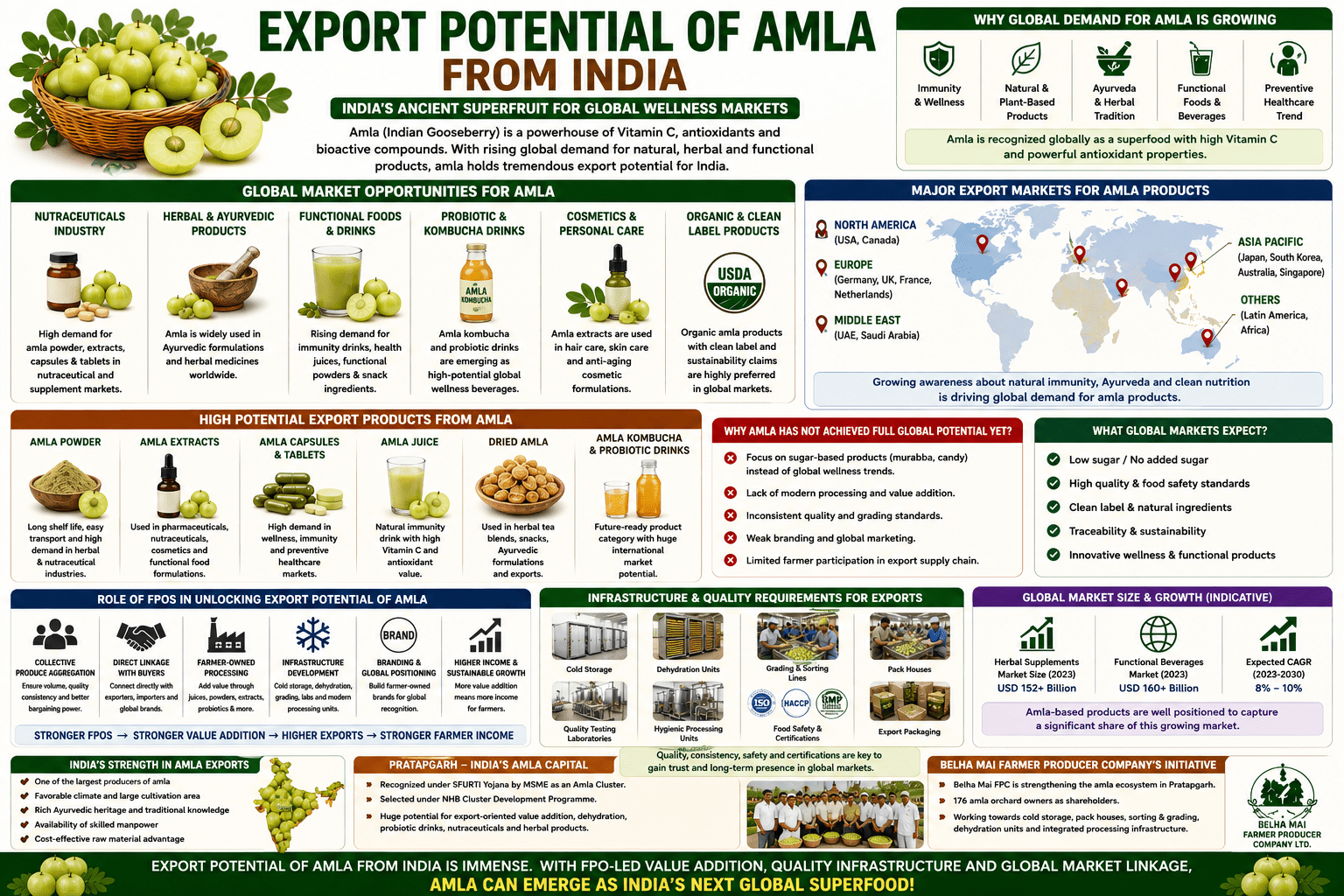
Export potential of amla from India is growing rapidly because global consumers are increasingly demanding natural wellness and nutraceutical products. Export potential of amla from India are increasingly shifting toward natural and plant-based products. Amla (Indian Gooseberry) is one of the richest natural sources of Vitamin C, antioxidants, and medicinal compounds, making it one of the most promising superfoods for international markets.
India is one of the world’s largest producers of amla and possesses:
- favorable climatic conditions,
- large cultivation area,
- traditional Ayurvedic knowledge,
- and strong raw material availability.
However, despite its enormous medicinal value, amla still remains underrepresented in global wellness markets compared to products like:
- turmeric,
- moringa,
- matcha,
- kombucha,
- and acai.
One of the major reasons is that a large portion of India’s small-scale processing sector still focuses heavily on:
- sugary murabba,
- sweet candy,
- and traditional preserved products,
while global consumers are increasingly demanding:
- low-sugar products,
- probiotics,
- functional beverages,
- nutraceuticals,
- and preventive healthcare products.
In this blog, we will understand:
- export potential of amla from India,
- global market demand,
- export opportunities,
- high-value products,
- major challenges,
- and how FPOs can help build a modern export-oriented amla ecosystem.
👉 Learn more about Role of FPOs in amla value chain : https://belhamaifpo.com/agriculture/role-of-fpos-in-amla-value-chain/
Why Global Demand for Amla from India Is Increasing
Worldwide consumers are increasingly shifting toward:
- natural wellness,
- herbal supplements,
- immunity boosters,
- plant-based nutrition,
- and preventive healthcare.
Amla fits perfectly into this trend because of its:
- extremely high Vitamin C content,
- antioxidant richness,
- Ayurvedic heritage,
- and functional health benefits.
👉 Learn about Amla supply chain in India explained https://belhamaifpo.com/uncategorized/amla-supply-chain-india-explained/
Major International Demand Drivers
1. Natural Immunity Boosters
Global consumers increasingly prefer natural alternatives over synthetic supplements.
Amla’s high Vitamin C content makes it highly attractive in:
- herbal wellness markets,
- immunity supplements,
- and functional nutrition.
2. Nutraceutical Industry Growth
The global nutraceutical industry is expanding rapidly.
Amla is widely suitable for:
- capsules,
- powders,
- extracts,
- herbal blends,
- and wellness supplements.
3. Rising Popularity of Ayurvedic Products
Interest in Ayurveda is growing globally.
Amla already holds a strong position in:
- Ayurvedic medicine,
- herbal formulations,
- and wellness products.
👉 Learn about Amla market price trends in India : https://belhamaifpo.com/agriculture/amla-market-price-trends-in-india/
4. Growing Functional Food Market
Consumers increasingly demand:
- low-sugar products,
- probiotic drinks,
- fermented beverages,
- and clean-label nutrition.
This creates huge future potential for:
- amla kombucha,
- probiotic drinks,
- and wellness beverages.
High-Potential Export Products from Amla
Amla Powder
One of the most promising export products because of:
- long shelf life,
- easy transportation,
- nutraceutical demand,
- and herbal applications.
Amla Extracts
Used in:
- pharmaceutical industries,
- nutraceuticals,
- cosmetics,
- and herbal supplements.
Amla Capsules and Tablets
Rapidly growing in:
- wellness industries,
- herbal healthcare,
- and preventive medicine markets.
Amla Juice
Growing demand in:
- natural wellness beverages,
- detox products,
- and immunity drinks.
Probiotic and Kombucha Products
One of the most exciting future opportunities.
Global consumers increasingly prefer:
- gut-health beverages,
- probiotics,
- and functional fermented drinks.
Amla kombucha can become a premium export-oriented wellness product.
The growing awareness about the export potential of amla from India is creating new opportunities in herbal wellness and functional nutrition markets.
Why Amla Still Has Not Achieved Full Global Recognition
Despite its enormous health benefits, amla still has not achieved the same global popularity as many other superfoods.
One major reason is the mismatch between:
- current global wellness trends,
- and traditional processing patterns in India.
The Sugar-Based Processing Challenge
India has one of the world’s largest diabetic populations, yet a significant portion of the small-scale amla processing industry still focuses heavily on:
- sugary murabba,
- sweet candy,
- and sugar-preserved products.
Meanwhile, global wellness markets are increasingly shifting toward:
- low sugar,
- probiotics,
- gut health,
- and functional nutrition.
This gap limits amla’s positioning as a modern global superfood.
Importance of Scientific Infrastructure for Exports
Export-oriented value addition requires:
- cold storage,
- dehydration systems,
- grading and sorting lines,
- pack houses,
- quality testing labs,
- and scientific processing infrastructure.
Without proper infrastructure:
- quality consistency becomes difficult,
- post-harvest losses increase,
- and export competitiveness weakens.
👉 Learn important facts related to Amla farming in India: complete guide for Farmers, Processing & Business Opportunities : https://belhamaifpo.com/farmer-producer-organisation/amla-farming-in-india/
Importance of Quality Standards
International markets require:
- hygiene,
- traceability,
- food safety,
- standardized processing,
- and export certifications.
Scientific handling is essential for:
- export acceptance,
- premium pricing,
- and long-term market access.
Role of FPOs in Export-Oriented Amla Value Addition
Farmer Producer Organizations (FPOs) can play a transformational role in export development.
1. Collective Supply Aggregation
FPOs can aggregate produce from farmers and maintain:
- quality consistency,
- bulk supply,
- and traceability.
2. Farmer-Owned Processing
FPOs can establish:
- dehydration units,
- powder plants,
- juice processing units,
- and probiotic beverage facilities.
3. Direct Export Linkage
FPOs can connect directly with:
- exporters,
- nutraceutical companies,
- herbal brands,
- and international buyers.
4. Reduction of Middlemen
Direct export linkage improves:
- farmer share in profits,
- transparency,
- and bargaining power.
5. Branding and Global Positioning
FPOs can build:
- farmer-owned wellness brands,
- cluster-based export identity,
- and regional superfood positioning.
Pratapgarh’s Emerging Role in Export-Oriented Amla Development
Pratapgarh is widely recognized as one of India’s most important amla-growing regions and is often called the traditional Amla Capital of India.
The district is recognized:
- under SFURTI Yojana by MSME as an Amla Cluster,
- and under NHB cluster development initiatives.
This creates huge opportunities for:
- export-oriented value addition,
- dehydration,
- nutraceutical products,
- probiotic beverages,
- and global wellness branding.
Belha Mai Farmer Producer Company’s Initiative
Belha Mai Farmer Producer Company is playing an important role in strengthening the amla ecosystem in Pratapgarh.
The organization currently has:
- 176 amla orchard owners as shareholders
and is actively working toward:
- cold storage,
- pack houses,
- sorting and grading systems,
- dehydration units,
- and integrated processing infrastructure.
This initiative has the potential to help create a farmer-led export-oriented amla value chain in India.
Conclusion
Export potential of amla from India is extremely promising because of rising global demand for:
- herbal wellness,
- nutraceuticals,
- immunity boosters,
- probiotics,
- and functional foods.
India already has:
- strong raw material availability,
- Ayurvedic heritage,
- and large-scale amla cultivation.
However, to fully unlock global opportunities, the sector must move toward:
- low-sugar wellness products,
- probiotic beverages,
- scientific processing,
- quality infrastructure,
- and export-oriented branding.
FPO-led value addition, farmer-owned processing, modern infrastructure, and direct international market linkage can help position amla as a globally recognized superfood.
The work being undertaken in Pratapgarh by Belha Mai Farmer Producer Company represents an important step toward building a modern export-oriented amla ecosystem in India. FPO-led value addition and export-oriented infrastructure can help unlock the true export potential of amla from India while improving farmer income and global market access.
Some Useful Links:-
👉 https://nhb.gov.in/schemes.aspx
👉 https://www.uphorticulture.in/