Amla Market Price Trends in India
Introduction
Amla market price trends in India have become highly unpredictable in recent years because of changing demand patterns, weak post-harvest infrastructure, trader domination, and the absence of scientific value-chain management.
Although India is one of the world’s largest producers of amla (Indian Gooseberry), most orchard owners still struggle to receive fair prices for their produce. Price fluctuations are heavily influenced by:
- harvesting season,
- post-harvest losses,
- storage availability,
- processor demand,
- and the role of traders and intermediaries.
In many amla-growing regions, farmers are forced to sell produce quickly because proper:
- cold storage,
- dehydration infrastructure,
- grading systems,
- and direct market linkage
are still largely absent.
As a result:
- orchard owners bear yearly production expenses,
- while traders and processors often capture the largest share of profits.
In this blog, we will understand:
- current amla market price trends in India,
- factors affecting prices,
- seasonal fluctuations,
- role of traders,
- future market opportunities,
- and how FPOs can improve farmer price realization.
👉 Learn about Amla farming in India: complete guide for Farmers, Processing & Business Opportunities: https://belhamaifpo.com/farmer-producer-organisation/amla-farming-in-india/
Current Amla Market Scenario in India
India is one of the largest producers of amla globally.
Major producing states include:
- Uttar Pradesh
- Madhya Pradesh
- Rajasthan
- Punjab
- Haryana
- Chhattisgarh
- Uttarakhand
Among them, Pratapgarh is widely recognized as one of India’s most important amla-growing regions and is often called the traditional Amla Capital of India.
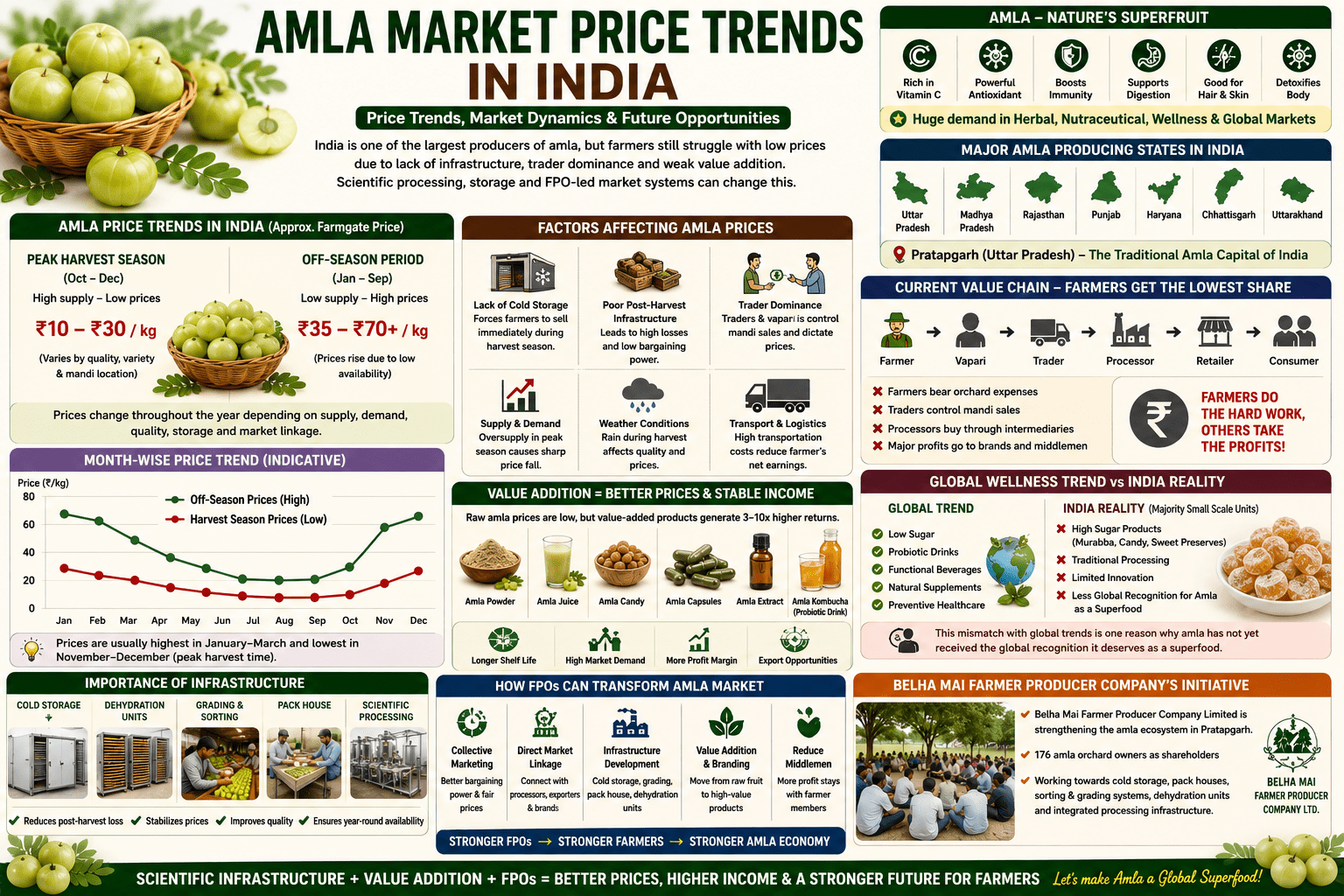
Average Amla Market Price Trends
Peak Harvest Season
During peak harvesting months:
👉 prices often fall sharply because of oversupply.
Approximate farmgate prices may range between:
- ₹10–₹30 per kg
depending on: - quality,
- variety,
- and local mandi conditions.
Off-Season Period
During low supply periods:
👉 prices rise significantly.
Processed or stored products often generate much higher returns compared to fresh fruit selling.
👉 Learn about Amla juice manufacturing process : https://belhamaifpo.com/agriculture/amla-juice-manufacturing-process/
Why Amla Prices Fluctuate So Much
1. Lack of Cold Storage
Fresh amla has limited shelf life.
Without cold storage:
- farmers are forced into distress selling,
- prices collapse during peak arrivals,
- and wastage increases.
2. Poor Post-Harvest Infrastructure
Most growing regions still lack:
- grading systems,
- pack houses,
- dehydration units,
- and scientific handling systems.
This weakens farmer bargaining power.
3. Trader and Vapari Dominance
One of the biggest structural issues in India’s amla economy is trader-controlled marketing.
In many regions:
- farmers lease orchards to Vapari,
- traders control mandi sales,
- and processors procure through intermediaries.
The current supply chain often works like this:
Farmer → Vapari → Trader → Processor → Retailer → Consumer
Meanwhile:
- farmers bear yearly orchard expenses,
- but the majority of profits go to intermediaries and brands.
The Hidden Reality Behind Amla Pricing
In many amla-growing regions, orchard owners are financially distressed despite cultivating premium-quality fruits.
This happens because:
- farmers generally sell raw produce,
- value addition happens elsewhere,
- and processors often purchase through trader networks.
As a result:
- farmers have little control over pricing,
- market transparency is weak,
- and real profit remains concentrated among traders and processors.
Why Value Addition Can Improve Farmer Prices
Scientific value addition can completely transform the economics of amla farming.
High-Value Products
Value-added products include:
- amla juice,
- dry powder,
- nutraceuticals,
- capsules,
- herbal wellness products,
- kombucha,
- and probiotic beverages.
Compared to raw fruit selling, processed products generate:
- higher margins,
- longer shelf life,
- and export opportunities.
👉 Learn about Health benefits of amla juice for immunity : https://belhamaifpo.com/agriculture/health-benefits-of-amla-juice-for-immunity/
Growing Global Trend Toward Wellness Products
Global consumers are increasingly shifting toward:
- low-sugar products,
- probiotics,
- functional beverages,
- natural supplements,
- and preventive healthcare.
However, many small-scale processors in India still focus heavily on:
- sugary murabba,
- sweet candy,
- and sugar-preserved products.
This mismatch with global wellness trends is one of the reasons why amla has still not received the global recognition it deserves as a modern superfood.
👉 Learn about Amla powder benefits and uses : https://belhamaifpo.com/agriculture/amla-powder-benefits-and-uses/
Future Scope of Amla Market in India
The future of the amla market is strongly linked with:
- value addition,
- nutraceutical demand,
- herbal wellness,
- and preventive healthcare industries.
Fast-Growing Segments
Dry Amla Powder
Huge demand in:
- Ayurveda,
- supplements,
- and exports.
Probiotic Amla Drinks
Growing future potential in:
- kombucha,
- fermented beverages,
- and gut-health products.
Functional Nutrition
Demand for:
- natural Vitamin C,
- immunity boosters,
- and wellness supplements
is increasing rapidly.
Importance of Cold Storage and Dehydration
Modern infrastructure can dramatically improve price realization.
Benefits
Reduces Distress Selling
Farmers can store produce longer.
Stabilizes Prices
Controlled supply improves market balance.
Supports Processing
Year-round raw material availability improves industrial demand.
Reduces Post-Harvest Losses
Scientific handling improves quality and shelf life.
👉 Learn about Value-added products from amla : https://belhamaifpo.com/agriculture/value-added-products-from-amla/
Why FPOs Can Transform Amla Market Prices
Farmer Producer Organizations (FPOs) can significantly improve farmer bargaining power and price realization.
Role of FPOs
Collective Marketing
Farmers can negotiate better prices collectively.
Direct Market Linkage
FPOs can directly connect with:
- processors,
- exporters,
- wellness brands,
- and retailers.
Scientific Infrastructure
FPOs can establish:
- cold storage,
- dehydration units,
- grading systems,
- and pack houses.
Farmer-Owned Processing
FPOs can move farmers into:
- value addition,
- branding,
- and wellness product manufacturing.
Reduction of Middlemen
Direct linkage reduces trader dependency.
Pratapgarh’s Emerging Role in Amla Value Chain Development
Pratapgarh is gaining importance as a major center for integrated amla value-chain development.
The district is recognized:
- under SFURTI Yojana by MSME as an Amla Cluster,
- and under NHB cluster development initiatives.
This creates huge opportunities for:
- dehydration,
- processing,
- cold storage,
- probiotic beverages,
- and export-oriented value addition.
Belha Mai Farmer Producer Company’s Initiative
Belha Mai Farmer Producer Company is playing an important role in strengthening the amla ecosystem in Pratapgarh.
The organization currently has:
- 176 amla orchard owners as shareholders
and is actively working toward:
- cold storage,
- pack houses,
- sorting and grading systems,
- dehydration units,
- and integrated processing infrastructure.
This initiative has the potential to significantly improve farmer price realization and reduce dependency on trader-controlled systems.
Conclusion
Amla market price trends in India are heavily influenced by post-harvest infrastructure, trader networks, value addition, and market linkage systems.
At present:
- farmers remain highly vulnerable to price fluctuations,
- distress selling,
- and trader domination.
However, the future of the amla economy looks promising because of growing demand in:
- herbal wellness,
- nutraceuticals,
- probiotics,
- kombucha,
- and preventive healthcare industries.
Scientific infrastructure, FPO-led processing, cold storage, dehydration systems, and direct market linkage can completely transform the amla value chain by:
- improving price realization,
- reducing losses,
- and increasing farmer income.
The work being undertaken in Pratapgarh by Belha Mai Farmer Producer Company represents an important step toward building a modern, farmer-led amla market ecosystem in India.
👉 https://www.uphorticulture.in/