Introduction
The market linkage problems faced by FPOs are among the biggest barriers to improving farmer income in India. While Farmer Producer Organizations are formed to strengthen collective marketing and eliminate middlemen, many FPOs still struggle to connect directly with reliable buyers.
Without strong market linkages, even well-organized FPOs cannot realize the full value of their produce. Farmers may produce high-quality crops, but if they are unable to sell them at the right place, time, and price, their income remains low. Understanding these market-related challenges is essential to building a successful FPO.
(To know more about FPOs- https://belhamaifpo.com/uncategorized/farmer-producer-organizations-fpos/ )
What are Market Linkages?
Market linkages refer to the connections between producers (farmers/FPOs) and buyers such as:
- Wholesalers
- Retailers
- Food processing companies
- Exporters
Strong market linkages ensure that produce is sold efficiently at competitive prices.
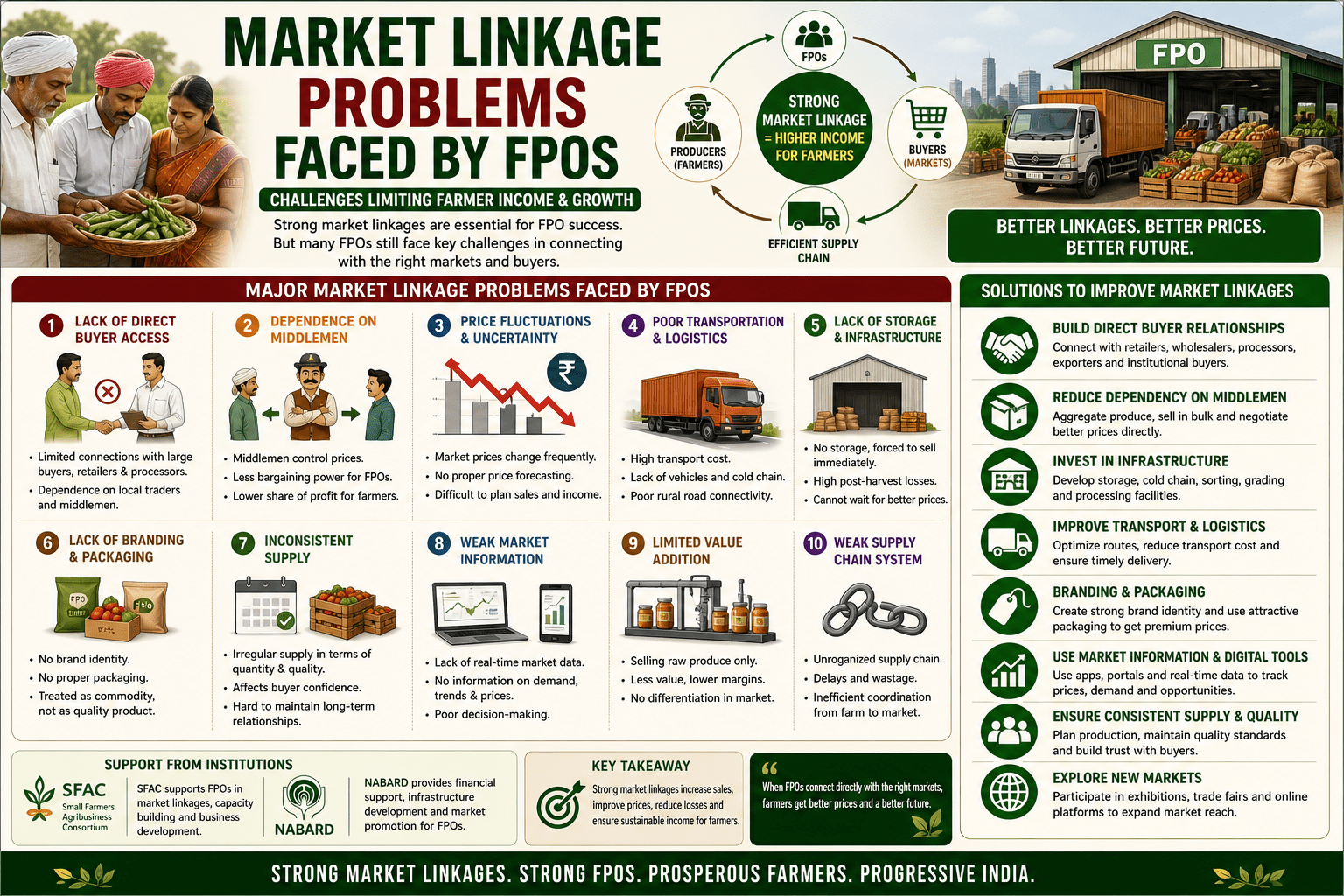
Lack of Direct Buyer Access
One of the biggest market linkage problems faced by FPOs is the lack of direct connections with buyers.
Most FPOs:
- Depend on local traders
- Have limited exposure to larger markets
- Lack networking opportunities
This reduces profit margins and keeps farmers dependent on intermediaries.
Price Fluctuation and Uncertainty
Agricultural markets are highly volatile.
FPOs often face:
- Sudden price drops
- Seasonal demand changes
- Lack of price forecasting
- Price up by middleman during season.
Without proper market intelligence, FPOs are forced to sell at unfavorable prices.
Poor Transportation and Logistics
Logistics is a major challenge in rural areas.
Problems include:
- High transportation costs
- Lack of vehicles
- Poor road connectivity
This limits access to distant and better-paying markets.
Lack of Storage and Infrastructure
Without proper storage:
- Produce must be sold immediately
- Farmers cannot wait for better prices
- Post-harvest losses increase
This weakens market positioning.
Lack of Branding and Packaging
Many FPOs sell products without identity.
- No branding
- No packaging
- No differentiation
Buyers treat products as generic commodities, leading to lower prices.
Inconsistent Supply
Buyers prefer consistent supply, but FPOs often struggle due to:
- Seasonal production
- Member coordination issues
- Quality variation
This makes it difficult to build long-term buyer relationships.
Weak Market Information System
FPOs often lack access to:
- Real-time price data
- Demand trends
- Consumer preferences
This results in poor decision-making.
Dependence on Middlemen
Even after formation, many FPOs still rely on intermediaries due to:
- Lack of confidence
- Limited market exposure
- Immediate cash needs
( Eliminate middlemen → https://belhamaifpo.com/agriculture/how-to-eliminate-middlemen-through-fpos/)
Pro Tip
Strong market linkage is not built overnight. FPOs must focus on building relationships with buyers, maintaining quality, and ensuring consistent supply. Storage facility is the most important denomination Fpo involved in trading must have a storage facility of there own or leased. Fpos must hold the raw material for at least 3to 6 month to realize better margin and for that a strong banking support is imperative.
Connection with Business Growth
Market linkage directly impacts:
- Revenue generation
- Profit margins
- Business expansion
( How FPOs earn money →https://belhamaifpo.com/agriculture/how-fpos-earn-money/)
Institutional Support
Organizations like Small Farmers Agribusiness Consortium and National Bank for Agriculture and Rural Development support FPOs in developing better market linkages, but effective implementation is key.
❓ FAQ
What is the biggest market challenge for FPOs?
The biggest challenge is the lack of direct access to reliable buyers, which forces FPOs to depend on middlemen.
Conclusion
The market linkage problems faced by FPOs are not just operational challenges—they directly affect farmer income, sustainability, and long-term growth. Even if an FPO is well-organized internally, without strong and reliable market connections, it cannot unlock its full potential. Farmers may produce quality crops, but without access to the right buyers and fair pricing mechanisms, their efforts do not translate into higher earnings.
To overcome these challenges, FPOs must shift from a passive selling approach to a more strategic and proactive market-oriented mindset. This includes identifying target buyers, building long-term relationships, and understanding market demand trends. Establishing direct linkages with retailers, processors, and institutional buyers can significantly reduce dependency on middlemen and improve profit margins.
Investment in infrastructure such as storage facilities, transportation systems, and basic processing units can further strengthen market positioning. Additionally, branding and packaging play a crucial role in differentiating products and attracting premium buyers. FPOs should also leverage digital platforms and online marketplaces to expand their reach beyond local markets.
Ultimately, strong market linkages are the backbone of a successful FPO. Organizations that focus on building efficient supply chains, maintaining consistent quality, and developing trust with buyers will not only increase farmer income but also create a sustainable and scalable business model. Over time, this transformation can lead to stronger rural economies and improved livelihoods for farming communities.
Some usefull links:-
👉 https://www.nabard.org/EngDefault.aspx