Difference Between FPO, Cooperative, and SHG
FPO, Cooperative और SHG में क्या अंतर है?
Introduction
In rural India, collective institutions like Farmer Producer Organizations / FPOs, Cooperative Societies and Self-Help Groups / SHGs are playing an important role in improving livelihoods, strengthening rural communities and supporting economic development.
ग्रामीण भारत में Farmer Producer Organizations / FPOs, Cooperative Societies और Self-Help Groups / SHGs जैसे collective institutions livelihoods सुधारने, rural communities को मजबूत करने और economic development को support करने में महत्वपूर्ण भूमिका निभा रहे हैं।
Although FPOs, Cooperatives and SHGs may look similar from outside, their purpose, structure, legal identity, working style and impact are different.
हालांकि FPOs, Cooperatives और SHGs बाहर से एक जैसे दिख सकते हैं, लेकिन इनका purpose, structure, legal identity, working style और impact अलग-अलग होता है।
Understanding FPO vs Cooperative vs SHG helps farmers, rural entrepreneurs, NGOs, policymakers and development agencies choose the right model for growth, empowerment and market linkage.
FPO vs Cooperative vs SHG को समझना farmers, rural entrepreneurs, NGOs, policymakers और development agencies को growth, empowerment और market linkage के लिए सही model चुनने में मदद करता है।
What Is an FPO / Farmer Producer Organization?
FPO / Farmer Producer Organization क्या है?
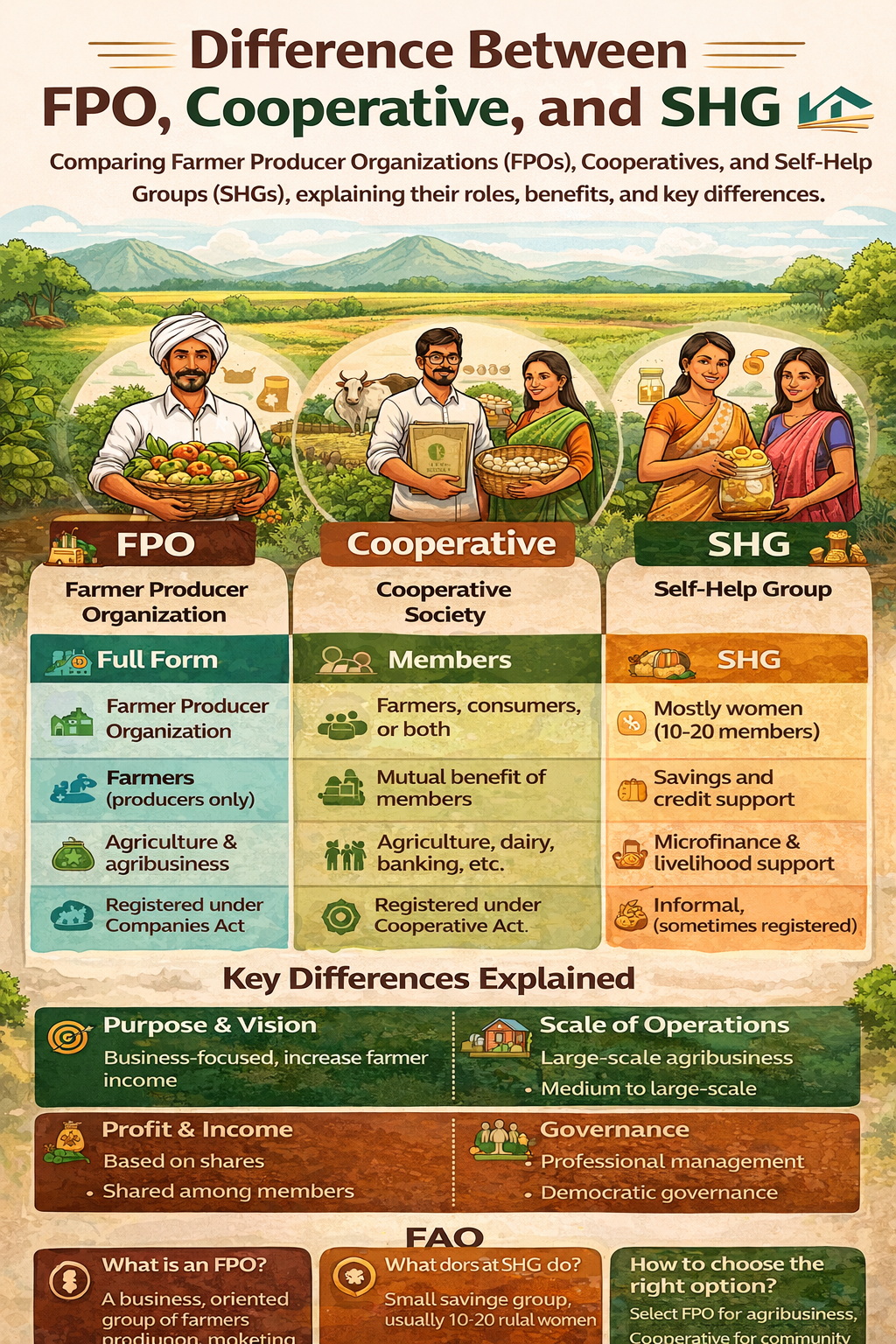
An FPO, or Farmer Producer Organization, is a farmer-led business organization formed by farmers to improve income through collective efforts, aggregation, input supply, processing, value addition, branding and market linkage.
FPO, यानी Farmer Producer Organization, किसानों द्वारा बनाई गई farmer-led business organization है, जिसका उद्देश्य collective efforts, aggregation, input supply, processing, value addition, branding और market linkage के माध्यम से किसानों की income बढ़ाना है।
In an FPO, farmers are members, shareholders and decision makers. The directors are also farmers, which makes the FPO different from ordinary trading companies.
FPO में किसान members, shareholders और decision makers होते हैं। Directors भी किसान होते हैं, इसलिए FPO ordinary trading companies से अलग होता है।
An FPO focuses on agriculture as a business. It helps farmers move from individual selling to collective marketing, processing and value-added food product development.
FPO agriculture को business के रूप में मजबूत करता है। यह किसानों को individual selling से collective marketing, processing और value-added food product development की ओर ले जाता है।
Key Features of an FPO
FPO की मुख्य विशेषताएं
An FPO is generally registered as a Farmer Producer Company under the Companies Act. It works with a business-oriented approach while keeping farmers at the centre.
FPO सामान्य रूप से Companies Act के तहत Farmer Producer Company के रूप में registered होता है। यह business-oriented approach के साथ काम करता है, लेकिन farmers को centre में रखता है।
The main focus of an FPO is aggregation, input support, machinery support, processing, packaging, branding, marketing and better price realization.
FPO का main focus aggregation, input support, machinery support, processing, packaging, branding, marketing और better price realization होता है।
In simple words, FPO means farmers working together like a company for better income, stronger bargaining power and long-term market access.
सरल शब्दों में, FPO का मतलब है किसान बेहतर income, stronger bargaining power और long-term market access के लिए company की तरह मिलकर काम करें।
Infographic Insight:
FPO = Farmers + Business + Profit Growth
Infographic Insight:
FPO = किसान + Business + Income Growth
What Is a Cooperative Society?
Cooperative Society क्या है?
A Cooperative Society is a voluntary association formed by people for mutual benefit. It works on democratic principles where members participate collectively for common welfare.
Cooperative Society एक voluntary association है, जिसे लोग mutual benefit के लिए बनाते हैं। यह democratic principles पर काम करती है, जहां members common welfare के लिए collectively participate करते हैं।
Cooperatives are common in sectors like dairy, banking, housing, credit, agriculture and consumer services. Their main goal is service and welfare of members.
Cooperatives dairy, banking, housing, credit, agriculture और consumer services जैसे sectors में common हैं। इनका main goal members की service और welfare होता है।
A cooperative usually follows the principle of “one member, one vote,” which means voting power is equal, regardless of shareholding.
Cooperative सामान्य रूप से “one member, one vote” principle पर चलता है, जिसका मतलब है कि voting power equal होती है, चाहे shareholding कितनी भी हो।
Key Features of a Cooperative Society
Cooperative Society की मुख्य विशेषताएं
A Cooperative Society works for shared benefits and community welfare. It may not always be strongly business-oriented like an FPO.
Cooperative Society shared benefits और community welfare के लिए काम करती है। यह हमेशा FPO की तरह strongly business-oriented नहीं होती।
Cooperatives can include farmers, consumers, workers, depositors or other groups depending on the purpose of the society.
Cooperatives में society के purpose के अनुसार farmers, consumers, workers, depositors या अन्य groups शामिल हो सकते हैं।
In simple words, Cooperative means community members coming together for equality, support and shared benefits.
सरल शब्दों में, Cooperative का मतलब है community members equality, support और shared benefits के लिए साथ आएं।
Infographic Insight:
Cooperative = Community + Equality + Shared Benefits
Infographic Insight:
Cooperative = Community + Equality + Shared Benefits
What Is an SHG / Self-Help Group?
SHG / Self-Help Group क्या है?
An SHG, or Self-Help Group, is a small informal group, usually formed by 10 to 20 members. In India, SHGs are mostly associated with women’s savings, microcredit and livelihood support.
SHG, यानी Self-Help Group, एक छोटा informal group होता है, जिसमें सामान्य रूप से 10 से 20 members होते हैं। India में SHGs mostly women’s savings, microcredit और livelihood support से जुड़े होते हैं।
SHGs encourage members to save small amounts regularly and provide internal loans to members for household needs, small businesses or livelihood activities.
SHGs members को regularly छोटी savings करने और household needs, small businesses या livelihood activities के लिए internal loans देने में मदद करते हैं।
SHGs are important for financial inclusion, women empowerment and local-level livelihood activities.
SHGs financial inclusion, women empowerment और local-level livelihood activities के लिए important हैं।
Key Features of an SHG
SHG की मुख्य विशेषताएं
SHGs are usually informal or semi-formal groups. They are not primarily designed as large business organizations.
SHGs सामान्य रूप से informal या semi-formal groups होते हैं। इन्हें primarily large business organizations के रूप में design नहीं किया जाता।
Their main focus is savings, small loans, mutual support, empowerment and local livelihood development.
इनका main focus savings, small loans, mutual support, empowerment और local livelihood development होता है।
In simple words, SHG means a small group of people coming together for savings, microcredit and empowerment.
सरल शब्दों में, SHG का मतलब है लोगों का छोटा group savings, microcredit और empowerment के लिए साथ आए।
Infographic Insight:
SHG = Savings + Small Loans + Empowerment
Infographic Insight:
SHG = Savings + Small Loans + Empowerment
FPO vs Cooperative vs SHG: Purpose
FPO vs Cooperative vs SHG: Purpose
In FPO vs Cooperative vs SHG, the purpose of an FPO is to increase farmer income through business activities such as aggregation, processing, branding and marketing.
FPO vs Cooperative vs SHG में FPO का purpose aggregation, processing, branding और marketing जैसी business activities के माध्यम से farmer income बढ़ाना है।
The purpose of a Cooperative is to provide services, welfare and shared benefits to its members.
Cooperative का purpose members को services, welfare और shared benefits देना है।
The purpose of an SHG is financial inclusion, savings habit, microcredit and empowerment, especially for women and small livelihood groups.
SHG का purpose financial inclusion, savings habit, microcredit और empowerment है, खासकर women और small livelihood groups के लिए।
FPO vs Cooperative vs SHG: Structure
FPO vs Cooperative vs SHG: Structure
An FPO usually has a company-based structure and is registered as a Farmer Producer Company. It works with directors, shareholders and business plans.
FPO का structure सामान्य रूप से company-based होता है और यह Farmer Producer Company के रूप में registered होता है। यह directors, shareholders और business plans के साथ काम करता है।
A Cooperative Society has a society-based democratic structure and works under cooperative laws.
Cooperative Society का structure society-based democratic होता है और यह cooperative laws के तहत काम करता है।
An SHG is a small informal or semi-formal group with simple internal rules, savings records and lending systems.
SHG एक छोटा informal या semi-formal group होता है, जिसमें simple internal rules, savings records और lending systems होते हैं।
FPO vs Cooperative vs SHG: Members
FPO vs Cooperative vs SHG: Members
In an FPO, members are farmers or producers. This is why an FPO is directly connected with agriculture and farmer income.
FPO में members farmers या producers होते हैं। इसी कारण FPO directly agriculture और farmer income से जुड़ा होता है।
In a Cooperative, members can be farmers, consumers, workers, depositors or people from different sectors depending on the type of cooperative.
Cooperative में members cooperative के type के अनुसार farmers, consumers, workers, depositors या different sectors के लोग हो सकते हैं।
In an SHG, members are usually small groups of people, often women, who come together for savings, credit and empowerment.
SHG में members सामान्य रूप से लोगों के छोटे groups होते हैं, अक्सर women, जो savings, credit और empowerment के लिए साथ आते हैं।
FPO vs Cooperative vs SHG: Profit System
FPO vs Cooperative vs SHG: Profit System
An FPO is business-oriented and can distribute benefits based on shareholding, participation, business activity and rules of the company.
FPO business-oriented होता है और company के rules, shareholding, participation और business activity के आधार पर benefits distribute कर सकता है।
A Cooperative shares benefits among members according to cooperative principles and its internal rules.
Cooperative cooperative principles और internal rules के अनुसार members के बीच benefits share करता है।
An SHG is usually not profit-driven. Its focus is savings, internal lending and livelihood support rather than business profit distribution.
SHG सामान्य रूप से profit-driven नहीं होता। इसका focus business profit distribution के बजाय savings, internal lending और livelihood support पर होता है।
FPO vs Cooperative vs SHG: Scale of Operation
FPO vs Cooperative vs SHG: Scale of Operation
An FPO can work at a larger scale in agribusiness, input supply, output aggregation, processing, packaging, branding and market linkage.
FPO agribusiness, input supply, output aggregation, processing, packaging, branding और market linkage में larger scale पर काम कर सकता है।
A Cooperative may work at small, medium or large scale depending on the sector, membership and resources.
Cooperative sector, membership और resources के अनुसार small, medium या large scale पर काम कर सकता है।
An SHG generally works at local level with small savings, microcredit and small livelihood activities.
SHG सामान्य रूप से local level पर small savings, microcredit और small livelihood activities के साथ काम करता है।
Why This Difference Matters
यह Difference क्यों महत्वपूर्ण है?
Understanding FPO vs Cooperative vs SHG is important because many farmers and rural entrepreneurs confuse these models.
FPO vs Cooperative vs SHG को समझना important है क्योंकि कई farmers और rural entrepreneurs इन models को confuse कर देते हैं।
If the goal is farmer income growth, aggregation, processing, branding and market access, an FPO is usually the better model.
अगर goal farmer income growth, aggregation, processing, branding और market access है, तो FPO usually better model होता है।
If the goal is community welfare and equal member service, a Cooperative may be suitable.
अगर goal community welfare और equal member service है, तो Cooperative suitable हो सकता है।
If the goal is savings, microcredit and women empowerment, an SHG may be the right starting point.
अगर goal savings, microcredit और women empowerment है, तो SHG सही starting point हो सकता है।
Role in Rural Development
Rural Development में भूमिका
FPOs, Cooperatives and SHGs all contribute to rural development, but in different ways.
FPOs, Cooperatives और SHGs सभी rural development में योगदान देते हैं, लेकिन अलग-अलग ways में।
FPOs are important for agribusiness, farmer income, value addition, food processing and market integration.
FPOs agribusiness, farmer income, value addition, food processing और market integration के लिए important हैं।
Cooperatives strengthen community networks, shared services and collective welfare.
Cooperatives community networks, shared services और collective welfare को strengthen करते हैं।
SHGs empower women, promote savings culture and support small livelihood activities.
SHGs women empowerment, savings culture और small livelihood activities को support करते हैं।
Together, these three models create a stronger rural ecosystem for economic and social development.
ये तीनों models मिलकर economic और social development के लिए stronger rural ecosystem create करते हैं।
Which Model Should Farmers Choose?
Farmers को कौन सा Model चुनना चाहिए?
Farmers should choose the model based on their goal. If farmers want to build a business, sell collectively, process produce and create a brand, they should consider an FPO.
Farmers को model अपने goal के आधार पर choose करना चाहिए। अगर farmers business बनाना चाहते हैं, collectively sell करना चाहते हैं, produce process करना चाहते हैं और brand create करना चाहते हैं, तो उन्हें FPO consider करना चाहिए।
If rural people want service-based welfare and community benefit, a Cooperative can be useful.
अगर rural people service-based welfare और community benefit चाहते हैं, तो Cooperative useful हो सकता है।
If a small group wants savings, loans and empowerment, SHG is a practical model.
अगर छोटा group savings, loans और empowerment चाहता है, तो SHG practical model है।
Belha Mai FPO and Farmer-Led Development
Belha Mai FPO और Farmer-Led Development
Belha Mai Farmers Producer Company Ltd. is an example of how an FPO can work toward farmer development through input support, machinery access, information, value addition, processing, branding and market linkage.
Belha Mai Farmers Producer Company Ltd. इस बात का example है कि FPO input support, machinery access, information, value addition, processing, branding और market linkage के माध्यम से farmer development की दिशा में कैसे काम कर सकता है।
The larger aim of an FPO is to help farmers move from raw produce selling to organized business growth.
FPO का बड़ा aim किसानों को raw produce selling से organized business growth की ओर ले जाना है।
This is why the FPO model is very important for the future of rural India.
इसीलिए FPO model rural India के future के लिए बहुत important है।
Conclusion
निष्कर्ष
FPOs, Cooperatives and SHGs each play a unique role in rural transformation. SHGs focus on savings and empowerment, Cooperatives focus on collective welfare, and FPOs focus on farmer business growth.
FPOs, Cooperatives और SHGs rural transformation में अपनी unique role निभाते हैं। SHGs savings और empowerment पर focus करते हैं, Cooperatives collective welfare पर focus करते हैं, और FPOs farmer business growth पर focus करते हैं।
The main difference in FPO vs Cooperative vs SHG is purpose. An FPO is best for farmers who want income growth, market linkage, processing, value addition and business development.
FPO vs Cooperative vs SHG में main difference purpose है। FPO उन farmers के लिए best है जो income growth, market linkage, processing, value addition और business development चाहते हैं।
Understanding these differences is the first step toward building a stronger, more organized and more sustainable rural economy.
इन differences को समझना stronger, more organized और more sustainable rural economy बनाने की first step है।
FAQ
What is the main difference between FPO vs Cooperative vs SHG?
The main difference is purpose. FPOs focus on farmer business growth, Cooperatives focus on member welfare, and SHGs focus on savings, microcredit and empowerment.
Main difference purpose है। FPOs farmer business growth पर focus करते हैं, Cooperatives member welfare पर focus करते हैं, और SHGs savings, microcredit और empowerment पर focus करते हैं।
Which is better for farmers: FPO, Cooperative or SHG?
For farmers who want market linkage, processing, value addition and income growth, an FPO is usually more suitable.
जो farmers market linkage, processing, value addition और income growth चाहते हैं, उनके लिए FPO usually more suitable होता है।
Is an FPO a company?
Yes, many FPOs are registered as Farmer Producer Companies under the Companies Act.
हाँ, कई FPOs Companies Act के तहत Farmer Producer Companies के रूप में registered होते हैं।
What is the purpose of an SHG?
The purpose of an SHG is savings, internal lending, microcredit, women empowerment and small livelihood support.
SHG का purpose savings, internal lending, microcredit, women empowerment और small livelihood support है।
What is the purpose of a Cooperative Society?
A Cooperative Society works for member welfare, shared services and mutual benefits.
Cooperative Society member welfare, shared services और mutual benefits के लिए काम करती है।
Internal Links Section
👉 Farmer Producer Organizations Complete Guide
https://belhamaifpo.com/farmer-producer-organisation/farmer-producer-organizations-fpos/
For the current blog “FPO vs Cooperative vs SHG”, use this corrected internal link section:
Internal Links Section
👉 Farmer Producer Organizations Complete Guide
https://belhamaifpo.com/farmer-producer-organisation/farmer-producer-organizations-fpos/
👉 What is a Farmer Producer Organization / FPO in India?
https://belhamaifpo.com/agriculture/what-is-fpo-in-india/
👉 Top Benefits of Joining an FPO for Small Farmers in India
https://belhamaifpo.com/agriculture/top-benefits-of-joining-an-fpo-for-small-farmers-in-india/
👉 How Farmer Producer Organizations / FPOs Are Transforming Rural India
https://belhamaifpo.com/agriculture/how-farmer-producer-organizations-fpos-are-transforming-rural-india/
👉 Government Support for FPOs in India
https://belhamaifpo.com/farmer-producer-organisation/government-support-for-fpos-in-india/
👉 Role of Small Farmers Agribusiness Consortium in Promoting FPOs
https://belhamaifpo.com/farmer-producer-organisation/role-of-small-farmers-agribusiness-consortium-in-promoting-fpos/
👉 Role of Digital Platforms in FPO Growth
https://belhamaifpo.com/farmer-producer-organisation/role-of-digital-platforms-in-fpo-growth/
👉 How to Build Market Linkages for FPOs
https://belhamaifpo.com/farmer-producer-organisation/how-to-build-market-linkages-for-fpos/
External Authority Links
👉 SFAC — Farmer Producer Organizations
https://sfacindia.com/
👉 NABARD — Self Help Groups
https://www.nabard.org/
👉 Ministry of Cooperation
https://cooperation.gov.in/
👉 Ministry of Agriculture & Farmers Welfare
https://agricoop.nic.in/
👉 FSSAI
https://www.fssai.gov.in/
Follow Belha Mai FPO for More Updates
For more farmer awareness blogs, agriculture updates, FPO development content, product information and practical farming videos, please follow and connect with Belha Mai Farmers Producer Company Ltd.
👉 Website
https://belhamaifpo.com/
👉 Facebook Page
https://www.facebook.com/profile.php?id=61561043486818
👉 YouTube Channel
https://www.youtube.com/channel/UC9ZvojoTMCa7mU1-Q_Bh60A
👉 LinkedIn
https://www.linkedin.com/in/abhay-singh-ab5568280/
👉 Instagram
https://instagram.com/belhamaifpo
Belha Mai FPO is working to support farmers through better information, technology, market linkage, value addition, FPO awareness and rural development.